
The pharmaceutical industry is moving faster than ever. Clinical trials now generate massive amounts of data from electronic health records, wearable devices, ePRO systems, laboratory platforms, imaging tools, and decentralized trial technologies. Managing this data accurately while producing statistically reliable insights has become one of the biggest challenges for sponsors, CROs, and biotech companies.
According to recent industry reports, the global clinical data management market continues to expand rapidly due to rising clinical trial complexity, increasing regulatory scrutiny, and the adoption of AI-driven analytics in clinical research. Regulatory agencies such as the FDA and EMA also expect sponsors to maintain high standards for data integrity, transparency, traceability, and patient safety throughout the study lifecycle.
This growing demand has pushed pharmaceutical companies to invest heavily in Clinical Data Management Services, Biostatistics Services, and advanced statistical programming solutions. Organizations that fail to establish strong data governance often face delayed submissions, protocol deviations, inconsistent datasets, and regulatory findings. On the other hand, companies that implement structured clinical data workflows can accelerate study timelines, improve decision-making, and reduce operational risks.
For pharma sponsors, biotech startups, and medical device companies, outsourcing specialized clinical data management and statistical analysis support has become a strategic necessity rather than an optional operational task. Reliable partners help transform raw clinical trial data into actionable regulatory evidence while ensuring compliance with ICH-GCP, CDISC, FDA, and EMA guidelines.
Why Clinical Data Management Matters in Modern Pharma Research
Modern pharmaceutical research depends entirely on reliable clinical data. Every decision made during a clinical trial—from dose adjustments to safety monitoring and regulatory submissions—relies on accurate and traceable information. Clinical data management acts as the backbone of this entire ecosystem because it ensures that collected trial data remains complete, consistent, validated, and audit-ready throughout the study lifecycle.
Years ago, many clinical trials relied heavily on paper-based systems and manual workflows. Today, sponsors manage enormous datasets coming from global trial sites, electronic data capture systems, wearable devices, imaging platforms, and remote monitoring technologies. This shift has dramatically increased both the volume and complexity of clinical research data. Without proper Clinical Data Management Services, pharma companies can quickly face data inconsistencies, missing records, duplicate entries, or delayed database locks.
Another major factor driving the importance of clinical data management is regulatory pressure. Agencies like the FDA, EMA, MHRA, and PMDA now require strong evidence of data integrity and traceability. Regulators expect sponsors to demonstrate that every data point within a submission can be verified and tracked throughout the study. Poorly managed databases can result in warning letters, costly delays, or rejected submissions.
Clinical data management also plays a direct role in patient safety. Imagine a trial monitoring severe adverse events across multiple countries. If safety data is incomplete or delayed, investigators may fail to identify emerging risks in time. Efficient data management systems help clinical teams detect safety signals early, improving both participant protection and trial quality.
Organizations investing in professional clinical trial data management, data validation, and centralized monitoring solutions often achieve faster study timelines and stronger submission outcomes. As pharmaceutical research becomes increasingly digital, robust data management infrastructure has evolved into a competitive advantage rather than just an operational requirement.
Core Components of Clinical Data Management Services
Clinical data management involves far more than simply entering information into a database. It includes a structured framework of processes, technologies, quality controls, and regulatory procedures designed to ensure data accuracy and compliance across every stage of a clinical study.
Data Collection and Database Design
The first step in clinical data management involves designing a reliable data collection system. This process typically includes creating Case Report Forms (CRFs), configuring Electronic Data Capture (EDC) systems, and defining data standards aligned with CDISC requirements. A well-designed database minimizes inconsistencies and simplifies downstream statistical analysis.
Pharmaceutical companies increasingly prefer EDC systems because they reduce manual transcription errors and support real-time monitoring. Advanced platforms also enable remote data review, automated edit checks, and centralized oversight. These capabilities become particularly important in global studies where investigators operate across multiple countries and regulatory environments.
Database design must also align closely with protocol objectives. Poorly designed CRFs can create confusion for site staff, generate unnecessary queries, and increase study costs. Experienced clinical data management teams work closely with clinical operations and biostatistics professionals to ensure the database captures all required efficacy and safety endpoints correctly.
Data standardization represents another critical component. Sponsors often use CDISC standards such as SDTM and ADaM to ensure datasets remain submission-ready for regulatory agencies. Standardized datasets also improve interoperability between systems and facilitate faster statistical analysis.
Improve Clinical Trial Data Accuracy
Need reliable clinical data management services for your pharma studies? Curexbio supports sponsors with database design, data validation, medical review, and regulatory-compliant clinical trial data workflows.
Data Validation and Quality Control
Once clinical data enters the system, validation becomes essential. Data validation processes identify inconsistencies, missing values, protocol deviations, and unusual trends before they impact study outcomes. Automated edit checks, discrepancy management systems, and manual medical reviews work together to maintain database quality.
Query management forms a major part of this process. Data managers communicate with study sites to resolve inconsistencies and clarify questionable entries. Efficient query workflows reduce delays and improve database lock timelines significantly.
Quality control procedures also involve ongoing reconciliation activities. Teams compare clinical databases with laboratory systems, pharmacovigilance platforms, and external vendor data sources to ensure consistency across all datasets. This process becomes particularly important in oncology, rare disease, and long-term safety studies where multiple systems interact continuously.
Another essential area involves audit trails and compliance documentation. Regulatory agencies expect complete traceability for all database changes. Clinical data management teams maintain documentation showing who modified data, when changes occurred, and why updates were necessary. This transparency supports regulatory inspections and strengthens submission credibility.
Organizations that prioritize strong clinical data management systems, clinical monitoring, and centralized review processes often reduce protocol deviations and improve study efficiency substantially. Reliable data quality processes also support more accurate statistical conclusions during later trial phases.
The Role of Statistical Analysis in Clinical Trials
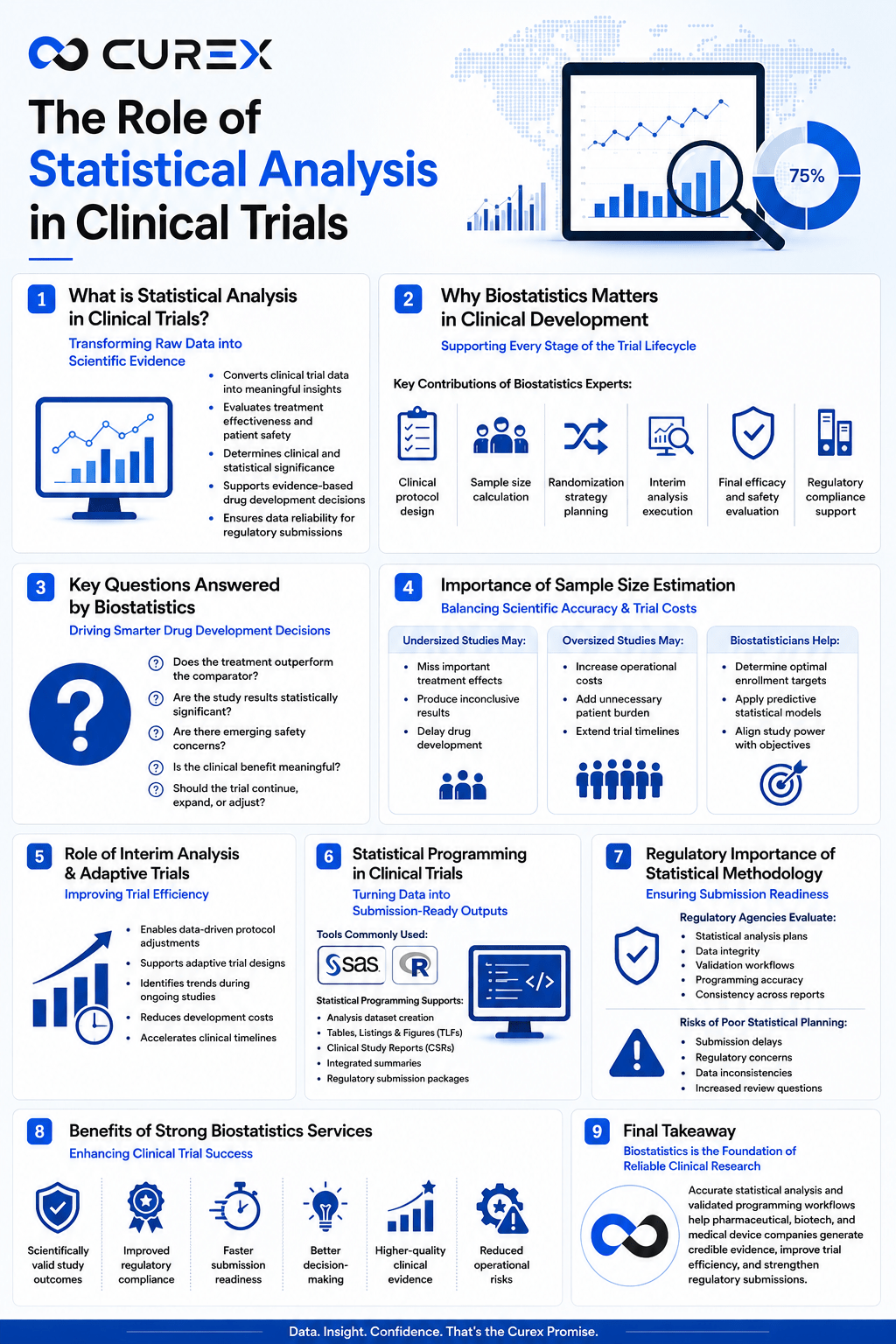
Statistical analysis transforms raw clinical data into meaningful scientific evidence. Without proper biostatistical interpretation, even the largest clinical trial datasets provide little practical value. Statistical analysis helps sponsors determine whether investigational therapies are effective, safe, and clinically significant.
Biostatistics influences nearly every stage of clinical development. Statistical experts contribute to protocol design, sample size calculations, randomization strategies, interim analyses, and final efficacy evaluations. Their work ensures studies remain scientifically valid while maintaining regulatory compliance.
Biostatistics and Decision-Making in Drug Development
Biostatistics professionals help pharma companies answer critical questions throughout drug development. Does the investigational treatment outperform the comparator? Are observed improvements statistically significant? What safety trends require additional monitoring? Statistical analysis provides objective evidence to support these decisions.
Sample size estimation represents one of the most important responsibilities in trial planning. Studies with insufficient participants may fail to detect meaningful treatment effects, while oversized studies increase unnecessary costs and patient burden. Biostatisticians use statistical models to determine optimal enrollment targets based on study objectives and anticipated outcomes.
Interim analyses also play a growing role in modern clinical trials. Sponsors increasingly rely on adaptive trial designs that allow protocol adjustments based on ongoing statistical evaluations. These approaches can improve efficiency, reduce costs, and accelerate development timelines.
Statistical programming teams support these activities using tools like SAS and R. Programmers create analysis datasets, tables, listings, and figures required for regulatory submissions. Accurate statistical programming ensures consistency between clinical study reports, integrated summaries, and submission packages.
Regulatory agencies pay close attention to statistical methodologies used during analysis. Poorly designed statistical plans can raise concerns during submission reviews and delay approvals. Strong Biostatistics Services, clinical statistical analysis, and validated programming workflows help sponsors avoid these risks while strengthening submission quality.
CTA: Accelerate Regulatory Submissions
Curexbio provides expert biostatistics services, statistical programming, and submission-ready analysis support tailored for pharmaceutical, biotech, and medical device studies.
Benefits of Outsourcing Clinical Data Management and Statistical Analysis
Many pharmaceutical companies now outsource clinical data management and biostatistics functions to specialized CROs and service providers. This strategy offers significant operational, financial, and regulatory advantages, especially for emerging biotech firms and mid-sized sponsors with limited internal infrastructure.
One of the biggest benefits involves access to specialized expertise. Experienced clinical data managers, SAS programmers, and biostatisticians understand evolving regulatory expectations and industry best practices. They can implement validated workflows quickly while minimizing operational risks.
Outsourcing also improves scalability. Clinical trial workloads often fluctuate significantly between projects and development phases. Building large internal teams for temporary studies may not remain financially sustainable. Outsourcing allows sponsors to scale resources up or down depending on project demands.
Cost Efficiency and Faster Regulatory Timelines
Maintaining in-house clinical data management infrastructure requires significant investment in technology platforms, software licenses, training programs, and compliance systems. Outsourcing eliminates many of these operational expenses while providing immediate access to established expertise.
Specialized service providers also accelerate study execution timelines. Dedicated data management and statistical teams can configure databases, perform validation checks, and generate analysis outputs more efficiently because they work within standardized operational frameworks. Faster database locks often translate directly into quicker regulatory submissions and reduced time-to-market.
Another important advantage involves improved compliance readiness. Experienced CRO partners understand FDA, EMA, and ICH expectations thoroughly. They maintain validated systems, SOPs, audit trails, and quality management frameworks designed specifically for regulated environments.
Risk reduction also becomes a major benefit. Clinical trials involve enormous financial investments, and data quality issues can jeopardize entire development programs. Professional outsourcing partners implement structured quality control procedures that reduce the likelihood of submission delays or regulatory findings.
Global pharmaceutical companies increasingly adopt hybrid outsourcing models combining internal oversight with external operational support. This approach enables sponsors to maintain strategic control while leveraging specialized expertise for technical execution.
| Outsourcing Benefit | Impact on Pharma Companies |
| Faster database lock | Accelerated submissions |
| Access to experts | Improved data quality |
| Lower infrastructure costs | Better budget control |
| Regulatory compliance support | Reduced inspection risks |
| Flexible resource scaling | Operational efficiency |
Choosing the Right Clinical Data Management Partner
Selecting the right clinical data management and statistical analysis partner can significantly influence trial success. Sponsors should evaluate potential providers carefully based on expertise, compliance capabilities, technology infrastructure, therapeutic experience, and operational flexibility.
A strong partner should demonstrate experience across multiple trial phases and therapeutic areas. Oncology, CNS, rare disease, and vaccine studies often involve highly specialized data management requirements. Providers with therapeutic expertise can anticipate challenges more effectively and implement tailored solutions.
Technology capabilities also matter tremendously. Sponsors should assess whether the provider supports modern EDC systems, centralized monitoring tools, AI-enabled analytics, and validated statistical programming environments. Advanced technologies improve efficiency while supporting regulatory expectations for data traceability and integrity.
Regulatory Compliance and Technology Capabilities
Compliance remains one of the most important evaluation criteria. Sponsors should confirm that providers maintain validated systems, SOP-driven workflows, audit readiness programs, and quality management frameworks aligned with ICH-GCP guidelines.
Data security has become another major concern due to increasing cybersecurity threats and global privacy regulations. Clinical data management providers must implement secure infrastructure, role-based access controls, encrypted data storage, and compliance with regulations such as GDPR and HIPAA.
Communication and project management capabilities also influence outsourcing success. Clinical studies involve continuous collaboration between sponsors, investigators, statisticians, data managers, and regulatory teams. Providers should maintain transparent communication processes and proactive issue escalation procedures.
Sponsors should additionally evaluate turnaround times and operational flexibility. Fast-growing biotech companies often need rapid onboarding, accelerated database builds, and adaptive support models. Providers capable of responding quickly to evolving project needs deliver greater long-term value.
Reliable providers offering Clinical Development Services, clinical monitoring, medical writing, regulatory affairs support, and clinical data management systems under one umbrella can further simplify sponsor operations. Integrated service models reduce coordination complexity and improve cross-functional collaboration throughout the study lifecycle.
End-to-End Clinical Trial Support
Looking for integrated clinical data management, biostatistics, and clinical development services? Curexbio helps sponsors streamline trial execution with scalable, regulatory-focused support.
Conclusion
Clinical trials today generate more data than ever before, and the pressure to maintain accuracy, compliance, and efficiency continues to increase across the pharmaceutical industry. Reliable Clinical Data Management Services and advanced Statistical Analysis Services for Pharma have become essential for transforming raw clinical information into meaningful regulatory evidence.
Organizations that invest in structured data workflows, validated systems, and expert biostatistical support often achieve faster submissions, improved compliance outcomes, and stronger decision-making throughout the drug development lifecycle. As decentralized trials, AI-driven analytics, and global study models continue evolving, the importance of high-quality clinical data management will only grow further.
Outsourcing specialized clinical data and statistical analysis functions provides pharma companies with flexibility, operational scalability, and access to experienced professionals who understand complex regulatory requirements. Sponsors that choose experienced partners can reduce risks, accelerate timelines, and focus more effectively on innovation and patient outcomes.
For pharmaceutical companies, biotech startups, and medical device organizations aiming to improve trial efficiency and regulatory readiness, strategic investment in data management and biostatistics is no longer optional—it is a critical foundation for long-term clinical success.
FAQs
1. What are Clinical Data Management Services?
Clinical Data Management Services involve collecting, validating, cleaning, and managing clinical trial data to ensure accuracy, consistency, and regulatory compliance throughout the study lifecycle.
2. Why is statistical analysis important in clinical trials?
Statistical analysis helps determine treatment effectiveness, safety outcomes, and scientific validity. It supports regulatory submissions and evidence-based decision-making during drug development.
3. What tools are commonly used in clinical data management?
Common tools include Electronic Data Capture (EDC) systems, SAS programming software, CDISC standards, centralized monitoring platforms, and clinical database management systems.
4. Why do pharma companies outsource biostatistics services?
Outsourcing provides access to specialized expertise, reduces operational costs, improves scalability, and accelerates regulatory submission timelines.
5. How does clinical data management improve regulatory compliance?
Clinical data management ensures data traceability, audit readiness, quality control, and standardized documentation aligned with FDA, EMA, and ICH-GCP expectations.


