
Clinical research has transformed into a highly structured and data-driven ecosystem where every decision impacts patient safety and regulatory success. This shift has made Clinical Trial Management Services a central pillar in modern drug development. If you think of a clinical trial as a complex orchestra, these services act as the conductor—ensuring every instrument plays in harmony without delays or errors. Without proper coordination, even the most promising therapy can fail due to operational inefficiencies rather than scientific limitations.
In today’s competitive pharmaceutical landscape, companies face mounting pressure to accelerate timelines while maintaining strict compliance standards. This is where Clinical Research Organizations (CROs) come into play. They bring specialized expertise, advanced infrastructure, and global operational capabilities that sponsors often lack internally. Services like clinical development services and clinical trial monitoring ensure that studies are not only scientifically sound but also executed efficiently across multiple regions.
The growing complexity of clinical trials, driven by personalized medicine and biomarker-based approaches, has increased the need for integrated service models. Instead of working with multiple vendors, sponsors now prefer full-service CROs that offer seamless coordination across all stages. This approach reduces delays, improves data quality, and enhances regulatory compliance. In a world where time-to-market determines commercial success, effective clinical trial management is no longer optional—it is essential.
Why CROs Are Essential in Modern Drug Development
The role of CROs has evolved far beyond simple outsourcing. Today, they act as strategic partners who contribute to both operational execution and decision-making. Pharmaceutical and biotech companies increasingly rely on CROs to manage the complexities of clinical trials, from regulatory approvals to patient recruitment. This shift reflects a broader trend where sponsors focus on innovation while delegating execution to experts who specialize in clinical operations.
One of the key advantages of working with a CRO is scalability. Whether you are conducting a small Phase I study or a large global Phase III trial, CROs provide the resources and expertise needed to scale operations efficiently. Services such as regulatory affairs services and medical writing services streamline documentation and submission processes, ensuring compliance with global regulatory standards. This reduces the risk of delays and increases the likelihood of successful approvals.
CROs also play a critical role in risk management. Clinical trials involve numerous uncertainties, including patient recruitment challenges, protocol deviations, and data inconsistencies. By implementing standardized processes and advanced monitoring systems, CROs help mitigate these risks. Their ability to integrate multiple services into a unified framework ensures that trials run smoothly from start to finish. This integrated approach not only improves efficiency but also enhances the overall quality of clinical research.
Clinical Trial Lifecycle: Phase I–IV Explained
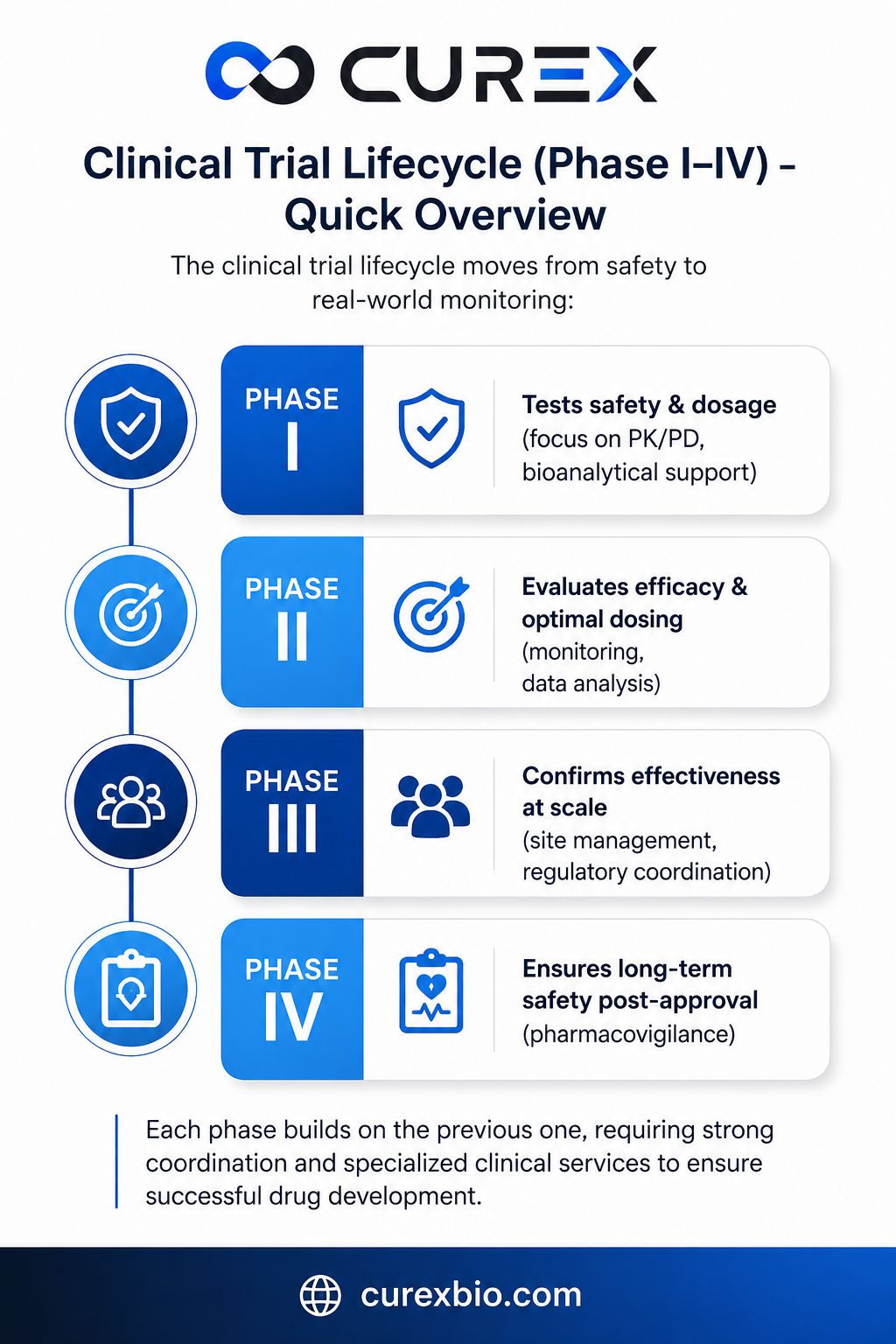
Understanding the clinical trial lifecycle is essential for anyone involved in drug development. Each phase serves a unique purpose and requires specialized management strategies to ensure success. From initial safety assessments to post-marketing surveillance, every stage contributes to the overall evaluation of a drug’s efficacy and safety.
Key Differences Between Trial Phases
| Phase | Objective | Key Services |
| Phase I | Safety & dosage | Bioanalytical, PK/PD |
| Phase II | Efficacy | Monitoring, data analysis |
| Phase III | Validation | Site management, regulatory |
| Phase IV | Post-marketing | Pharmacovigilance |
Phase I trials focus on safety and pharmacokinetics, often relying on bioanalytical services to understand how a drug interacts with the human body. Phase II shifts toward evaluating efficacy and optimal dosing, while Phase III involves large-scale validation across diverse patient populations. This phase is the most resource-intensive and requires extensive coordination between sites, investigators, and regulatory bodies.
Phase IV trials continue after a drug reaches the market, focusing on long-term safety and real-world effectiveness. Services like pharmacovigilance services and safety pharmacovigilance play a critical role in monitoring adverse events and ensuring patient safety. Each phase builds upon the previous one, making seamless integration and coordination essential for success.
🔘 Start Your Clinical Development Journey with Confidence
Looking for a reliable Clinical Research Organization (CRO)? Curexbio provides end-to-end clinical development services, including clinical trial management, biostatistics, and regulatory support to accelerate your drug development process.
Core Clinical Trial Management Services
Clinical Development and Study Design
A well-designed clinical trial is the foundation of successful drug development. Poor planning can lead to protocol amendments, delays, and increased costs, which ultimately impact the overall success of the study. This is why clinical development focuses on creating scientifically robust and operationally feasible study designs that align with regulatory expectations.
CROs play a crucial role in this process by conducting feasibility assessments, selecting appropriate study sites, and developing protocols that optimize patient recruitment and retention. They use data-driven insights to identify potential challenges and implement strategies to mitigate risks. This proactive approach ensures that trials are designed for efficiency and compliance from the outset.
Data Management and Biostatistics
Data is the backbone of clinical trials, and its accuracy directly impacts regulatory approval. Advanced clinical data management systems ensure that data is collected, stored, and analyzed efficiently. These systems integrate multiple data sources, including electronic data capture, laboratory results, and patient-reported outcomes, providing a comprehensive view of the trial.
Biostatistics adds another layer of sophistication by transforming raw data into meaningful insights. Statistical analysis ensures that study results are scientifically valid and meet regulatory requirements. Together, data management and biostatistics services enable faster decision-making and improve the overall quality of clinical trials. As data complexity continues to grow, the importance of integrated solutions becomes increasingly evident.
Role of Technology in Clinical Trials
AI, Decentralization, and Real-Time Monitoring
Technology is reshaping clinical trials at an unprecedented pace. AI-driven tools now assist in patient recruitment, data analysis, and risk prediction, improving efficiency and reducing costs. Decentralized clinical trials (DCTs) allow patients to participate remotely, increasing accessibility and improving retention rates.
Real-time monitoring is another transformative innovation. It enables sponsors to track trial progress continuously and identify issues before they escalate. Services like central lab support and remote monitoring systems play a critical role in enabling these advancements. By integrating technology into clinical trial management, CROs can deliver faster and more reliable results.
Benefits of Full-Service CRO Partnerships
Cost, Speed, and Compliance Advantages
Outsourcing clinical trials to a full-service CRO offers significant advantages. It reduces operational costs by eliminating the need for in-house infrastructure and provides access to specialized expertise. This allows sponsors to focus on innovation while ensuring efficient execution.
CROs also accelerate timelines by streamlining processes and reducing delays. In an industry where time-to-market is critical, this can make a significant difference. Compliance is another key benefit, as CROs ensure adherence to global regulatory standards. Services like scientific affairs services and clinical site management services ensure that trials are conducted with the highest level of quality and consistency.
👉 Build smarter clinical strategies with expert support
Optimize your clinical development with Curexbio’s integrated CRO services, including clinical trial management, data management, and biostatistics for faster and compliant outcomes.
How to Choose the Right CRO Partner
Selecting the right CRO is a critical decision that can determine the success of your clinical program. Sponsors should evaluate potential partners based on expertise, technological capabilities, and global reach. A CRO that offers integrated services can provide a seamless experience, reducing complexity and improving efficiency.
Transparency and communication are equally important. A reliable CRO should provide clear timelines, regular updates, and proactive risk management. By acting as an extension of your team, they can help you navigate the complexities of clinical research with confidence. Choosing the right partner ensures that your clinical trials are executed efficiently and successfully.
👉 Work with a CRO that delivers measurable results
Strengthen your clinical development strategy with Curexbio’s expert-driven services—covering clinical trial management, data management, and biostatistics to ensure faster, compliant, and high-quality outcomes.
Future Trends in Clinical Trial Management
The future of clinical trial management is driven by innovation and data-driven decision-making. AI, machine learning, and real-world evidence are transforming how trials are designed and conducted. These technologies enable faster and more accurate insights, improving overall efficiency.
Patient-centric approaches are also gaining traction, with decentralized trials making participation more accessible. This shift improves patient engagement and enhances data quality. As the industry continues to evolve, CROs that embrace these trends will lead the way in delivering advanced clinical trial solutions.
Conclusion
Clinical trial management services have become indispensable in modern drug development. From Phase I to Phase IV, every stage requires expertise, coordination, and innovation. CROs provide integrated solutions that accelerate timelines, reduce costs, and ensure compliance. By partnering with a reliable CRO, sponsors can navigate the complexities of clinical research and bring innovative therapies to market faster.
FAQs
1. What are clinical trial management services?
They include planning, execution, monitoring, and reporting of clinical trials.
2. Why are CROs important in clinical trials?
They provide expertise, reduce costs, and improve efficiency.
3. What is the role of data management in trials?
It ensures data accuracy, integrity, and regulatory compliance.
4. How do CROs improve clinical trial timelines?
By streamlining processes and using advanced technologies.
5. What should you look for in a CRO partner?
Expertise, global reach, integrated services, and strong communication.


