

Biomarkers are essential in development programs, influencing enrollment, dosing decisions, and the market potential of drugs in precision medicine trials. However, a significant gap exists between initial exploratory signals and robust biomarker strategies that meet regulatory standards. This blog examines the relationship between biomarker types and trial decisions, the impact of assay choices on data quality, and the regulatory expectations for biomarker validation and companion diagnostics in such trials.
Biomarker Categories and Clinical Decision-Making
The FDA-NIH BEST glossary categories serve primarily to clarify the specific purpose of a biomarker rather than merely labeling it; each category is associated with varying levels of evidentiary requirements.
- Predictive biomarkers help identify patients likely to benefit from specific therapies, serving as the foundation for patient selection and companion diagnostics. Establishing their predictive value necessitates demonstrating a treatment-by-biomarker interaction rather than just an association with outcomes.
- Prognostic biomarkers provide insights into disease progression and are crucial for trial stratification to prevent confounding imbalances, but they alone do not justify patient selection for drug treatments.
- Pharmacodynamic/response biomarkers indicate that a biological effect has occurred, aiding in dose selection, proof of mechanism, and guiding go/no-go decisions in early phases.
- Safety biomarkers indicate the likelihood or existence of toxicity, playing a crucial role in guiding monitoring plans and rules for dose modification.
- Monitoring and diagnostic biomarkers are essential for tracking disease status or confirming the studied condition, and they can serve as criteria for enrollment or response.
- Surrogate endpoints require substantial evidence to predict clinical benefit reliably, evaluated within the specific context of disease and therapy.
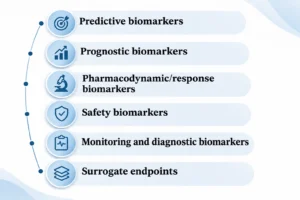
The common thread is the context of use (COU), which is a clear statement of a biomarker’s category and its intended role in drug development. Validation, assay performance targets, and regulatory pathways are derived from the COU, underscoring the importance of drafting it early and revisiting it intentionally as the program evolves.
Analytical Platforms
Platform choice is a scientific and operational decision at once. A few considerations recur across the main technology families:
- Immunohistochemistry (IHC) remains crucial for assessing protein expression. However, scoring systems like tumor proportion or combined positive scores can introduce interpretive variability. Emphasis should also be placed on pathologist training, scoring algorithms, and inter-reader concordance alongside the staining process itself.
- Next-generation sequencing (NGS) facilitates multi-gene panels, tumor mutational burden, and fusion detection but necessitates careful validation of bioinformatic pipelines, variant calling thresholds, and reference databases. Discrepancies may arise between tissue and ctDNA assays, highlighting the need for specified sample types.
- PCR and digital PCR are ideal for detecting targeted variants and low-abundance targets, such as minimal residual disease, due to their high sensitivity and low limits of detection.
- Flow and mass cytometry is effective for immune phenotyping and receptor occupancy, but it requires careful attention to sample handling, panel design, and gating strategy, all of which must be fixed and documented.
- Ligand-binding assays and ultrasensitive immunoassays are essential tools for evaluating soluble and circulating protein biomarkers, with challenges including critical reagents and lot-to-lot consistency being major risks.
- LC-MS/MS is crucial for detecting small-molecule and certain protein biomarkers, with an emphasis on specificity.
Biomarker Validation
Biomarker assays differ from conventional PK assays due to the absence of a blank matrix and reference standard matching the endogenous analyte. This difference influences the application of validation parameters, necessitating a fit-for-purpose approach based on the context of use (COU), as highlighted in recent FDA guidance on bioanalytical method validation for biomarkers. Practical elements in these assays often require explicit justification.
- Analytical validation encompasses accuracy (trueness via methods such as parallelism and spike recovery), precision, selectivity, sensitivity (including limits of blank, detection, and quantitation), range, and stability under relevant storage and freeze-thaw conditions.
- Pre-analytical variables such as collection tubes, fixation time, ischemia time, processing delays, and shipping conditions can significantly affect results, often more than the assay itself, and are frequently overlooked until discrepancies arise at the site level.
- Cutoff definition involves establishing a threshold either prospectively from earlier phase data or retrospectively and determining how it is locked before pivotal analysis.
- Clinical validation refers to the evidence demonstrating that a biomarker functions as intended within a target population. This includes evaluating its sensitivity and specificity regarding pertinent clinical questions and, for predictive markers, assessing treatment effect disparities among groups defined by the biomarker.
- Reproducibility in testing is crucial, especially when involving both central and local testing across different sites and operators.
- Data integrity and traceability are crucial aspects that include sample chain of custody, audit trails, and consistent management of re-tests and invalid results.
Companion Diagnostics
Teams frequently overlook the extent to which issues can be resolved prior to enrolling the first patient, as well as the high costs associated with making adjustments later on.
- Early alignment on the intended-use claim and the relationship of the companion diagnostic (CDx) to the pivotal trial population is essential.
- In registrational studies, a final or closely bridged assay is essential for patient selection. If a clinical trial assay varies from the commercial format, a bridging study must be conducted to ensure that selection and outcomes are compatible.
- Effective regulatory management of investigational devices in trials is crucial. In the US, it includes IDE considerations and early agency communication, while in the EU, the IVD Regulation (IVDR) categorizes companion diagnostics (CDx) as higher risk, necessitating notified body review and consultation with a medicines authority.
- Planning is necessary for biomarker-negative and unevaluable samples, as evidence for a restricted indication relies on the management of the excluded population.
- Operational logistics focus on tissue availability, turnaround time, testing failure rates, and the support of a central laboratory network to maintain the trial’s pace.
Designing Precision Medicine Trials Around the Biomarker
Trials that neglect the diagnostic often encounter late submissions, limited labels, or demands for extra bridging data.
- Biomarker strategies significantly influence the design of clinical trials. Common approaches include enrichment trials, biomarker-stratified designs, basket trials targeting specific molecular alterations across various tumor types, umbrella trials assessing multiple targeted therapies within a single disease, and platform trials featuring adaptive arms. Each design type presents unique considerations.
- Low-prevalence alterations lead to high screen-failure rates and prolonged enrollment timelines; thus, screening strategies and site selection should be planned in advance.
- Statistical analysis plans must include pre-specification for multiplicity, interaction testing, and the handling of missing biomarker data.
- Sample strategies, including archival versus fresh biopsy and plasma-based alternatives, impact both participant enrollment and the quality of exploratory analyses due to tissue sufficiency considerations.
- Exploratory biomarkers require that consent language, sample retention, and data sharing plans be established prior to sample collection rather than afterward.
Regulatory expectations
It highlights the need for a clearly defined COU and properly validated assays. Agencies emphasize early discussions on novel or high-impact biomarkers and require thorough documentation to track results from sample collection to analysis. For biomarkers used in multiple drug programs, a formal qualification pathway exists, although it requires significant evidence and time. Questions often arise regarding the test description, result interpretation, and management of indeterminate patient results.
Biomarker programs thrive when science, assay operations, and regulatory writing are integrated. CurexBio supports sponsors and development teams by defining biomarker strategies, planning assay validation, aiding companion diagnostic co-development, contributing to trial documents, and preparing regulatory submissions. The aim is to create a cohesive biomarker narrative from the initial protocol to final submission, minimizing unexpected issues.
Planning a biomarker-driven program? Contact CurexBio to discuss how we can support your validation, companion diagnostic, and precision medicine trial strategy.


