
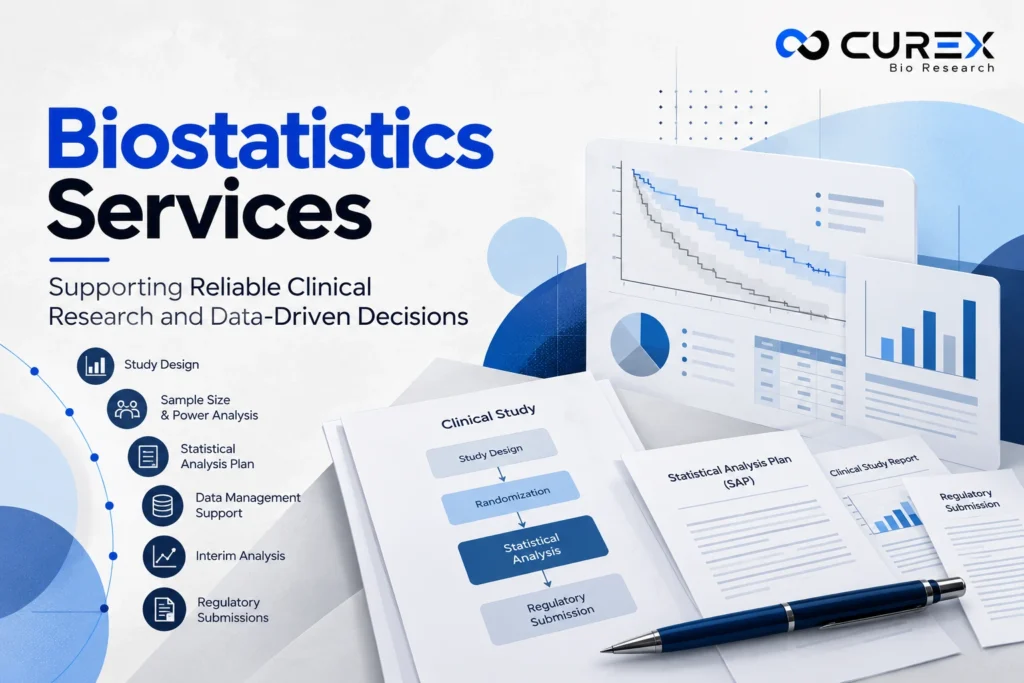
Every clinical study starts by questioning the efficacy and safety of a treatment, which relies on the quality of trial execution and data analysis. Biostatistics plays a crucial role in transforming raw clinical data into reliable evidence for regulators, clinicians, and patients.
At CurexBio, we provide biostatistics services to sponsors, researchers, and healthcare organizations, supporting each stage of the research process from the initial protocol draft to the final study report.
Learn about Biostatistics services:
Biostatistics applies statistical methods to medicine, biology, and public health, influencing study design, participant numbers, data analysis, and result reporting in clinical research. It mitigates risks of misleading conclusions from poorly designed trials, inadequate sample sizes, or biased data handling, ensuring decisions are based on solid evidence rather than assumptions.
Key Biostatistics Services That Include
1. Study Design and Protocol Development
The most critical statistical decisions occur prior to participant enrollment, where biostatisticians define the primary and secondary endpoints, choose the trial design (such as parallel, crossover, adaptive, or non-inferiority), and establish randomization and blinding strategies. Early statistical involvement enhances the robustness of the protocol and minimizes the potential for expensive amendments later.
Sample Size Calculation and Power Analysis
Enrolling too few participants can lead to inconclusive studies, while too many participants waste resources and burden individuals. Sample size and power calculations help achieve an optimal balance by considering expected effect size, variability, significance level, and anticipated dropout rates.
Statistical Analysis Plan (SAP)
The SAP outlines the analysis roadmap by specifying populations, statistical methods, missing data management, and multiplicity and subgroup analysis approaches. Finalizing the SAP before database lock ensures study integrity and supports regulatory credibility.
2. Randomization and Data Management Support
Reliable analysis relies on accurate data. Biostatisticians collaborate with data management teams to establish randomization schedules, set data validation rules, and assess data quality, ensuring that the dataset used for analysis is clean, consistent, and traceable.
Statistical Programming and Analysis
This process involves creating analysis datasets, tables, listings, and figures (TLFs) following industry standards like CDISC SDTM and ADaM. Validation through programming and independent quality checks ensures reproducibility of all numbers in the report.
3. Interim Analyses and Data Monitoring Committee Support
Statistical oversight is crucial for trials with interim looks. Biostatisticians design stopping rules, manage the overall type I error rate, and prepare unblinded outputs for independent Data Monitoring Committees, ensuring that the study team remains appropriately blinded.
4. Real-World Evidence and Observational Studies
Biostatistics encompasses various methodologies beyond randomized trials, including registry studies, retrospective database analyses, and comparative effectiveness research. Techniques like propensity score matching and regression adjustment are employed to mitigate confounding factors.
Clinical Study Reports and Regulatory Submissions
Results should be communicated clearly and accurately, ensuring transparency and defensibility through the use of statistical input in clinical study reports, integrated summaries, and responses to regulatory queries.
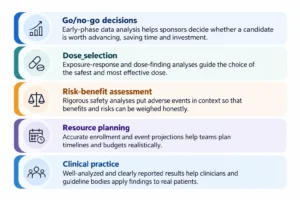
Statistics is not only about satisfying regulators. It informs decisions at every level:
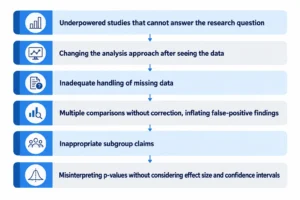
Common Pitfalls Good Biostatistics Helps You Avoid
Involving a biostatistician from the earliest planning stage is the simplest way to avoid most of these problems.
CurexBio collaborates with research teams to provide tailored biostatistics services for various projects, including first-in-human studies, pivotal trials, and real-world data analysis.
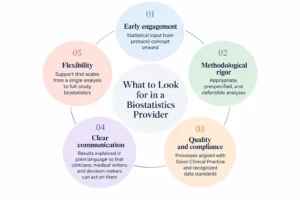
When choosing a biostatistics services provider, evaluate their experience in your therapeutic area, understanding of regulatory expectations, validated processes, and effective communication with your clinical and medical writing teams. Successful partnerships resemble an extension of your own team.


