
The UAE is emerging as a prominent destination for clinical research, driven by government support for research, a diverse patient base, and strong healthcare infrastructure. Clinical Trial Data Management in the UAE plays a critical role in maintaining trial credibility by ensuring accurate data collection, data quality, and compliance with an evolving regulatory framework. This blog discusses effective clinical data management practices in the UAE and highlights how CurexBio assists sponsors, CROs, and investigators in meeting these standards.
This blog discusses effective clinical data management practices in the UAE and highlights how CurexBio assists sponsors, CROs, and investigators in achieving these standards.
The UAE Regulatory Landscape
Clinical Trial Data Management in the UAE operates within a regulatory framework overseen by the Ministry of Health and Prevention (MOHAP) and the Emirates Drug Establishment (EDE), which regulates clinical trials under a framework based on Good Clinical Practice (GCP). The EDE acts as the federal medicines authority, and as of January 2, 2025, Pharmacy Law 38 mandates that research entities obtain the necessary licenses and approvals prior to commencing trials.
Emirate-level authorities in the UAE impose specific requirements for clinical trials. Abu Dhabi’s Department of Health (DOH) mandates its own Standard on Human Subject Research, necessitating DOH ethics approval. Similarly, Dubai Health Authority’s Clinical Trials Policy adopts Good Clinical Practice (GCP) as its foundational standard, highlighting the rights, safety, welfare, and data confidentiality of participants.
One more point deserves attention regarding the detailed terms, controls, and procedures for clinical research, which will be defined in upcoming Implementing Regulations. Until then, the UAE will rely on the existing GCP-based framework, necessitating flexibility in data management plans.
Data management is crucial for regulators, ethics committees, and sponsors, who rely on data that is attributable, legible, contemporaneous, original, and accurate (ALCOA), preferably complete, consistent, enduring, and available (ALCOA+). Weak data management compromises these standards.

Key Practices for Clinical Trial Data Management in the UAE
Effective Clinical Trial Data Management in the UAE requires structured processes that support data accuracy, consistency, traceability, and regulatory compliance throughout the clinical trial lifecycle.
- A robust Data Management Plan (DMP) serves as a roadmap for the entire data lifecycle, outlining data flow, roles, timelines, database lock criteria, and quality metrics prior to the enrollment of the first participant.
- Well-designed Case Report Forms (CRFs) and databases must accurately reflect protocol requirements. They should include built-in edit checks, range validations, and logic to identify errors during data entry. Adhering to standards like CDISC (CDASH, SDTM) ensures data consistency and readiness for submission.
- EDC systems must be validated and include role-based access, audit trails, electronic signature controls, and documented change management to comply with 21 CFR Part 11-style controls.
- Ongoing data cleaning and query management. Regular reconciliation, covering lab data, SAEs, and external vendor data, keeps discrepancies from piling up before database lock
- Medical coding. Consistent MedDRA and WHODrug coding makes safety and concomitant medication data comparable and analyzable.
- Risk-based quality management. Focusing monitoring and review on critical data and processes, in line with ICH E6(R3) principles, improves quality while using resources efficiently.
Data Privacy and Security
Clinical Trial Data Management in the UAE must account for health data protection requirements, including applicable provisions of the UAE’s Health Information Law, which governs the handling of health information. Sponsors must ensure proper data storage, access control, and compliance with data transfer laws. Data protection and localization must be integrated from the outset with vendors, contracts, and system design. Informed consent forms must explicitly outline data collection, usage, sharing, and protection measures.
CurexBio collaborates with sponsors, CROs, and research sites to ensure reliable and compliant clinical data management.
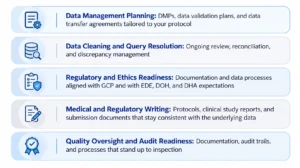
Combining local regulatory awareness with international data standards, CurexBio aids trial teams in transitioning from database build to database lock with minimized surprises.


