
Delays in clinical trials often result from numerous minor oversights, such as late site activation or unaddressed data issues, rather than a single major failure. These accumulated delays lead to stretched budgets and reduced recovery options by the time issues are recognized by steering committees. The key to successful trials lies in rigorous clinical project management practices that are implemented early and continuously assessed, enhancing the sponsor-CRO partnership.
Before tools and tactics, it helps to be precise about the usual failure points:
- Start-up drift occurs when critical paths like contract, budget, and ethics/regulatory steps are underestimated by sponsors. This leads to delays in site activation, which directly impacts recruitment timelines.
- Enrollment is characterized by an optimistic approach, with feasibility estimates based more on investigator enthusiasm rather than on historical data regarding screen failures and dropouts.
- Scope creep occurs when small, reasonable requests accumulate without formal change control, leading to budget challenges when discussions become difficult.
- Every protocol amendment affects the CRFs, monitoring plan, site retraining, reconsent, and the database.
- Late data issues include query aging, protocol deviations, and reconciliation gaps identified at the interim or database lock stages rather than on a monthly basis.
Planning: Build the Plan You Can Actually Defend
Effective clinical project management begins before first patient in, with a plan that holds under pressure.
- Effective project planning requires highlighting the critical path and explicitly showing dependencies, such as vendor readiness and drug supply release, beyond merely using a Gantt chart. Tracking these dependencies is essential, with all non-critical elements assigned float time.
- A budget’s reliability hinges on its underlying assumptions, including site numbers, screen-failure rates, patient visit frequency, monitoring intervals, and query volumes. Documenting these assumptions ensures that any future variances can be explained and that change orders remain equitable.
- Realistic enrollment modeling benefits from scenario-based projections (conservative, expected, upside) complemented by site-level ramp curves, providing greater utility than a single linear line and facilitating cost estimates for potential rescue plans.
- A risk register should be actionable, clearly identifying an owner, a trigger, mitigation strategies, and contingencies for each item. It must be reviewed regularly rather than simply filed after initiation.
- Balance Appropriate Authority
Slow decisions can cause significant delays in projects. An effective governance structure should feature a joint steering committee for strategic decisions, regular operational team meetings with concise agendas, predefined escalation thresholds for issues, and clear RACI ownership for deliverables. The goal is to ensure that no issue remains unassigned for longer than one meeting cycle.
Dashboards full of lagging indicators tell you what already happened. The most useful ones lead:
| Area | Leading indicator |
| Start-up | Time from site selection to contract execution; document turnaround by site |
| Enrollment | Screen-to-randomization ratio; activated-site productivity (patients per site per month) |
| Quality | Protocol deviation rate by site; query aging and recurrence |
| Monitoring | Visit completion vs. plan; open action-item age |
| Financial | Earned value vs. planned; burn rate vs. milestone progress; pending change orders |
Slow decisions can cause significant delays in projects. An effective governance structure should feature a joint steering committee for strategic decisions, regular operational team meetings with concise agendas, predefined escalation thresholds for issues, and clear RACI ownership for deliverables. The goal is to ensure that no issue remains unassigned for longer than one meeting cycle.
Risk-Based Management in Clinical Project Management
Risk-based quality management effectively reallocates effort by utilizing central monitoring to identify outlier sites based on key risk indicators. This allows for targeted on-site visits instead of a fixed schedule, ultimately lowering monitoring costs and detecting quality issues earlier. However, if implemented poorly, it turns into a mere documentation task. Success is measured by whether the risk signals influence the team’s actions within the week.
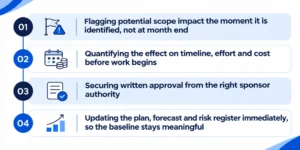
Change control is an honest mechanism for maintaining the sponsor-CRO relationship. Effective practice is essential in this process.
- Turnaround Strategy
Effective studies are distinguished by the speed and concrete nature of the team’s responses to challenges.
- Diagnose based on the specific site rather than relying solely on averages, as these averages can obscure the true situation; often, a few sites account for the majority of the shortfall.
- Selective addition or reactivation of sites should utilize data from comparable studies instead of a broad second-wave approach.
- To improve efficiency, streamline visit logistics, improve screening processes, and address recurring queries.
- Re-forecasting transparently with a revised plan that includes explicit assumptions can rebuild sponsor confidence more effectively than making a series of small, optimistic adjustments.
- Deciding on trade-offs early ensures that time, cost, and scope are effectively balanced, allowing sponsors to choose wisely when options are appropriately priced.
The best project managers provide concise, actionable updates that clearly outline changes, their impacts, required actions, and deadlines. They distinguish between status, risk, and decisions and communicate bad news promptly along with proposed solutions. This practice fosters greater trust over time than merely meeting scheduled milestones.
CurexBio supports clinical project management for sponsors, ensuring studies remain aligned with timelines, budgets, and vendors.
Key activities include developing integrated project plans and risk registers, maintaining budget forecasts, coordinating cross-functional teams, tracking operational and financial indicators, supporting recovery planning for timeline slips, and ensuring study documentation is clear and inspection-ready.
Effective trial management relies on disciplined planning, honest metrics, prompt governance, and strict change control from the outset. Sponsors and their partners who commit to these practices enhance the likelihood of completing programs on time and within budget.
Planning a study or concerned about one already in motion? Contact CurexBio to discuss how we can support your clinical project management.


