
India has evolved from a cost-efficient manufacturing hub to a prominent destination for clinical development, making Regulatory Affairs in India increasingly important for global biotech sponsors. This growth is supported by a diverse patient pool, experienced investigators, and an improved regulatory environment following the New Drugs and Clinical Trials (NDCT) Rules of 2019. However, for many global biotech sponsors new to the market, the path from dossier submission to approval can still be lengthy, significantly affecting program timelines.
This blog determines regulatory approval timelines and highlights in India the role of a specialized CRO regulatory partner in improving outcomes.
Regulatory Affairs in India: Key Causes of Approval Delays
Delays in the Indian pathway primarily arise from avoidable friction rather than the rules themselves.
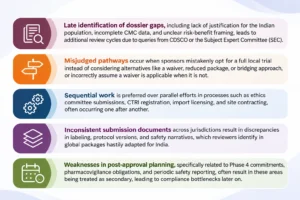
The Mechanism that Influences the Progression of Time
Strategies before submission
The NDCT Rules outline various approval routes based on the type of product, including new entities, existing drugs, Indian-developed drugs, biologics, and reformulations. Review timelines vary, with faster processing for Indian-developed drugs. An effective strategy early in the process determines if a local phase 3 trial or a smaller confirmatory study is needed, or if a local trial waiver can be obtained, potentially saving over a year in the development timeline.
SEC-ready dossiers
The Subject Expert Committee focuses on rigorous scientific evaluation, requiring dossiers to address specific questions to facilitate faster processing. Key elements include a clear rationale for dosing and endpoints relevant to India, explicit pharmacokinetic and ethnic-sensitivity arguments, consistency between nonclinical and CMC summaries and the clinical narrative, and pre-prepared responses for anticipated queries regarding safety, unmet needs, and benefit-risk assessments.
Parallel-track execution
Well-run programs execute several workstreams concurrently, including CDSCO application through the SUGAM portal, ethics committee registration checks, CTRI registration, import or test license requirements for investigational products, and site feasibility with investigator selection. Coordinating these as an integrated plan rather than a sequential handoff results in significant time savings.
Query management
A regulatory query is a critical decision point where timely and well-supported responses are essential for keeping processes on track. Strong CRO partners ensure effective communication and consistency by maintaining a query-response playbook, monitoring clock stops, and facilitating direct interactions among regulatory, clinical, CMC, and medical writing teams.
Quality of regulatory writing
Clear and consistent documents with traceable data cross-references are essential for reviewers in any agency, who often read extensively under time constraints. This necessity spans various regulatory documents, including protocols and informed consent forms. Regulatory writing is crucial for expediting review processes, rather than being a mere clerical task.
Effective Regulatory Affairs support also depends on maintaining alignment across all submission documents. Information presented in clinical, nonclinical, and CMC sections should remain consistent, with supporting data clearly referenced throughout the dossier. This helps reduce discrepancies, simplifies document review, and allows regulatory teams to address potential gaps before submission. A coordinated approach to document preparation also supports smoother communication between sponsors, CROs, and regulatory stakeholders throughout the review process.
Beyond Approval: Where Programs Stay Compliant
Approval is a critical stage in the regulatory lifecycle, and for India, it necessitates early planning for specific obligations.
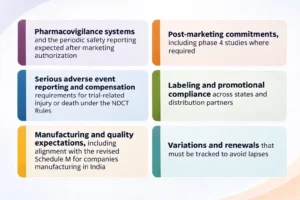
A regulatory partner that plans for these early prevents the common scenario in which a successful approval is followed by a compliance scramble.
CurexBio supports sponsors in navigating Regulatory Affairs in India by integrating regulatory expertise with proficient scientific and medical writing, strategically focusing on areas that optimize timelines.
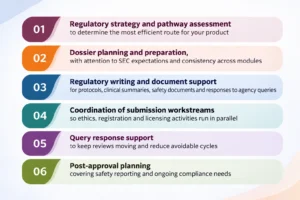
Our aim is simple: fewer surprises, fewer review cycles, and a clearer path to approval.
Regulatory requirements and timelines are updated periodically, so sponsors should confirm current CDSCO guidance and notifications before finalizing any submission plan.
Planning an India submission? Contact CurexBio for expert Regulatory Affairs support to help navigate CDSCO requirements and move from dossier to approval with confidence.


