
The convergence of biostatistics, compliance, and regulatory inspection readiness is crucial in clinical development. Statistical outputs now serve as documented, reproducible, and auditable evidence rather than being merely correct or incorrect. With growing scrutiny from global regulators regarding statistical computing, analysis traceability, and adherence to standards like CDISC ADaM, biostatistics teams face pressure to demonstrate data and process integrity. This article explores key compliance risk areas in 2026 and discusses how specialized audit and compliance services can aid sponsors and CROs in navigating this landscape.
The FDA’s Office of Biostatistics is crucial in drug and biologic reviews, assessing the alignment of study designs with clinical and regulatory questions, the reliability of endpoints, the suitability of analyses, and the robustness of findings. Sponsors must show that their statistical methods are scientifically valid, documented, verifiable, and in compliance with global regulatory data integrity standards.
In 2026, the regulatory focus on biostatistics has deepened, driven by:
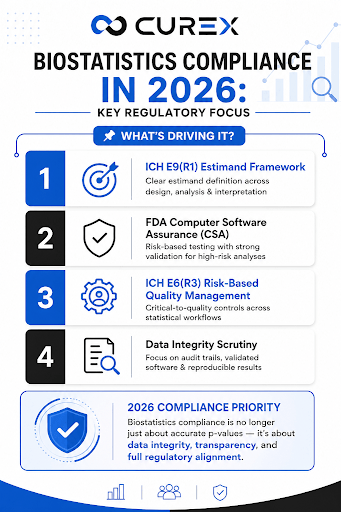
- ICH E9(R1) Estimand Framework: Regulators expect a clearly defined estimand that synchronizes design, conduct, analysis, and interpretation. The Statistical Analysis Plan (SAP) should implement this framework, eliminating any ambiguity regarding the handling of intercurrent events.
- FDA’s Final Computer Software Assurance (CSA) Guidance: The FDA is transitioning to risk-based testing, reducing documentation requirements; however, high validation evidence standards persist, especially for high-risk applications such as primary endpoint analysis.
- ICH E6(R3) and Risk-Based Quality Management: The updated GCP framework emphasizes identifying critical-to-quality factors and implementing proportionate controls across all trial processes, including statistical analysis and reporting.
- Data Integrity Scrutiny: Warning letters are increasingly addressing data integrity issues in analytical environments, highlighting concerns such as missing audit trails, unvalidated software, and results that cannot be reproduced.
Compliance in biostatistics now focuses on integrity, transparency, and regulatory alignment throughout the entire statistical process, rather than solely on accurate p-values.
Key Risk Areas: What Regulators Look For
Understanding compliance risk areas is essential for establishing an audit-ready biostatistics function.
- Regulatory‑ready Statistical Analysis Plans (SAPs)
A SAP (Statistical Analysis Plan) is a contract that transforms trial intent into analyzable results. It must be completed prior to database lock, detailing statistical models, analysis sets, and management of intercurrent events while referencing protocols without repetition. The SAP operationalizes the estimand and outlines coding rules for analysis populations, ensuring that outputs can be traced to pre-defined specifications.
- CDISC Compliance and Submission‑Ready Datasets
Sponsors must ensure datasets meet FDA standards by conforming to CDISC SDTM and ADaM requirements, including a Define-XML file for traceability. ADaM datasets should derive directly from SDTM, with metadata submitted as part of the eCTD.
- Validation of Statistical Software and Computing Environments
Statistical computing requires validation of software packages used in submission analyses, according to FDA expectations. Code must be version-controlled, and the Statistical Computing Environment (SCE) should be maintained with change control and an audit trail. Inspectors may request to review final outputs as well as the exact code, dataset versions, and package versions utilized. For open-source tools like R, validated repositories of approved packages and versions must be maintained.
- Analysis Traceability and Reproducibility
A key inspection question is how the derived table or safety analysis was produced. Regulators require traceability from raw data to final output, necessitating documented data-flow diagrams and version-controlled programs. Additionally, analysis must be reproducible using only the final database. Change control is crucial after database lock, and any modifications to outputs post-lock need documented justification and approval.
- Audit Trails in Statistical Environments
21 CFR Part 11 mandates that electronic records maintain audit trails documenting the creation, modification, or deletion of records, including date, time, and user identity. In statistical contexts, this involves tracking analysis execution details like the user, timing, and software version utilized. Contemporary SCE platforms facilitate automatic audit trail generation for inspection purposes.
How CurexBio Delivers Audit & Compliance Biostatistics Services
CurexBio provides biostatistics services tailored to fulfill FDA, EMA, and CDSCO requirements for audit readiness and regulatory compliance, ensuring embedded statistical integrity from study design to final submission.
-
Statistical Analysis Plan (SAP)
CurexBio biostatistician develops Statistical Analysis Plan (SAP) that adhere to the ICH E9(R1) estimand framework, detailing analysis populations, handling of intercurrent events, and statistical models. These plans are designed to endure regulatory scrutiny, ensuring a clear link from protocol objectives to final analysis outputs.
-
CDISC-Compliant SDTM and ADaM Datasets
Our biostatistics team creates submission-ready SDTM and ADaM datasets that meet FDA and CDISC standards, along with validated Define-XML files for traceability of variables and derivations, enhancing the technical review process and minimizing submission queries.
-
Risk-Based Compliance for CSA and ICH E6(R3)
We align our services with the FDA’s final Computer Software Assurance (CSA) guidance through a risk-based approach to software validation, documenting essential aspects for high-risk components while ensuring regulatory compliance. Our quality management system incorporates ICH E6(R3) principles, identifying critical-to-quality factors and applying appropriate controls in statistical processes.
-
Traceable Programming and TLF Generation
All tables, listings, and figures are created using version-controlled programming scripts, ensuring traceability from analysis specifications to final outputs. This allows for verification of results by inspectors. The programming teams adhere to Good Programming Practices, focusing on readability, documentation, and reproducibility.
-
Inspection Support and Mock Audits
CurexBio provides mock regulatory inspections that emphasize biostatistics and data integrity, assisting sponsors in identifying gaps prior to regulatory reviews. Their services include preparing documentation for inspections, conducting pre-audit assessments of statistical processes, and offering on-call statisticians and programmers during live inspections.
CurexBio provides the audit‑ready framework for your statistical submissions. Our expert biostatisticians and programmers deliver inspection‑ready analyses and datasets that satisfy even the most rigorous regulatory reviewers.
Get Inspection‑Ready With CurexBio . Contact us for consultation on audit-ready biostatistics, CDISC compliance, CSA-aligned validation, and inspection support services to ensure regulatory submission success.


