

In precision medicine, the traditional “one-size-fits-all” drug development approach is evolving toward therapies customized for individual patients’ molecular profiles, with biomarkers as key tools. Biomarkers serve as measurable indicators guiding essential treatment decisions and evaluating therapeutic effects. However, raw biomarker data requires rigorous statistical analysis to be converted into regulatory-grade evidence for effective application. In 2026, biomarker statistical analysis is essential for the success of precision medicine programs. The article discusses key statistical methods, the regulatory framework influencing them, and the role of CurexBio in providing specialized biostatistical services to maximize biomarker data potential.
Core Statistical Methods Shaping Precision Medicine (2026)
The statistical methodologies for biomarker data have rapidly evolved to address the complexities of modern trials, with several approaches being essential for robust precision medicine studies.
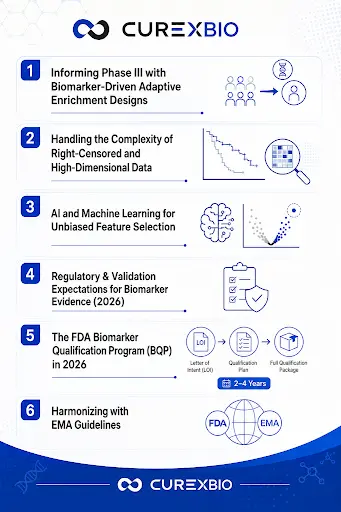
- Informing Phase III with Biomarker‑Driven Adaptive Enrichment Designs
Biomarker-driven adaptive enrichment designs are integral to precision medicine, following a two-stage process: an interim analysis to evaluate the predictive value of a candidate biomarker, followed by a second stage that selectively enrolls patients most likely to benefit, specifically biomarker-positive individuals.
More advanced frameworks incorporate quality-by-design principles from the beginning. A 2026 design employs a pre-specified statistical analysis plan to identify the ideal biomarker signature, such as a multi-omics profile, by continually adjusting treatment allocation as data is gathered. This strategy ensures that the trial population is accurately aligned with the therapy, thereby significantly enhancing efficiency and minimizing patients’ exposure to ineffective treatments.
- Handling the Complexity of Right‑Censored and High‑Dimensional Data
Biomarker analysis often includes time-to-event outcomes, which may be right-censored due to patient loss or premature trial conclusion. Traditional methodologies, such as the Cox proportional hazards model, are common; however, high-dimensional data, characterized by numerous genomic or proteomic predictors relative to the patient count, necessitate advanced techniques.
In 2026, state‑of‑the‑art approaches include:
ü Network-regularized Accelerated Failure Time (AFT) models maintain biological interpretability of biomarkers while ensuring competitive predictive performance.
ü Deep neural network frameworks, such as SurvDNN, are designed to model complex, non-linear interactions between biomarkers, capturing intricate relationships that linear models overlook.
ü Novel two-step tests for zero-inflated biomarkers help identify predictive biomarkers more reliably, particularly in early-phase trials with small sample sizes. The approach includes a spike test for biomarker-negative patients and a tail test for biomarker-positive patients.
- AI and Machine Learning for Unbiased Feature Selection
Machine learning is increasingly essential in discovery-phase biomarker analysis, with emphasis on controlling false discovery rates (FDR) to prevent overfitting. The novel method SurvClipper effectively manages FDR while handling non-linear relationships, serving as a strong alternative to traditional methods. Additionally, Bayesian frameworks for biomarker discovery enhance statistical power and interpretability by integrating prior biological knowledge. Advanced machine learning techniques like contrastive learning improve sensitivity in analyzing deeply sequenced omics data by distinguishing true signals from biological and technical noise.
- Regulatory & Validation Expectations for Biomarker Evidence (2026)
Statistical rigor is crucial not only as a scientific preference but also as a regulatory requirement, making the understanding of the current validation framework essential for sponsors aiming for successful submissions.
- The FDA Biomarker Qualification Program (BQP) in 2026
The FDA’s Biomarker Qualification Program (BQP), created by the 21st Century Cures Act, is the key route for gaining regulatory acceptance of biomarkers in drug development, following a structured process.
- ü Submission of a Letter of Intent (LOI).
- ü Submission of a Qualification Plan.
- ü Submission of a Full Qualification Package.
The biomarker qualification process usually takes 2–4 years, allowing a biomarker qualified for a specific Context of Use (COU) to be utilized across various drug development programs without re-validation. In 2026, the FDA is expected to enhance this process with new resources and incentives through PDUFA VIII.
- Harmonizing with EMA Guidelines
The regulatory landscape is becoming global, particularly with the FDA and EMA collaboratively issuing ten guiding principles for the responsible use of AI in medicine by 2026. These principles address AI and machine learning in biomarker development and validation, making adherence to these international standards essential for programs aiming at the US and European markets.
CurexBio Advances Precision Medicine Through Biostatistics
CurexBio provides biomarker biostatistics services tailored for modern precision medicine, ensuring data is scientifically robust and compliant with global regulatory standards.
Advanced biostatistics models at CurexBio are utilized to discover predictors of clinical outcomes, enhancing personalized medicine through targeted patient subgroup analysis. Our comprehensive biomarker statistical support encompasses method development and validation of assays, adhering to global regulatory guidelines. This full lifecycle approach aids in patient stratification and early efficacy detection, contributing to safer and more effective therapeutic strategies.
Ready to Advance Your Precision Medicine Program? Contact CurexBio to explore how our biomarker biostatistics services can enhance drug development and facilitate regulatory approval.


