
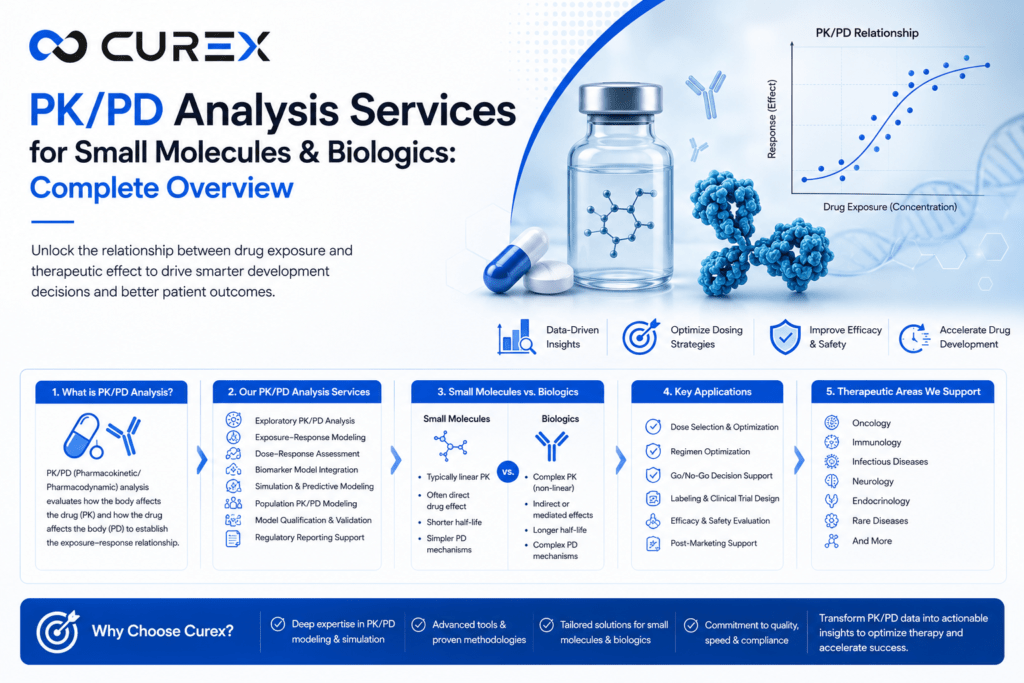
Pharmaceutical development has changed dramatically over the last decade. Drug sponsors no longer rely only on traditional laboratory testing to predict how therapies behave inside the human body. Today, PK/PD analysis services play a central role in clinical development, regulatory strategy, dose optimization, and biomarker-driven drug development. Whether companies develop small molecules, monoclonal antibodies, biosimilars, peptides, or advanced biologics, pharmacokinetic and pharmacodynamic analysis has become one of the most important scientific pillars of modern clinical research.
According to recent industry reports, biologics are projected to approach nearly 60% of global prescription revenues by 2028, while model-informed drug development and AI-supported clinical pharmacology workflows continue gaining regulatory importance. Sponsors increasingly depend on advanced PK/PD modeling, population pharmacokinetics, exposure-response analysis, and PBPK simulations to accelerate approvals and reduce development risk.
For pharmaceutical, biotech, and medical device companies, selecting the right PK/PD analysis service provider can directly influence study quality, regulatory acceptance, and clinical trial timelines. This guide explains how PK/PD services work, why they matter for small molecules and biologics, and how modern CRO partners support end-to-end clinical pharmacology programs.
Understanding PK/PD Analysis in Modern Drug Development
Drug development is a little like navigating a spacecraft through unknown territory. Scientists need precise data, predictive models, and continuous monitoring to avoid failure. This is exactly where PK/PD analysis services become essential. Pharmacokinetics (PK) and pharmacodynamics (PD) together help researchers understand how a drug behaves in the body and how the body responds to the therapy. Without these insights, clinical trials would become expensive guessing games rather than evidence-based scientific programs.
Pharmacokinetics focuses on absorption, distribution, metabolism, and excretion. In simple terms, PK explains what the body does to the drug over time. Pharmacodynamics, on the other hand, evaluates what the drug does to the body, including therapeutic effects, toxicity, biomarker response, and efficacy relationships. Together, PK and PD create a complete picture of treatment behavior.
Modern pharmaceutical companies increasingly depend on clinical pharmacology services, population PK modeling, exposure-response analysis, and model-informed drug development strategies to support clinical decisions. Regulatory agencies like the FDA and EMA now expect sponsors to provide scientifically credible PK/PD evidence packages during submissions. Recent regulatory guidance also emphasizes integrated evidence frameworks and biologically meaningful models rather than isolated statistical outputs.
For small molecules and biologics, PK/PD analysis supports nearly every development stage, from preclinical assessments to Phase I dose escalation studies and late-phase registration trials. It helps determine optimal dosing schedules, therapeutic windows, safety thresholds, and patient variability. As biologics, antibody-drug conjugates, and gene therapies continue expanding, sponsors increasingly require specialized PK/PD expertise capable of handling complex modalities and nonlinear pharmacokinetic profiles.
What is Pharmacokinetics (PK)?
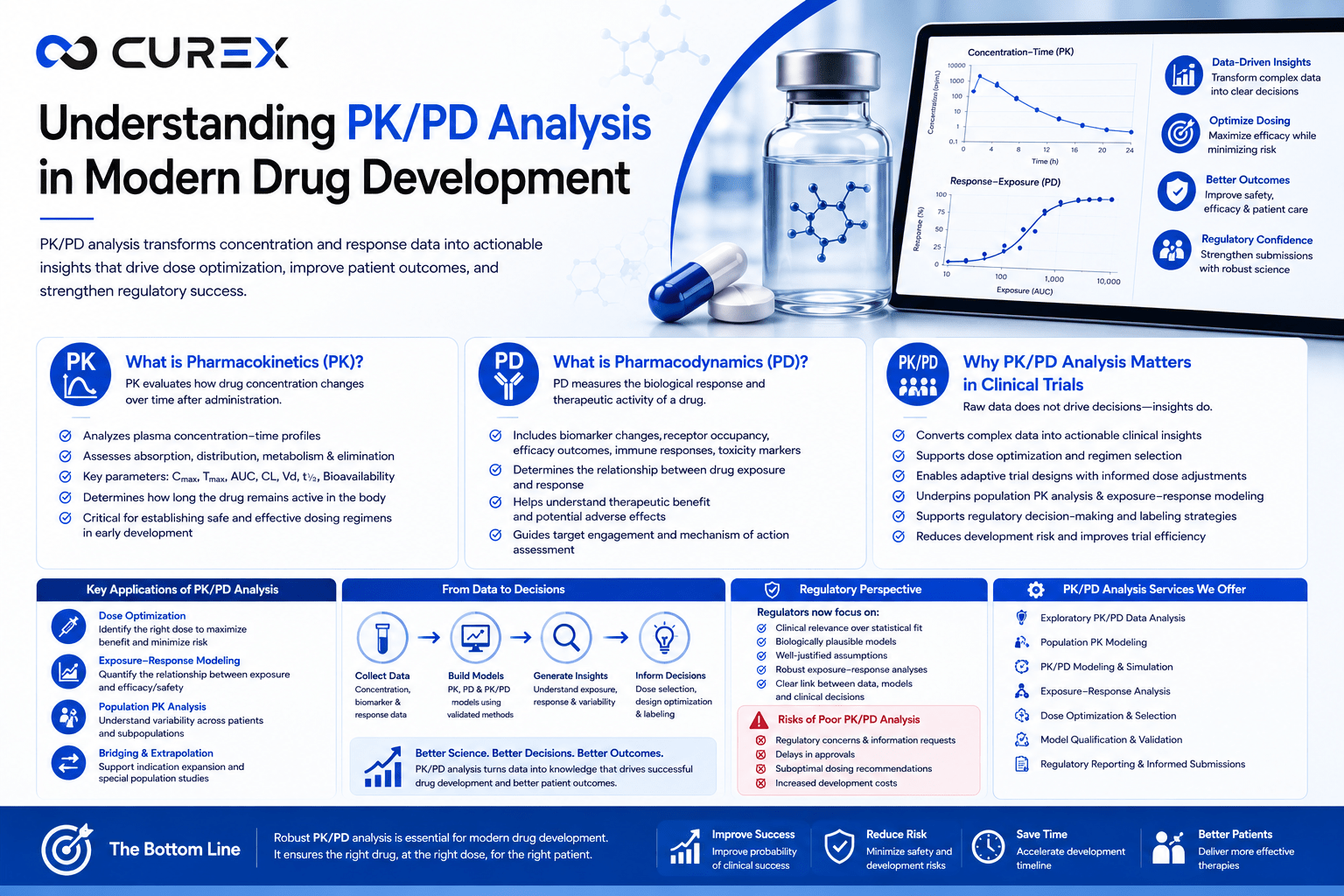
Pharmacokinetics evaluates how drug concentration changes over time after administration. Researchers analyze plasma concentrations, bioavailability, clearance, half-life, and distribution characteristics to determine how long therapies remain active within the body. PK analysis becomes especially important during early-stage clinical development when sponsors must establish safe and effective dosing regimens.
What is Pharmacodynamics (PD)?
Pharmacodynamics measures biological response and therapeutic activity. PD endpoints may include biomarker changes, receptor occupancy, efficacy outcomes, immune responses, or toxicity markers. PD analysis helps sponsors understand whether drug exposure levels correlate with clinical benefits or adverse effects.
Why PK/PD Analysis Matters in Clinical Trials
Clinical trials generate enormous amounts of data, but raw data alone provides little value without scientific interpretation. This is where PK/PD analysis services for biologics and small molecules become critical. Statistical models transform concentration-time datasets into actionable clinical insights that guide development strategy and regulatory decision-making.
Dose optimization represents one of the most important applications of PK/PD analysis. Selecting the wrong dose can derail an otherwise promising therapy. Underdosing may reduce efficacy, while overdosing increases safety risks and patient discontinuation. PK/PD modeling helps identify dosing strategies that maximize therapeutic benefit while minimizing toxicity. These analyses also support adaptive clinical trial designs that allow dose adjustments during ongoing studies.
Modern clinical development increasingly depends on population pharmacokinetic analysis and exposure-response modeling. Sponsors use these approaches to understand patient variability across age groups, disease states, organ impairment populations, and ethnic subgroups. This allows pharmaceutical companies to design more personalized treatment strategies while improving labeling recommendations.
Regulators now pay much closer attention to clinical pharmacology strategy than they did in previous decades. Recent industry insights show regulators increasingly evaluate whether PK/PD models reflect biological and clinical reality rather than simply demonstrating statistical fit. Poorly justified assumptions, overcomplicated models, or weak exposure-response analyses can create regulatory concerns and delay approvals.
Role in Dose Optimization
PK/PD modeling enables sponsors to identify ideal dosing intervals, loading doses, maintenance regimens, and titration strategies. These analyses improve study efficiency while reducing unnecessary patient risk.
Impact on Regulatory Submissions
Regulatory agencies increasingly expect validated PK/PD methodologies, exposure-response evaluations, and model-informed evidence packages within submission dossiers. Strong PK/PD workflows improve submission quality and reduce review questions.
PK/PD Analysis for Small Molecules
Small molecules continue representing a major segment of global pharmaceutical pipelines despite the rise of biologics. IQVIA reports that small molecule trials still dominate many clinical development phases, particularly early-stage research programs. These therapies often involve oral administration, rapid absorption, hepatic metabolism, and complex drug-drug interaction risks.
PK/PD analysis for small molecules focuses heavily on absorption profiles, bioavailability, clearance pathways, and exposure-response relationships. Researchers analyze food effects, hepatic impairment, renal impairment, and CYP-mediated interactions to establish safe dosing recommendations. PBPK modeling has become increasingly important for predicting drug interactions and optimizing first-in-human studies.
Small molecule development often requires intensive noncompartmental analysis and compartmental modeling approaches. Sponsors rely on these analyses to support bioequivalence studies, formulation optimization, dose proportionality assessments, and bridging strategies across clinical phases.
Common Challenges in Small Molecule Studies
Small molecule programs frequently encounter variability in metabolism, food effects, transporter interactions, and nonlinear kinetics. Drug-drug interaction assessments also become critical because many therapies share common metabolic pathways. Advanced PK modeling helps sponsors identify risks early and avoid late-stage development failures.
PK/PD Analysis for Biologics and Advanced Therapies
Biologics have transformed the pharmaceutical industry. Monoclonal antibodies, biosimilars, cell therapies, peptides, and antibody-drug conjugates now represent some of the fastest-growing therapeutic categories worldwide. Recent reports suggest biologics account for more than half of global prescription revenues and continue expanding rapidly.
Biologics introduce far greater PK/PD complexity compared to traditional small molecules. Large molecular size, target-mediated drug disposition, immunogenicity, receptor binding, and nonlinear elimination pathways create unique analytical challenges. Traditional PK models often fail to fully explain biologic behavior, forcing sponsors to adopt more advanced pharmacometric approaches.
Monoclonal antibodies, for example, may display target-mediated drug disposition where receptor interactions directly influence clearance rates. Biosimilars require comparative PK/PD analysis to demonstrate equivalence with reference products. Cell and gene therapies introduce even greater complexity because exposure-response relationships may evolve dynamically over time.
Scientific literature also highlights the growing importance of advanced PK modeling for monoclonal antibody-based therapies and next-generation biologics. Sponsors increasingly require specialized CRO partners capable of integrating immunogenicity analysis, biomarker evaluation, and population modeling into unified development strategies.
Complexities of Monoclonal Antibodies & Biosimilars
Biologics often involve nonlinear pharmacokinetics, long half-lives, immunogenicity concerns, and variable tissue penetration. PK/PD analysis helps sponsors optimize dosing frequency, therapeutic exposure, and safety monitoring.
Core PK/PD Services Offered by CROs
Modern CROs provide integrated PK/PD analysis services that support every stage of clinical development. These services extend beyond basic pharmacokinetic reporting and now include advanced pharmacometrics, modeling and simulation, regulatory consulting, and AI-supported analytics.
Key PK/PD services typically include:
| Service | Purpose |
| Noncompartmental Analysis (NCA) | Basic PK parameter estimation |
| Population PK Modeling | Evaluates patient variability |
| Exposure-Response Analysis | Links exposure to efficacy & safety |
| PBPK Modeling | Predicts drug interactions & special populations |
| Clinical Trial Simulation | Forecasts trial outcomes |
| Bioequivalence Analysis | Supports generic & biosimilar development |
| Statistical Programming | Generates TLFs and submission datasets |
| Regulatory Reporting | Supports FDA & EMA submissions |
Population PK modeling has become especially important because sponsors increasingly develop therapies for diverse patient populations. These models evaluate interpatient variability and support dose adjustments for special populations such as pediatric, geriatric, renal impairment, and hepatic impairment groups.
Population PK Modeling
Population PK analysis helps identify covariates influencing drug exposure, including age, weight, organ function, and concomitant medications. Sponsors use these models to personalize treatment recommendations.
PBPK Modeling & Simulation
PBPK modeling integrates physiological and mechanistic data to predict drug disposition across patient populations. Regulators increasingly expect PBPK evidence for drug-drug interaction strategies and special population assessments.
Statistical Programming & Software Used in PK/PD Analysis
PK/PD analysis depends heavily on accurate statistical programming and validated computational workflows. Statistical programmers create analysis datasets, tables, listings, figures, and submission-ready outputs required for regulatory review.
Industry-standard software platforms include SAS, R, NONMEM, Monolix, Phoenix WinNonlin, and MATLAB. Recent industry updates also highlight growing use of cloud-based platforms and AI-enabled workflows to improve speed and data consistency.
SAS remains the dominant regulatory submission platform because of its validation capabilities and widespread regulatory acceptance. R programming continues gaining popularity for advanced visualization, simulation, and exploratory modeling. Phoenix WinNonlin remains one of the most widely used PK analysis tools in clinical pharmacology.
Programming accuracy becomes critically important because inconsistencies between datasets, statistical outputs, and clinical study reports can trigger regulatory concerns. Strong validation procedures, quality control workflows, and reproducible programming standards help sponsors maintain submission integrity.
Regulatory Expectations for PK/PD Studies
Regulatory agencies have significantly increased expectations for clinical pharmacology evidence. FDA, EMA, PMDA, and global regulators now evaluate PK/PD methodologies as central components of overall development strategy.
Recent ICH guidance updates continue pushing sponsors toward model-informed drug development frameworks and integrated evidence packages. Regulators increasingly expect sponsors to justify assumptions biologically rather than relying solely on statistical significance.
Key regulatory expectations now include:
- Validated PK/PD methodologies
- Exposure-response assessments
- Population variability analysis
- Dose justification strategies
- Drug-drug interaction evaluations
- PBPK simulations where appropriate
- Transparent model assumptions
- Robust statistical programming validation
Sponsors failing to address these expectations risk receiving additional information requests, review delays, or even complete response letters. This is why many companies outsource PK/PD analysis to experienced CRO partners with strong regulatory expertise.
How AI & Advanced Analytics are Transforming PK/PD
Artificial intelligence is rapidly reshaping pharmaceutical R&D and clinical pharmacology workflows. Industry reports highlight growing adoption of AI-native R&D platforms, digital twins, and predictive analytics across clinical development.
AI now supports literature analysis, biomarker identification, patient stratification, simulation modeling, and automated data interpretation. Machine learning algorithms can identify hidden exposure-response patterns and improve prediction accuracy for complex biologics.
Digital twins and integrated simulation platforms also allow sponsors to evaluate hypothetical clinical scenarios before enrolling patients. These approaches may reduce trial costs, accelerate timelines, and improve development efficiency.
Despite these advancements, regulators still emphasize scientific credibility and mechanistic plausibility. AI models must remain explainable, clinically meaningful, and biologically grounded to gain regulatory acceptance.
Choosing the Right PK/PD Analysis Service Provider
Selecting the right CRO partner can dramatically influence development success. Sponsors should evaluate technical expertise, therapeutic area experience, software capabilities, regulatory history, and operational scalability before outsourcing PK/PD analysis.
A strong PK/PD service provider should offer:
- Expertise in small molecules and biologics
- Population PK and PBPK modeling capabilities
- Statistical programming support
- Regulatory submission experience
- Cross-functional collaboration
- Biomarker integration expertise
- Adaptive trial support
- Data visualization and reporting
Sponsors should also assess whether the CRO can integrate PK/PD workflows with related services such as biostatistics, clinical data management, pharmacovigilance, and medical writing. Integrated service models often improve efficiency and reduce communication gaps across development teams.
Future of PK/PD Analysis in Precision Medicine
Precision medicine is fundamentally changing how therapies are developed and prescribed. Future PK/PD analysis will increasingly integrate genomics, biomarkers, real-world evidence, wearable device data, and AI-powered predictive modeling.
Biologics, antibody-drug conjugates, RNA therapies, radiopharmaceuticals, and cell therapies continue increasing development complexity. This trend creates growing demand for advanced pharmacometric expertise capable of supporting highly personalized therapeutic strategies.
Model-informed drug development will likely become standard practice rather than an optional enhancement. Sponsors capable of integrating PK/PD analysis early in development may reduce failure rates, accelerate approvals, and improve clinical outcomes.
The future also points toward greater automation, cloud-based collaboration, and real-time adaptive modeling during ongoing clinical trials. As regulatory expectations continue evolving, scientifically robust PK/PD analysis will remain essential for competitive pharmaceutical innovation.
Conclusion
PK/PD analysis services have become indispensable for modern pharmaceutical and biotech development. From small molecules to advanced biologics, these analyses help sponsors understand drug behavior, optimize dosing, improve patient safety, and strengthen regulatory submissions. As therapies become more complex and personalized medicine expands, the demand for sophisticated pharmacometric expertise continues growing rapidly.
Sponsors now require more than simple pharmacokinetic reporting. They need integrated clinical pharmacology strategies that combine population modeling, exposure-response analysis, PBPK simulations, statistical programming, and regulatory expertise into unified development frameworks. Recent industry trends also show increasing reliance on AI-driven analytics, adaptive trials, and model-informed drug development strategies.
For pharmaceutical, biotech, and medical device companies, partnering with an experienced CRO offering comprehensive PK/PD analysis services can significantly improve development efficiency, reduce regulatory risk, and accelerate clinical success.
FAQs
1. What are PK/PD analysis services in clinical trials?
PK/PD analysis services evaluate how drugs behave in the body and how the body responds to treatment. These services support dose optimization, exposure-response analysis, safety evaluations, and regulatory submissions.
2. Why is PK/PD analysis important for biologics?
Biologics often display complex pharmacokinetic behavior such as target-mediated drug disposition and immunogenicity. PK/PD analysis helps sponsors understand these complexities and optimize treatment strategies.
3. What software is commonly used for PK/PD analysis?
Commonly used platforms include SAS, R, NONMEM, Monolix, MATLAB, and Phoenix WinNonlin for pharmacokinetic modeling, simulation, and statistical programming.
4. What is PBPK modeling?
Physiologically-Based Pharmacokinetic (PBPK) modeling uses mechanistic physiological data to predict drug behavior in various populations and evaluate drug-drug interactions.
5. How do CROs support PK/PD analysis?
CROs provide pharmacometric modeling, statistical programming, clinical pharmacology consulting, exposure-response analysis, regulatory reporting, and simulation services to support clinical development.


