
Table of Contents
ToggleClinical Development in 2026: Challenges and CRO-Driven Solutions
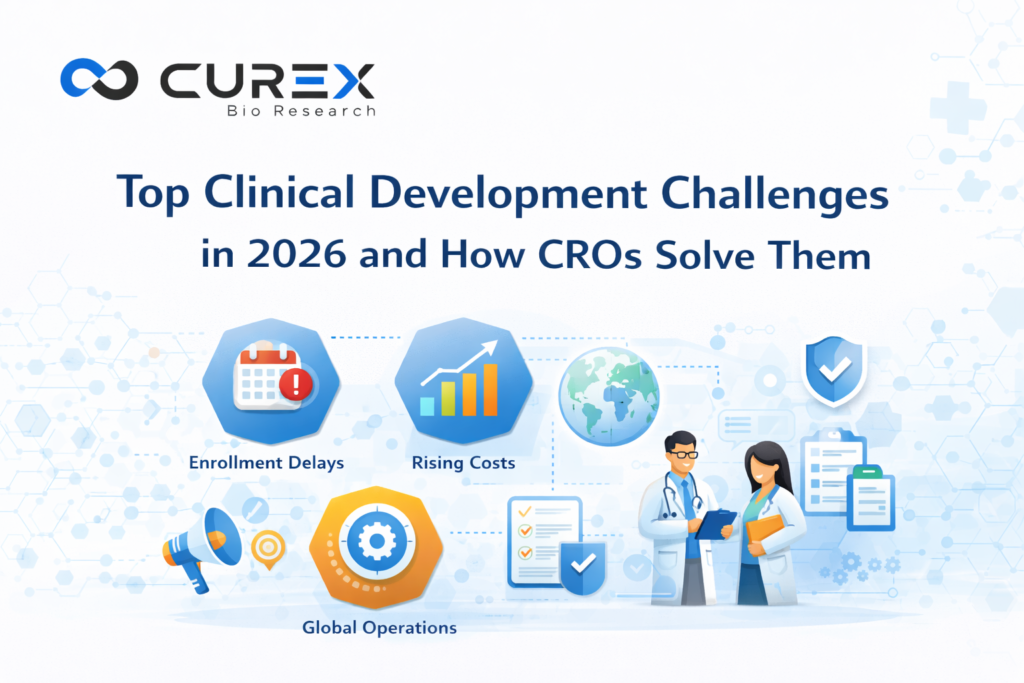
The clinical development landscape in 2026 is characterized by “complexity compression,” where sponsors aim for more sophisticated protocols while reducing cycle times, leading to tradeoffs between ambition and efficiency. This results in delayed timelines, rising budgets, and late-emerging quality issues. In this challenging environment, Contract Research Organizations (CROs) play a crucial role as strategic partners, aligning scientific goals with practical operations while addressing key clinical development challenges.
- Challenge 1: Patient Recruitment and Retention
Patient enrollment continues to be a significant challenge in clinical research, not due to a lack of willingness but because appropriate patients are not identified effectively. During the SCOPE Summit 2026, experts highlighted that recruitment issues stem from systemic problems including overly restrictive protocols, poor visibility of eligible patients, and logistical challenges like transportation and financial issues. The complexities of eligibility often lie within unstructured medical records, necessitating inefficient manual review processes. Furthermore, retention of participants is crucial, as reliance on their continued involvement can lead to delays and complications in trials.
- How CROs Solve It:
Forward-thinking CROs are shifting recruitment from a reactive to a proactive approach by utilizing AI-powered platforms that analyze unstructured clinical data to uncover potential eligibility patterns. They offer a unified patient engagement and enrollment infrastructure that identifies eligible patients early, preventing them from being overlooked. Some CROs use agentic AI systems to make contact within sixty seconds of identification, capturing patient interest quickly. Additionally, predictive models help forecast dropout events, allowing site coordinators to intervene prior to such occurrences.
- Challenge 2: Rising Costs, Staffing Shortages, and Efficiency Pressure
The clinical trial industry is grappling with increasing costs and staffing issues, leading to reduced capacity and loss of experienced personnel. As trial complexity rises, particularly in areas like rare diseases, CNS, and cardiovascular studies, organizations must navigate the challenges of “complexity compression” by implementing sophisticated protocols in shorter cycle times, resulting in difficult compromises between thoroughness and speed.
- How CROs Solve It:
CROs enhance efficiency by strategically differentiating and modernizing study processes, utilizing AI-driven protocol automation to expedite timelines, minimize manual work, and boost quality. They integrate fragmented tools into unified systems through “platformization” and adopt hybrid outsourcing models, facilitating global scalability for sponsors while easing the burden on internal teams.
- Challenge 3: Regulatory Uncertainty and FDA Capacity Constraints
In 2025, the FDA faced a significant staff loss and reduced capacity, leading to a focus on day-to-day reviews over policy development, which lengthened regulatory timelines and created uncertainty for sponsors. This has resulted in greater upfront efforts for submissions and difficulties in accessing guidance on innovative study designs. Some analysts suggest that these US regulatory inefficiencies are prompting early-stage trials to move offshore. Conversely, in January 2026, the FDA and EMA issued guiding principles for AI practices in medication development, indicating improved transatlantic collaboration on AI in drug development.
- How CROs Solve It:
Experienced CROs act as regulatory experts, leveraging relationships and knowledge to help sponsors navigate evolving expectations. They focus on improving submission quality and preparation to counteract slow agency responses. Additionally, CROs guide sponsors in exploring risk-based approaches and alternative strategies, particularly in the context of real-world evidence for regulatory purposes. As FDA guidelines on AI develop, CROs with strong governance frameworks are well-placed to support sponsors in responsibly integrating AI while ensuring compliance.
- Challenge 4: Data Fragmentation and Integration
In 2026, fragmented data collection poses significant operational risks due to variability in data management across sites. Challenges include duplicate entries, inconsistent systems, and siloed information, all of which hinder trial execution. The rise of decentralized and hybrid trials emphasizes the need for effective management of digitally collected data by data science teams.
- How CROs Solve It:
CROs are adopting specialized eSource systems to minimize discrepancies and enhance early issue detection during data capture. They are consolidating disparate tools into integrated platforms that supersede traditional EDC and protocol management through dynamic protocols and automated data capture. Utilizing real-world data and AI insights in trial planning helps CROs decrease enrollment failures, boost retention, and better assess patient demographics and site feasibility prior to study initiation.
- Challenge 5: Decentralized and Hybrid Trial Scalability
Decentralized clinical trial innovations face challenges in scaling due to inadequate change management. Although centralized investment can initiate momentum, sustained adoption requires functional-level ownership, proper incentives, and effective change management. Transitioning from fragmented tools to integrated care models necessitates organizational transformation beyond mere technology implementation.
- How CROs Solve It:
Decentralized clinical trial innovations face challenges in scaling due to inadequate change management. Although centralized investment can initiate momentum, sustained adoption requires functional-level ownership, proper incentives, and effective change management. Transitioning from fragmented tools to integrated care models necessitates organizational transformation beyond mere technology implementation.
How CurexBio Addresses These Challenges
At CurexBio, we recognize that 2026 requires a strategic partner with advanced capabilities to handle the complexities of modern CRO services.
- AI-Powered Patient Recruitment: We utilize advanced AI platforms to analyze unstructured clinical data, enabling large-scale identification of eligible patients and transforming enrollment into a proactive advantage.
- Unified Trial Platforms: Our platformized approach integrates fragmented tools into comprehensive systems, facilitating living protocols, automating data capture, and optimizing trials in real-time, circumventing historical limitations of protocol amendments.
- Regulatory Navigation: Our deep regulatory expertise and established agency relationships enable sponsors to navigate FDA capacity constraints, align with EMA-FDA AI guiding principles, and utilize risk-based pathways to expedite timelines.
- Hybrid and Decentralized Expertise: We provide the change management framework to effectively scale decentralized and hybrid trials, ensuring research is proximate to patients while maintaining quality and compliance.
CurexBio provides expertise, technology, and strategic partnership to succeed in launching rare disease studies, navigating regulatory changes, and modernizing clinical operations for 2026 and beyond.
Ready to enhance your clinical development program? Contact CurexBio to discover solutions for the major challenges of 2026 and expedite your market entry.


