
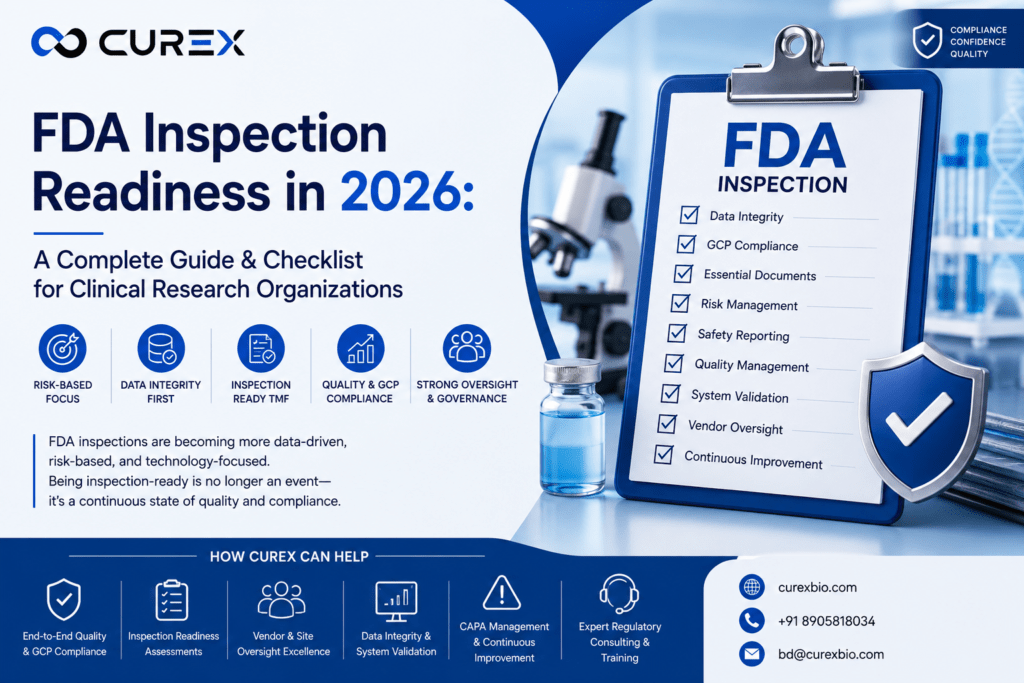
FDA inspection readiness in 2026 is no longer just a compliance requirement—it is a core operational capability that defines how efficiently a clinical research organization, sponsor, or biotech company functions under regulatory scrutiny.
In today’s environment, inspectors don’t just evaluate documents. They evaluate systems, behaviors, data integrity, and vendor ecosystems. That means organizations must demonstrate readiness across clinical development, data management, pharmacovigilance, regulatory affairs, and quality systems at all times.
CROs such as Curexbio play a central role in building this readiness by integrating clinical operations with regulatory compliance frameworks.
What FDA Inspection Readiness Means in 2026
FDA inspection readiness is the continuous state of compliance preparedness where every process, dataset, and decision can withstand real-time regulatory inspection.
In modern clinical research, this includes:
- Clinical trial execution and oversight
- Clinical data management systems (CDMS/EDC)
- Pharmacovigilance and safety reporting
- Biostatistics and PK/PD analysis
- Medical writing and regulatory documentation
- Vendor and site oversight systems
Organizations that operate with structured CRO support—such as clinical monitoring, centralized lab services, and data validation provided by Curexbio—are significantly better prepared for FDA inspections because compliance is embedded across workflows.
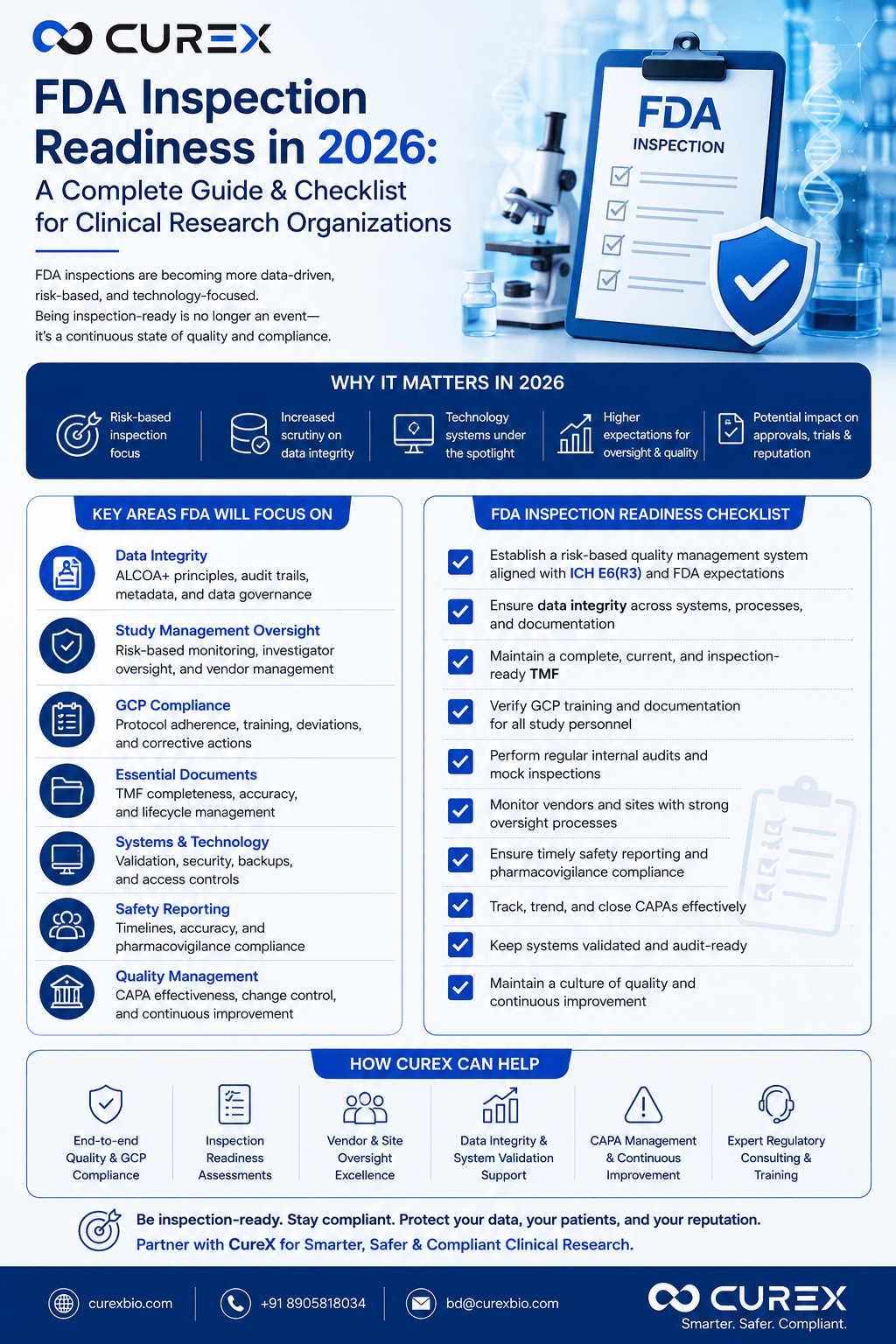
Why Inspection Readiness Is Now a Daily Operating System
FDA expectations in 2026 are shaped by one major shift: continuous oversight instead of periodic audits.
That means inspection readiness must be built into daily operations, not treated as a final checkpoint.
In practical terms, organizations must maintain:
- Real-time clinical trial monitoring
- Continuous TMF quality control
- Automated data validation systems
- Centralized safety surveillance (PV systems)
- Integrated regulatory documentation workflows
CRO partners now act as an extension of sponsor quality systems. For example, Curexbio supports clients through clinical development services, site management, and centralized monitoring models, ensuring compliance is maintained throughout the trial lifecycle—not just during audits.
FDA Regulatory Environment in 2026: Digital + Risk-Based Oversight
FDA inspection methodology is evolving toward data-driven and risk-based evaluation models. Inspectors now focus heavily on:
- Electronic audit trails
- System validation of EDC/CTMS/eTMF
- Risk-based quality management systems (RBQM)
- Vendor oversight documentation
- Safety reporting accuracy
This evolution is particularly important for CRO-driven trials, where multiple systems interact simultaneously.
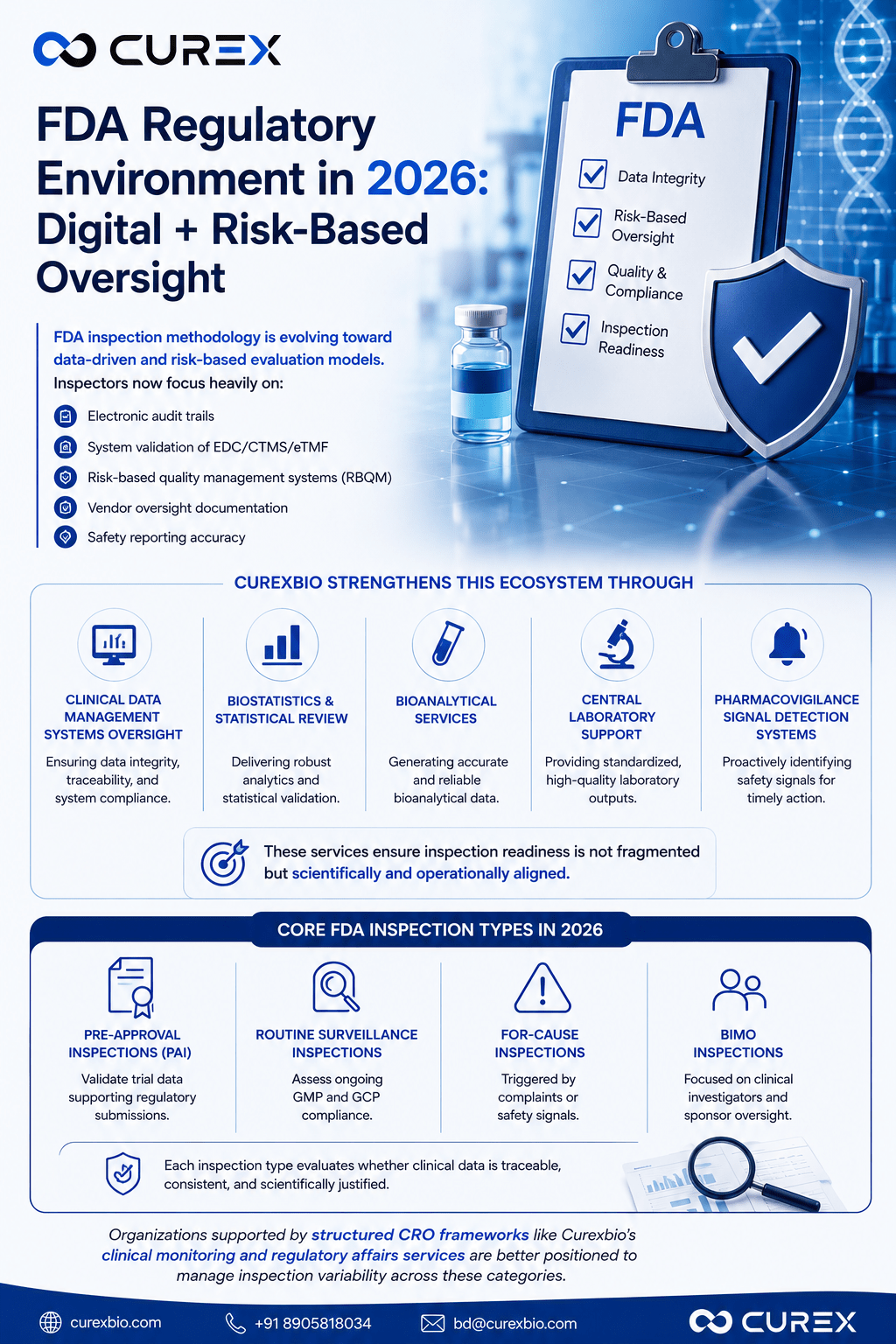
Curexbio strengthens this ecosystem through integrated services such as:
- Clinical data management systems oversight
- Biostatistics and statistical review
- Bioanalytical services for data accuracy
- Central laboratory support for standardized outputs
- Pharmacovigilance signal detection systems
These services ensure inspection readiness is not fragmented but scientifically and operationally aligned.
Core FDA Inspection Types in 2026
FDA inspections typically fall into four major categories:
- Pre-Approval Inspections (PAI) – Validate trial data supporting regulatory submissions
- Routine Surveillance Inspections – Assess ongoing GMP and GCP compliance
- For-Cause Inspections – Triggered by complaints or safety signals
- BIMO Inspections – Focused on clinical investigators and sponsor oversight
Each inspection type evaluates whether clinical data is traceable, consistent, and scientifically justified.
Organizations supported by structured CRO frameworks like Curexbio’s clinical monitoring and regulatory affairs services are better positioned to manage inspection variability across these categories.
Pre-Inspection Readiness Framework (Sponsors + CROs)
1. Documentation and Data Integrity Systems
FDA expects documentation to tell a complete, traceable scientific story.
This includes:
- Clean and complete Trial Master File (TMF)
- Validated electronic systems (EDC, CTMS, eTMF)
- Audit trails with no gaps or overwrites
- Cross-linked records between protocols, deviations, and CAPAs
Curexbio supports sponsors through medical writing services and regulatory documentation systems, ensuring consistency between clinical data, submissions, and audit readiness requirements.
2. Personnel and Inspection Behavior Training
Inspection readiness is not just about documents—it is about people.
Teams must be trained to:
- Respond concisely without speculation
- Explain scientific rationale behind decisions
- Escalate technical queries to SMEs
- Demonstrate protocol understanding during interviews
Curexbio’s clinical operations teams reinforce this through site management and clinical monitoring training frameworks, ensuring investigators and site staff are aligned with GCP expectations.
During FDA Inspection: Execution Strategy
When FDA inspectors arrive, execution discipline determines outcomes.
Key steps include:
- Immediate credential verification
- Controlled escort to inspection room
- Activation of inspection response team
- Structured document request tracking
- Real-time SME availability
A strong CRO partner like Curexbio ensures clinical monitoring teams, regulatory experts, and data managers are synchronized, enabling fast and accurate response to inspector queries.
Post-Inspection: FDA 483 Response Strategy
After inspection, FDA may issue Form 483 observations.
Strong responses must include:
- Root cause analysis
- Corrective and preventive actions (CAPA)
- Supporting documentation updates
- Timeline-based remediation plans
- Leadership accountability
Curexbio supports clients with pharmacovigilance systems, regulatory affairs expertise, and clinical data reconciliation, ensuring responses are not only compliant but scientifically robust.
FDA Inspection Readiness Checklist (2026)
Clinical & Data Systems
- Validated EDC and clinical data systems
- Clean and traceable TMF
- Integrated biostatistics review
- Bioanalytical data consistency checks
Clinical Operations
- Clinical development oversight
- Site management and monitoring reports
- Protocol deviation tracking
- Risk-based monitoring system
Safety & Regulatory
- Pharmacovigilance reporting system active
- Signal detection and risk evaluation
- Regulatory submissions aligned with FDA standards
- Medical writing documentation consistency
Quality Systems
- CAPA effectiveness tracking
- Vendor qualification records
- Audit readiness documentation
- Inspection simulation completed
Curexbio’s integrated services across clinical development, pharmacovigilance, biostatistics, regulatory affairs, and central lab support directly strengthen each of these checklist areas.
Common FDA Inspection Gaps in 2026
Most inspection findings arise from:
- Weak vendor oversight in outsourced trials
- Incomplete or inconsistent TMF documentation
- Delayed safety reporting
- Poor integration between clinical and regulatory teams
- Lack of real-time data reconciliation
Curexbio addresses these gaps through a fully integrated CRO model, combining clinical operations, data management, and regulatory compliance under one system.
How CROs Strengthen Inspection Readiness
Modern CROs are no longer just service providers—they are compliance partners.
Curexbio supports inspection readiness through:
- Clinical monitoring and centralized oversight
- Medical writing and regulatory documentation
- Pharmacovigilance and safety reporting systems
- Biostatistics and PK/PD analysis
- Bioanalytical and central lab services
- Clinical site management and trial execution support
This integrated model ensures that every stage of clinical development is FDA inspection-ready by design.
Conclusion
FDA inspection readiness in 2026 is no longer about preparing for an audit—it is about building a permanent compliance ecosystem.
Organizations that integrate clinical operations, data management, pharmacovigilance, and regulatory affairs into a unified system consistently perform better during inspections.
With end-to-end CRO support from Curexbio, sponsors can achieve continuous FDA readiness across clinical trials, ensuring smoother inspections, faster approvals, and higher data integrity standards.
FAQs
- What is FDA inspection readiness in 2026?
It is the continuous ability to demonstrate compliance across clinical, regulatory, and quality systems at any time. - Why is CRO support important for inspection readiness?
CROs provide structured oversight across clinical development, data management, and regulatory compliance. - What services help improve FDA readiness?
Clinical monitoring, pharmacovigilance, medical writing, biostatistics, and regulatory affairs services. - What are the biggest FDA focus areas?
Data integrity, risk-based quality systems, and vendor oversight. - How does Curexbio support inspection readiness?
Through integrated CRO services including clinical development, PV, regulatory affairs, biostatistics, and central lab support.


