
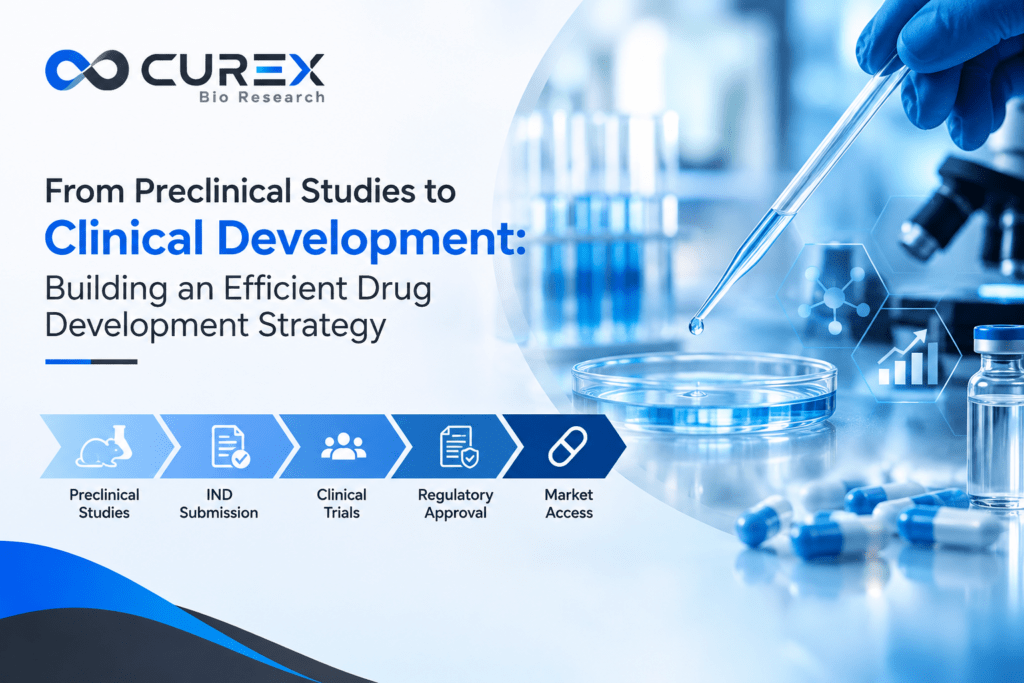
The transition from a validated drug candidate to an approved therapy is lengthy and challenging, often taking over a decade with attrition rates exceeding 90% from IND filing to final approval. Efficient programs versus those that face regulatory or operational delays depend significantly on the planning of the preclinical-to-clinical transition.
This blog analyzes the transition in clinical and regulatory processes, detailing scientific and procedural milestones essential for every program. It identifies risk factors that often hinder timelines and presents the strategic framework utilized by global clinical trial partners like CurexBio to maintain the alignment of clinical development programs from initial human dosing to pivotal trial outcomes.
The Scientific Foundation: What Regulators Expect Before Human Exposure
Before administering a single dose to humans, sponsors must gather preclinical evidence to demonstrate to regulatory authorities that the expected benefits outweigh the risks of clinical investigation.
- Pharmacology research focuses on elucidating the mechanisms of action of compounds and demonstrating proof-of-concept efficacy in appropriate models.
- GLP toxicology studies, including single- and repeat-dose toxicity, genotoxicity, and, where applicable, reproductive and developmental toxicity
- Pharmacokinetic and toxicokinetic characterization, establishing absorption, distribution, metabolism, and excretion (ADME) profiles
- Safety pharmacology studies assessing cardiovascular, respiratory, and central nervous system effects
The ICH M3(R2) and S-series guidelines structure the preclinical package, emphasizing that regulatory reviewers will assess not only individual studies but also the overall dataset’s consistency. They will evaluate if the proposed starting dose, dosing interval, and monitoring plan logically align with nonclinical findings. Programs that approach this as a narrative rather than just a checklist generally experience a smoother review process.
Where Efficient Programs Diverge from Delayed Ones
- Translational Alignment
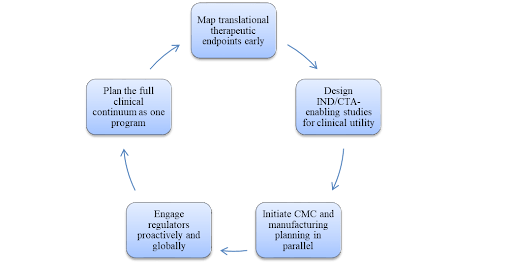
Efficient programs define the translation of preclinical biomarkers to clinically meaningful outcomes early on. Pharmacodynamic markers identified in animal models must be measurable, validated, and interpretable in human trials. Delaying this mapping until Phase 1 often leads to costly mid-study adjustments.
- IND/CTA-Enabling Studies
Toxicology and safety pharmacology studies must align with regulatory requirements while directly supporting clinical programs. They should inform starting dose selection through NOAEL calculations, anticipate dose-limiting toxicities, and guide safety monitoring for first-in-human studies. Finalizing study designs without clinical and regulatory team input often results in compliance data that lacks strategic value.
- CMC Development
Chemistry, Manufacturing, and Controls (CMC) are essential for drug development, encompassing process development, formulation, stability testing, and scale-up for clinical materials. Initiating CMC planning only post-preclinical studies often creates delays for IND submissions, making it a critical path. Conducting CMC alongside late-stage nonclinical work is a strategic advantage for sponsors.
- Early and Iterative Regulatory Engagement
Pre-IND meetings and informal regulatory interactions enable sponsors to refine their development plans prior to costly pivotal studies. Early dialogue with regulators on study design, patient populations, and endpoint selection is preferred, as late engagement often raises concerns only after protocols are finalized.
- Adaptive, Integrated Clinical Trial Design
Modern clinical development now prefers seamless Phase 1/2 designs, adaptive dose-escalation methods, and biomarker-driven enrichment strategies to expedite definitive results while maintaining statistical and safety integrity. Isolating Phase 1 design from the larger Phase 2/3 strategy often leads to protocol amendments and mismatches in patient populations.
Common Failure Points Across the Development Continuum
Clinical development programs frequently face delays due to several avoidable issues, including inadequate data sharing among preclinical and clinical teams, underestimation of GMP manufacturing scale-up timelines, late-stage regulatory and biostatistical input, lack of contingency plans for preclinical safety signals, and vendor selection primarily based on cost without proper operational diligence. Addressing these challenges necessitates a comprehensive systems-level perspective throughout the development pathway, which many sponsors find challenging to uphold internally.
CurexBio offers global clinical trial services that address continuity challenges by integrating preclinical translational strategy, IND/CTA-enabling study design, CMC and supply chain planning, regulatory strategy across key and emerging markets, and clinical trial execution into a cohesive pathway, rather than relying on separate vendor interactions.
- Cross-functional risk review entails the assessment of preclinical and translational data for our clinical and regulatory significance from the initial stages, emphasizing compliance.
- Global regulatory coordination aims to create a harmonized strategy among the FDA, EMA, and other regional authorities. This initiative is designed to minimize duplicative submissions and address misaligned requirements.
- Parallel-track planning involves sequenced operations in CMC, nonclinical, and clinical workstreams running concurrently when scientifically beneficial.
- Operational execution is supported by a multi-region site and vendor network, leveraging an established global footprint to reduce start-up timelines across various geographies.
- A single accountable partner coordinates through an integrated team across the full development continuum, avoiding the need to reconcile inputs from multiple disconnected providers.
At Curexbio, our team offers preclinical development services and end-to-end clinical research solutions under one roof—from clinical trial management and monitoring to pharmacovigilance, bioanalytical support, clinical development, central laboratory services, and regulatory affairs. Backed by experienced consultants across diverse domains, we deliver tailored solutions that help sponsors navigate every stage of the clinical development journey with confidence and efficiency.
By using an integrated model from preclinical planning to multi-region clinical execution, CurexBio aids sponsors in minimizing fragmentation and reactive decision-making, which often increase unplanned time and costs in drug development.


