
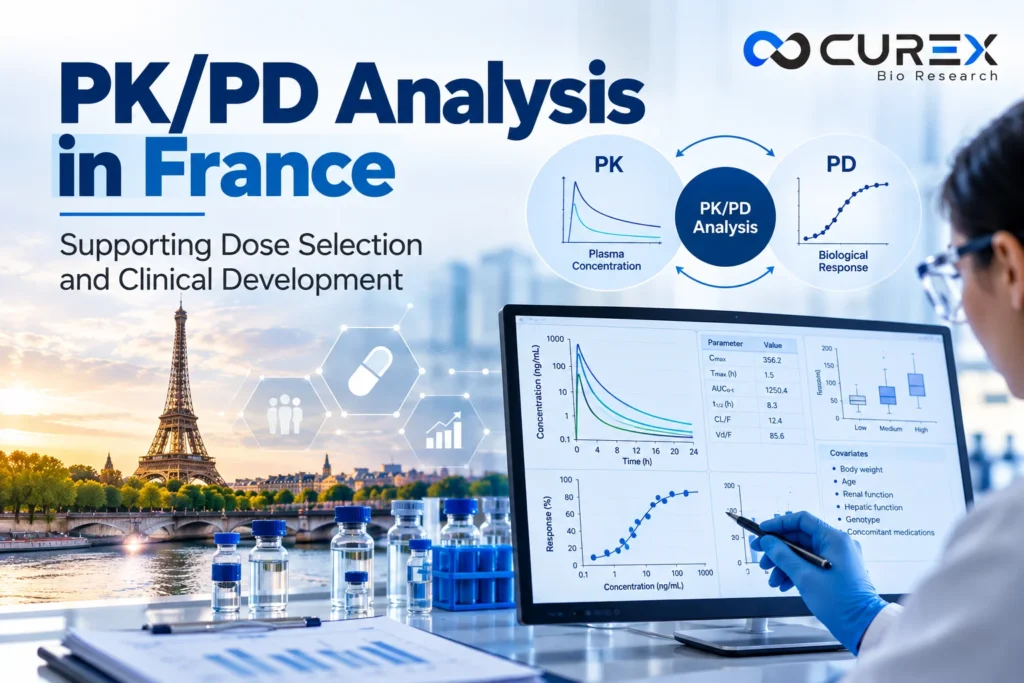
One of the most important decisions in drug development is determining the right dosage. An insufficient dose may limit a drug’s effectiveness in Phase 2, while an excessive dose can trigger safety concerns and delay clinical development. PK/PD analysis in France helps pharmaceutical and biotechnology companies make evidence-based dosing decisions by linking drug exposure to therapeutic effects and safety outcomes. This approach supports dose selection, optimizes clinical trial design, and strengthens development strategies for sponsors conducting clinical research in France.
Table of Contents
TogglePK/PD Analysis in France: Understanding Its Role in Drug Development
PK is the study of how a drug is absorbed, distributed, metabolized, and eliminated by the body. Target engagement, biomarker response, efficacy, and side effects are all described by PD. PK/PD analysis connects the two, providing answers to queries like:
- How much drug exposure is needed to achieve the desired biological effect?
- How variable is exposure between patients, and what drives that variability?
- Where does the therapeutic window sit between efficacy and tolerability?
- Will a dosing regimen proposed for one population hold up in another?
Dose selection, trial design, and regulatory strategy are all directly benefit from these responses.
Historically, oncology programs used the maximum tolerated dose to determine treatment levels. However, this method often fails to identify the optimal dose, particularly in targeted therapies and biologics. Recognizing this, regulators and sponsors now favor model-informed approaches, which enable exploration of multiple dose levels and schedules in silico prior to patient and budget commitments.
Well-planned PK and PD studies assist sponsors in justifying starting doses and escalation schemes in first-in-human trials, selecting doses for Phase 2 studies, supporting Phase 3 regimen choices, evaluating dose adjustments for various patient factors, and facilitating bridging between different formulations and populations.
Core methods used in PK/PD support
- Non-compartmental analysis (NCA) is essential for early-phase pharmacokinetics (PK) reporting, offering key parameters like Cmax, AUC, half-life, and clearance from concentration-time data.
- Population PK modeling utilizes nonlinear mixed-effects models to characterize typical PK behavior and measure variability among patients. These models also identify influencing covariates, like weight, age, organ function, or genotype, affecting drug exposure, even in scenarios with limited data.
- Exposure-response analysis connects exposure metrics with efficacy and safety endpoints, enabling teams to define the therapeutic window and assess whether altering the dose could enhance the benefit-risk balance.
- Physiologically based pharmacokinetic (PBPK) models combine drug properties and human physiology to predict exposure in special populations and drug-drug interactions, frequently prior to the availability of clinical data.
- Clinical trial simulation involves testing candidate designs and dosing regimens under realistic assumptions to help teams anticipate power, variability, and risk prior to finalizing a protocol.
France is a key center for clinical research in Europe, characterized by robust academic institutions, a skilled investigator community, and a comprehensive regulatory system. Clinical trials follow the EU Clinical Trials Regulation, with processes managed through the Clinical Trials Information System (CTIS) and involving the French National Agency for Medicines and Health Products Safety (ANSM) along with ethics committees. Regulators expect scientifically justified dose rationale, and model-informed drug development is gaining traction in scientific consultations. Consequently, for sponsors, PK/PD evidence plays a crucial role in regulatory narratives, addressing questions on dosing, scheduling, and target populations.
Where PK/PD analysis adds value across development
- Preclinical to first-in-human: Translating animal pharmacokinetic and pharmacodynamic data into a safe initial dose for first-in-human trials, ensuring clear exposure margins and a justified rationale for dose escalation.
- Phase 1. Characterizing single and multiple-dose PK, food effects, drug interactions and early PD biomarkers.
- Phase 2. Using exposure-response analysis and simulation to narrow dose options before the pivotal program.
- Phase 3 and beyond. Confirming dose rationale, supporting labeling statements for special populations, and informing post-approval dose optimization.
CurexBio provides sponsors with PK/PD analysis in France to aid in dose selection and clinical development decisions for studies in France and Europe.
PK/PD strategy and study design input
- Non-compartmental and population PK analysis
- Exposure-response modelling
- Clinical trial simulations to compare dosing scenarios
- Scientific reporting for clinical study reports, regulatory submissions and scientific advice briefing documents
Our goal is to simplify complex pharmacometric outputs into actionable recommendations for clinical, regulatory, and executive teams.
Practical Tips for Sponsor:
- Early planning of sampling is crucial, as timely PK and PD sampling enhances modeling effectiveness.
- Clearly define the decision needed from the model and determine the necessary data accordingly.
- Collect pertinent covariates like body weight, renal and hepatic function, concomitant medications, and relevant biomarkers to improve model quality.
- Engage modeling experts before finalizing the protocol, as minor design adjustments can prevent significant analytical issues later.
- Ensure transparent documentation of assumptions, as regulators appreciate clear model qualifications, diagnostics, and sensitivity analyses.
Planning a clinical program in France? Contact CurexBio to discuss how PK/PD analysis in France can support your dose selection and development strategy.


