
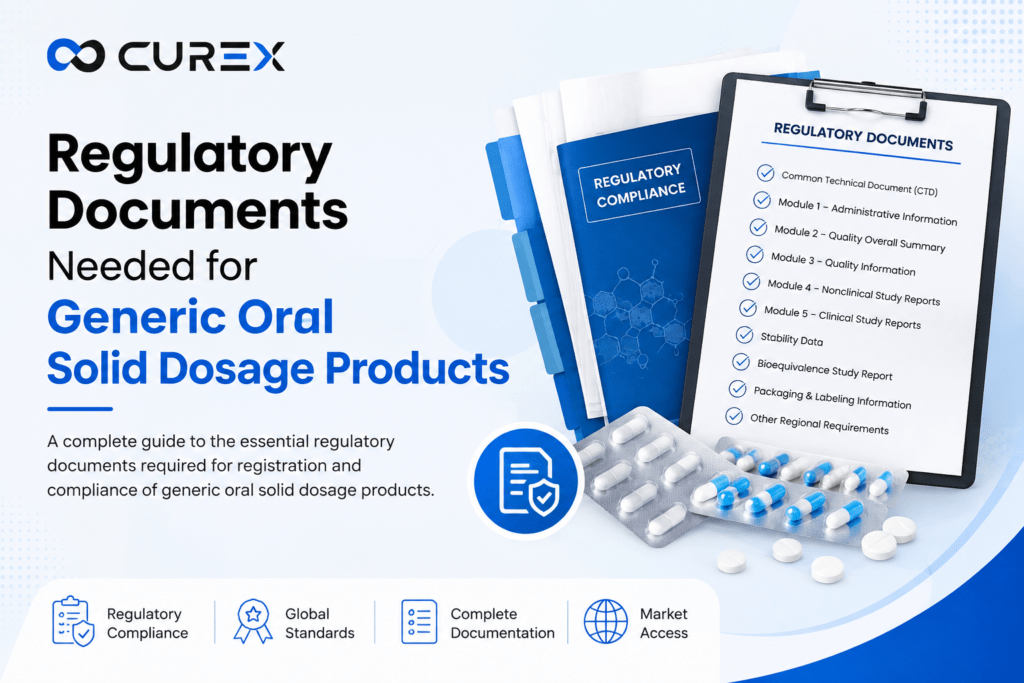
Generic oral solid dosage (OSD) products, including tablets and capsules, comprise a significant portion of the global pharmaceutical market. To obtain approval, manufacturers must provide comprehensive regulatory documents that establish quality, safety, efficacy via bioequivalence, and consistency with reference drugs. Although requirements differ by region, with variations like FDA ANDA in the US and EMA in Europe, submissions usually adhere to the Common Technical Document (CTD) format. The text outlines the key regulatory documents necessary for generic OSD products.
Table of Contents
ToggleModule 1 – Administrative and Regional Information
This region-specific module includes:
Accurate and current labeling is crucial for application forms, cover letters, patient information leaflets, environmental assessments, authorization letters, and patent information, particularly for US ANDAs. Labeling must match the reference product while incorporating any approved differences.
Module 2 – Common Technical Document Summaries
Key summaries include the Quality Overall Summary (QOS), Clinical Overview and Summary (focused on bioequivalence and literature support), and Nonclinical Overview and Summary (typically literature-based for standard generics). These documents collectively offer assessors a clear and concise narrative of the entire dossier.
Module 3 – Quality (CMC Documentation)
This module provides detailed information for OSD products, covering drug substance (API) data, drug product composition, manufacturing processes, and stability data. It includes comparative dissolution profiles, specifications validation, and batch analysis data. Comprehensive CMC documentation is essential to demonstrate the generic product’s pharmaceutical equivalence and consistent quality.
Module 4 – Nonclinical Study Reports
For conventional generic OSD products, applicants typically do not need new nonclinical studies. They can rely on literature references demonstrating the safety of the active ingredient and provide justifications for the lack of new studies.
Module 5 – Clinical Study Reports
This module is crucial for generic approvals, encompassing bioequivalence study protocols, clinical study reports, statistical analysis plans with results showing equivalence in absorption, dissolution data for biowaiver requests, case report forms, subject listings, and safety data. Properly conducted BE studies significantly influence approval timelines.
Additional Supporting Documents
Authorities may require Risk Management Plans, details on pharmacovigilance systems, GMP certificates or inspection history for manufacturing sites, Certificates of Suitability (CEP) or Drug Master Files (DMF/ASMF) references, and justification for any differences from the reference product, depending on market and product complexity.
CurexBio Supports These Requirements
Preparing a comprehensive and submission-ready dossier for generic oral solid dosage products requires specialized knowledge in regulatory strategy, medical writing, clinical development, and quality documentation.
CurexBio provides comprehensive support across these areas, including:
- Regulatory strategy and gap assessments for generic OSD submissions
- Medical writing for protocols, clinical study reports, CTD Module 2 summaries, and full dossier preparation
- Clinical development and bioequivalence study support
- Quality and compliance documentation aligned with global regulatory expectations
Our team assists generic manufacturers in creating clear and regulator-ready documents to minimize queries and facilitate smoother approvals. CurexBio is prepared to support documentation and clinical needs for regulatory submissions of generic oral solid dosage products.
Contact us at bd@curexbio.com to discuss how we can assist with your next generic OSD project.


