
Bringing a new medicine from the laboratory to patients is one of the most complex scientific endeavors in modern healthcare. A single drug candidate can require more than a decade of research, extensive clinical testing, and billions of dollars in investment before it receives regulatory approval. Despite these efforts, many promising compounds fail during development due to inadequate efficacy, unexpected toxicity, poor pharmacokinetics, or regulatory challenges.
At the center of every successful drug development program lies one essential capability: bioanalytical services. These services generate the high-quality scientific data needed to understand how a drug behaves in biological systems. From measuring drug concentrations in plasma to evaluating biomarkers that predict therapeutic response, bioanalytical testing provides the evidence that drives informed decisions throughout the drug development lifecycle.
As pharmaceutical companies, biotechnology innovators, and contract research organizations (CROs) race to develop safer and more effective therapies, the demand for advanced bioanalytical expertise continues to grow. Modern technologies such as LC-MS/MS, ligand-binding assays, and high-throughput analytical platforms have transformed the speed and precision of bioanalysis, enabling sponsors to accelerate timelines without compromising data integrity.
In this comprehensive guide, you’ll learn:
- What bioanalytical services are and why they matter
- How bioanalysis supports every phase of drug development
- Why pharmaceutical companies increasingly outsource bioanalytical testing
- The role of pharmacokinetic analysis, biomarker testing, and method validation
- How robust bioanalytical data accelerates regulatory approval
- Best practices for selecting the right bioanalytical partner
Whether you’re developing a small molecule, biologic, biosimilar, vaccine, or advanced therapy, understanding the role of bioanalytical services can help reduce development risks and improve the chances of regulatory and commercial success.
What Are Bioanalytical Services?
Bioanalytical services encompass the scientific methods and laboratory techniques used to detect, identify, and quantify drugs, metabolites, biomarkers, and biological molecules within biological samples. Unlike traditional analytical chemistry, which often focuses on testing pharmaceutical products or raw materials, bioanalysis measures compounds in complex biological matrices to understand how a therapy behaves inside the human body.
These services support every stage of drug development, from early discovery through post-marketing surveillance. The resulting data is fundamental for evaluating a drug’s safety, efficacy, pharmacokinetic profile, and overall clinical performance.
Common Biological Samples Used in Bioanalysis
Bioanalytical laboratories routinely analyze a wide range of biological matrices, including:
- Plasma
- Serum
- Whole blood
- Urine
- Cerebrospinal fluid (CSF)
- Saliva
- Tissue samples
- Synovial fluid
- Cell lysates
- Dried blood spots (DBS)
The choice of sample depends on the therapeutic area, route of administration, study objectives, and regulatory requirements.
What Do Bioanalytical Services Measure?
Modern bioanalytical laboratories evaluate:
- Drug concentrations
- Active metabolites
- Biomarkers
- Proteins
- Peptides
- Monoclonal antibodies
- Nucleic acids
- Hormones
- Cytokines
- Anti-drug antibodies (ADA)
The resulting data helps researchers answer fundamental questions such as:
- Is the drug absorbed efficiently?
- How long does it remain in circulation?
- Does it reach the intended target tissue?
- How is it metabolized?
- Is the selected dose appropriate?
- Is the treatment producing the desired biological response?
Without reliable bioanalytical data, answering these questions accurately would be impossible.
Where Bioanalytical Services Fit in Drug Development
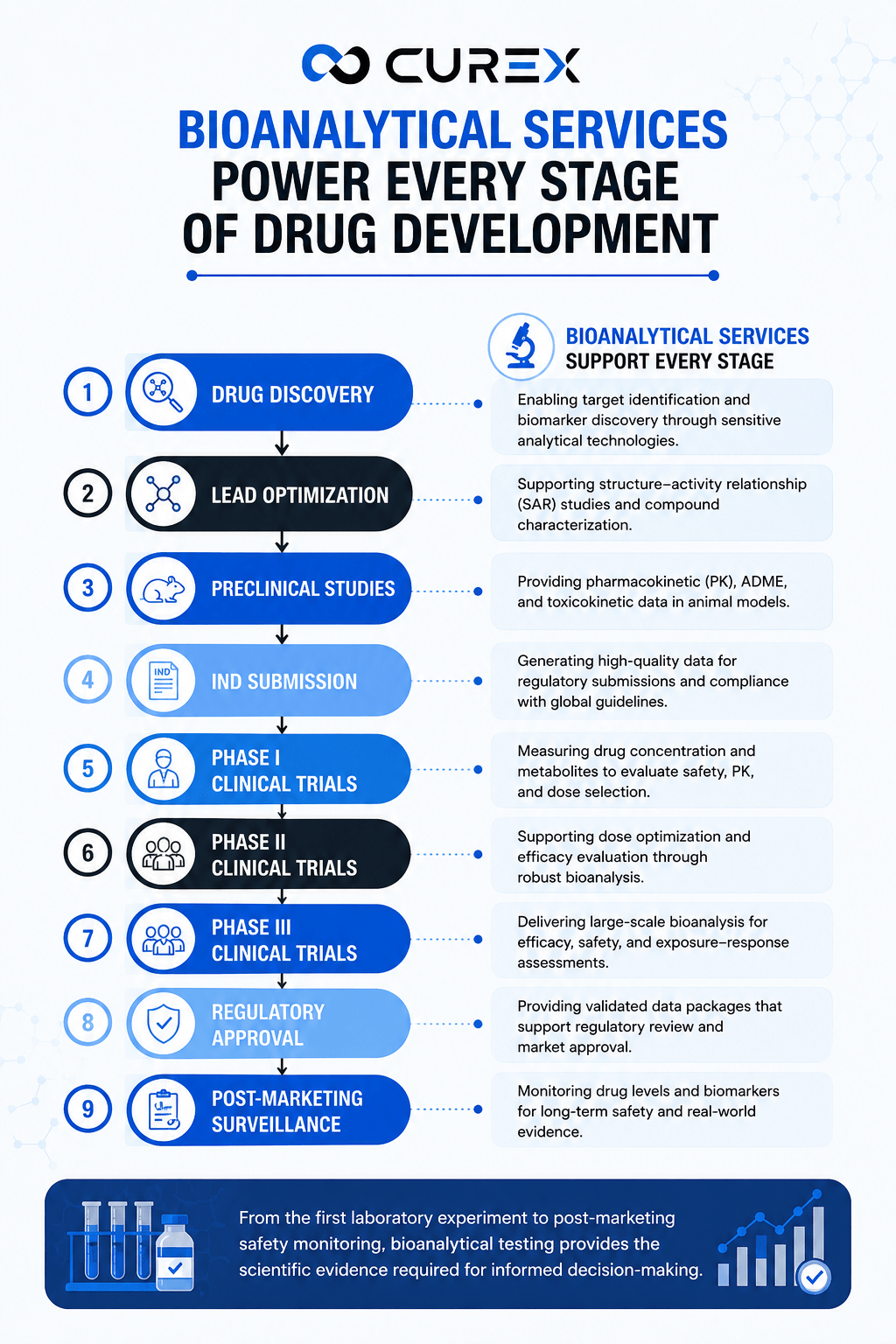
Why Are Bioanalytical Services Critical for Drug Development?
Developing a new therapeutic product involves answering hundreds of scientific and regulatory questions. Bioanalytical services provide the evidence needed to answer those questions with confidence.
Imagine a promising drug candidate that shows excellent activity in laboratory experiments. Before advancing to clinical trials, researchers must determine whether the compound can be absorbed into the bloodstream, reach its intended target, maintain therapeutic concentrations, and be eliminated safely. Each of these questions depends on accurate bioanalytical testing.
Without robust bioanalytical data, development teams risk making decisions based on incomplete or misleading information, which can lead to failed studies, increased costs, and regulatory delays.
Why Bioanalysis Matters Throughout Development
1. It supports informed decision-making.
Reliable data enables researchers to optimize dosing strategies, refine study designs, and prioritize the most promising candidates.
2. It improves patient safety.
Monitoring drug exposure helps identify potential toxicity and supports the selection of safe dosing regimens.
3. It demonstrates therapeutic effectiveness.
Bioanalytical testing confirms whether drug concentrations achieve the levels needed for a clinical effect.
4. It reduces development risks.
Early identification of pharmacokinetic or analytical issues allows teams to make adjustments before large-scale clinical trials.
5. It strengthens regulatory submissions.
Health authorities require scientifically validated, reproducible data to evaluate the safety and efficacy of investigational products.
Ultimately, bioanalytical services are not simply laboratory procedures—they are strategic tools that influence every major decision in drug development.
How Bioanalytical Services Accelerate Every Stage of Drug Development
Drug development is a continuous process in which data from one stage informs the next. Bioanalytical services provide that continuity by delivering consistent, high-quality information from discovery through commercialization.
1. Drug Discovery: Identifying the Right Candidate
Drug discovery begins with thousands of potential compounds, but only a small fraction advance to preclinical testing. Bioanalytical scientists help researchers identify the most promising candidates by measuring drug exposure, metabolic stability, and early pharmacokinetic behavior.
Bioanalytical Activities During Drug Discovery
- Screening candidate molecules
- Measuring compound concentrations
- Assessing metabolic stability
- Evaluating target engagement
- Early biomarker assessment
- Supporting structure-activity relationship (SAR) studies
Why It Matters
Early bioanalytical insights help eliminate weak candidates before significant resources are invested, reducing development costs and improving overall efficiency.
2. Preclinical Development: Building the Foundation for Human Studies
Before a drug can be tested in humans, it must undergo rigorous preclinical evaluation to establish an initial understanding of its safety profile and biological behavior.
Bioanalytical laboratories generate data that supports toxicology studies, pharmacokinetic assessments, and Investigational New Drug (IND) applications.
Key Bioanalytical Activities
- Toxicokinetic analysis
- Dose proportionality studies
- Metabolite profiling
- Tissue distribution studies
- Exposure-response assessment
- Stability testing
Benefits
Accurate preclinical bioanalysis helps researchers:
- Select appropriate first-in-human doses
- Predict potential safety concerns
- Optimize formulation strategies
- Generate high-quality regulatory documentation
Bioanalytical Support Across the Drug Development Lifecycle
| Development Stage | How Bioanalytical Services Help |
|---|---|
| Drug Discovery | Compound screening, metabolism, biomarker identification |
| Preclinical | Toxicokinetics, PK analysis, dose selection |
| Phase I | Human pharmacokinetics, safety monitoring |
| Phase II | Dose optimization, biomarker validation |
| Phase III | Large-scale sample analysis, regulatory data generation |
| Regulatory Submission | Validated analytical reports, compliance documentation |
| Post-Marketing | Therapeutic monitoring, long-term safety evaluation |
3. Clinical Development: Turning Data into Decisions
Once an investigational drug enters human trials, the volume and complexity of bioanalytical work increase significantly. Thousands of biological samples may be collected across multiple sites, each requiring precise analysis under validated methods.
During clinical development, bioanalytical services support:
- Pharmacokinetic (PK) profiling
- Pharmacodynamic (PD) evaluations
- Biomarker analysis
- Immunogenicity testing
- Therapeutic drug monitoring
- Population PK studies
These data help clinical teams answer critical questions:
- Is the selected dose achieving therapeutic exposure?
- Are drug concentrations consistent across patient populations?
- Do biomarkers indicate the expected biological response?
- Are there safety concerns related to drug accumulation or variability?
Rapid and reliable bioanalytical results allow sponsors to make evidence-based decisions, adapt study designs, and progress confidently through clinical phases.
How Bioanalytical Services Improve Clinical Trial Success
Clinical trials are expensive, time-sensitive, and highly regulated. Even minor analytical errors can delay timelines or compromise study outcomes.
Bioanalytical services improve clinical trial success by:
- Delivering accurate concentration data
- Supporting adaptive trial designs
- Reducing assay variability
- Enhancing patient safety monitoring
- Strengthening data integrity
- Enabling faster database lock
- Supporting robust statistical analyses
- Facilitating global regulatory submissions
High-quality bioanalysis not only improves operational efficiency but also increases confidence in the scientific conclusions drawn from clinical data.


