
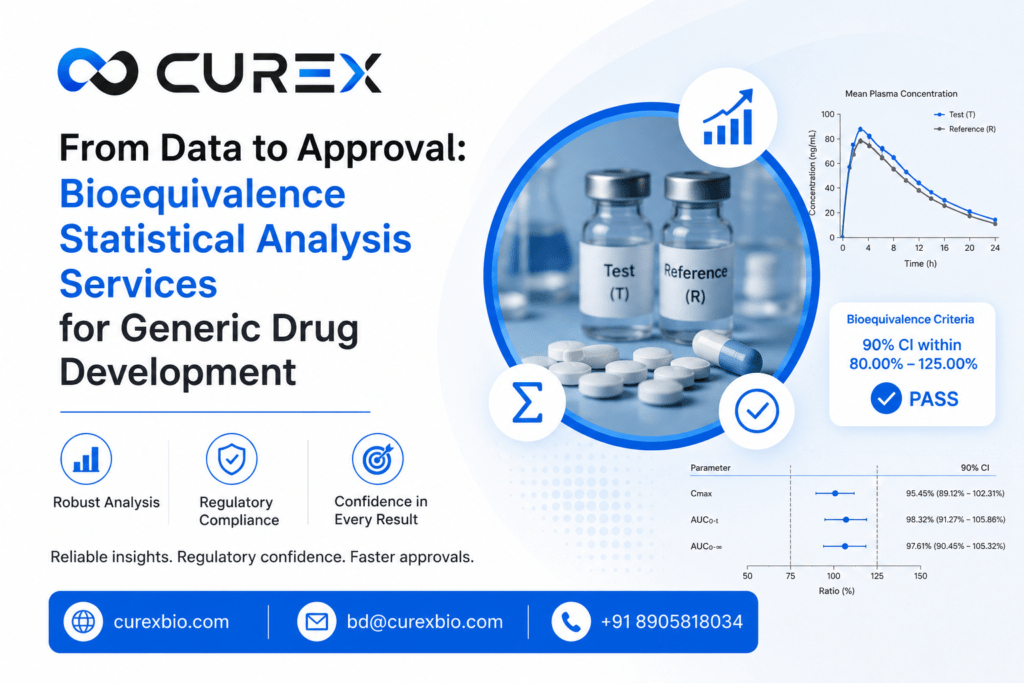
In the pharmaceutical industry, bioequivalence serves as the scientific and legal basis for generic drug approval. The success of an Abbreviated New Drug Application (ANDA) hinges on whether a proposed generic product performs nearly identically to its Reference Listed Drug (RLD). For companies aiming to meet the 2026 regulatory requirements, the key lies in the rigor, transparency, and precision of their bioequivalence (BE) statistical analysis.
As the US FDA and EMA harmonize standards under ICH M13A, statistical analysis is pivotal for regulatory success, transforming pharmacokinetic data into inspection-ready evidence. This blog discusses the statistical principles, regulatory expectations, and best practices in modern bioequivalence analysis, highlighting how CurexBio offers specialized biostatistical services to aid generic drug approval.
Table of Contents
ToggleThe 90% Confidence Interval Standard
At the core of BE assessment is the two one-sided test (TOST) procedure, which determines bioequivalence by confirming that the 90% confidence interval for the ratio of key pharmacokinetic parameters (Cmax and AUC) of the test product relative to the reference product is within the regulatory limits of 80.00% to 125.00%.
This framework applies a natural logarithmic transformation of pharmacokinetic (PK) parameters to normalize their distribution, enabling valid multiplicative ratio comparisons. The primary analysis employs ANOVA or linear mixed-effects models to consider fixed effects of sequence, period, and treatment, while treating subjects as a random effect nested within sequences. A thorough analysis should present a coherent narrative as per FDA expectations, showcasing design discipline and data traceability, with conclusions easily linked to specific tables in the clinical study report and raw data.
Understanding RSABE, NTI Drugs, and Biosimilars
Modern drug development often requires advanced statistical approaches due to complexities that exceed the standard 80–125% rule.
Reference‑Scaled Average Bioequivalence (RSABE) for Highly Variable Drugs (HVDs)
For drugs with high within-subject variability (≥30% CV), the standard 80–125% confidence interval might be too conservative, risking the rejection of genuinely equivalent generics due to biological noise. The FDA has developed responses to this issue.
Reference‑Scaled Average Bioequivalence (RSABE) approach:
This method adjusts bioequivalence (BE) acceptance limits according to the variability of the reference product, offering a scientifically sound approval pathway. Acceptable high variability drugs (HVD) must meet these scaled BE limits and a geometric mean ratio constraint. Advanced, model-integrated BE methods improve the robustness and reliability of RSABE analyses, especially for drugs with complex pharmacokinetic (PK) profiles, such as long half-lives.
Narrow Therapeutic Index (NTI) and Complex Products
For Narrow Therapeutic Index drugs, which can experience serious therapeutic failures or adverse reactions from small dosage or concentration changes, the standards for bioequivalence are significantly stricter. These drugs necessitate tighter bioequivalence limits and replicate study designs to ensure high assurance of sameness. Similar principles are also being applied to complex products like topical medications, with the FDA providing guidance on using physicochemical and structural characterization to demonstrate bioequivalence.
Biosimilars
The statistical principles of bioequivalence are crucial in biosimilar development. The FDA recommends using various study designs, like the 2×2 crossover and more complex setups, to demonstrate interchangeability, highlighting the importance of analytical work in the evidence package.
Avoiding Common Statistical Pitfalls
A comprehensive BE analysis entails not only performing statistical tests but also exercising foresight and discipline to sidestep regulatory pitfalls that could nullify the study.
- a) The Analysis Plan Trap: One common and preventable issue is an inadequately specified Statistical Analysis Plan (SAP), which should be completed and ideally signed before database lock. Deviations from this plan, such as post-hoc changes to the analysis set, modifications to the statistical model, or unplanned outlier analyses, raise significant concerns for reviewers.
- b) Outlier Management Without Anecdote: Outlier subjects’ data management by sponsors is closely examined. Data removal must adhere to scientifically defined, pre-established criteria documented in the protocol and SAP, detailing how to identify an outlier and the objective methods for including or excluding data.
- c) The “All Subjects” Principle: A core regulatory principle is that all treated subjects should be included in statistical analyses, and any exclusion of data necessitates a strong scientific justification rather than an operational one.
CurexBio Delivers Inspection‑Ready BE Analysis
CurexBio offers specialized biostatistics services for bioequivalence, facilitating compliance and clarity in regulatory submissions for generic drug development.
Contact our team at bd@curebio.com to learn about bioequivalence statistical analysis services that provide inspection-ready evidence for your generic drug product ANDA submission.


