
The pharmaceutical industry is facing increasing pressure to deliver safe and effective therapies within shorter timelines while maintaining strict regulatory compliance. As clinical trials become more global, complex, and data-intensive, pharmaceutical companies are increasingly turning to Clinical Research Organizations (CROs) for specialized support.
CROs play a critical role in accelerating drug development by offering integrated expertise across clinical trial management, regulatory affairs, data analytics, and patient safety monitoring.
End-to-end clinical development services provide a unified approach where a CRO manages the entire clinical lifecycle—from early-phase development to post-marketing surveillance—ensuring consistency, compliance, and operational efficiency.
At Curexbio, these services are designed to support pharmaceutical companies with a fully integrated clinical development ecosystem that improves speed, quality, and regulatory success rates.
Understanding End-to-End Clinical Development Services
End-to-end clinical development services refer to a comprehensive outsourcing model where a CRO manages all stages of clinical research under one coordinated framework.
This includes early-stage development, clinical trial design, clinical data management, statistical analysis, regulatory submissions, and pharmacovigilance support.
Unlike fragmented outsourcing, this model ensures that every function works in alignment, reducing duplication of effort and improving data integrity across the study lifecycle.
Modern pharma companies increasingly prefer this model because it integrates critical functions such as biostatistics services, clinical monitoring, and regulatory documentation support into a single streamlined workflow.
Clinical Drug Development Lifecycle
The clinical development lifecycle is a structured and highly regulated process that transforms a scientific molecule into a market-ready therapy.
It begins with preclinical testing, where compounds are evaluated for toxicity, pharmacokinetics, and biological activity. Only candidates that demonstrate acceptable safety profiles proceed to human trials.
In Phase I, the focus is on safety, dosage, and pharmacokinetics in healthy volunteers. Phase II expands testing into patient populations to assess therapeutic efficacy and optimal dosing strategies.
Phase III trials are large-scale, multi-center studies designed to confirm safety and effectiveness in comparison with existing treatments. These studies generate the core evidence required for regulatory approvals.
Following approval, Phase IV studies and post-marketing surveillance ensure long-term safety monitoring and real-world performance evaluation.
Each stage requires precise coordination between clinical operations teams, regulatory affairs specialists, and data management experts to ensure successful outcomes.
Need Expert Support for Global Clinical Trials?
Curexbio helps pharmaceutical and biotech companies streamline clinical development with integrated regulatory, safety, and data management solutions.
CRO Outsourcing Models in Pharma Industry
Pharmaceutical companies typically adopt different outsourcing strategies depending on project complexity and internal capabilities.
In a full-service CRO model, a single partner manages the entire clinical development process, including clinical trial monitoring, regulatory submissions, and pharmacovigilance services. This model provides strong integration and reduces operational fragmentation.
The Functional Service Provider (FSP) model allows sponsors to outsource specific functions such as clinical data management systems or biostatistics services, while retaining strategic control internally.
A hybrid model combines both approaches, offering flexibility and scalability depending on study requirements.
Curexbio supports all these engagement models, ensuring tailored solutions based on study complexity and therapeutic area.
Core Clinical Development Functional Areas
Clinical development is built on several interconnected functional domains that ensure trial success.
Clinical operations form the backbone of trial execution, covering site selection, investigator management, patient recruitment, and clinical trial monitoring. These activities directly influence study timelines and data quality.
Data management and biostatistics ensure the accuracy and reliability of clinical data. Advanced systems such as electronic data capture platforms support real-time data validation and statistical modeling.
Regulatory affairs ensure compliance with global agencies such as FDA and EMA, managing submissions like INDs, NDAs, and regulatory dossiers. Strong regulatory strategy is essential for avoiding approval delays.
Pharmacovigilance services play a critical role in monitoring patient safety by tracking adverse events and ensuring proper risk mitigation throughout the trial lifecycle.
Medical writing supports documentation requirements, including protocols, clinical study reports, and submission-ready regulatory documents.
Together, these services create a fully integrated clinical development ecosystem that ensures scientific rigor and regulatory alignment.
Improve Trial Efficiency with Integrated CRO Support
From clinical monitoring and medical writing to pharmacovigilance and regulatory affairs, Curexbio delivers scalable clinical development services for global pharma companies.
Clinical Trial Execution Strategy
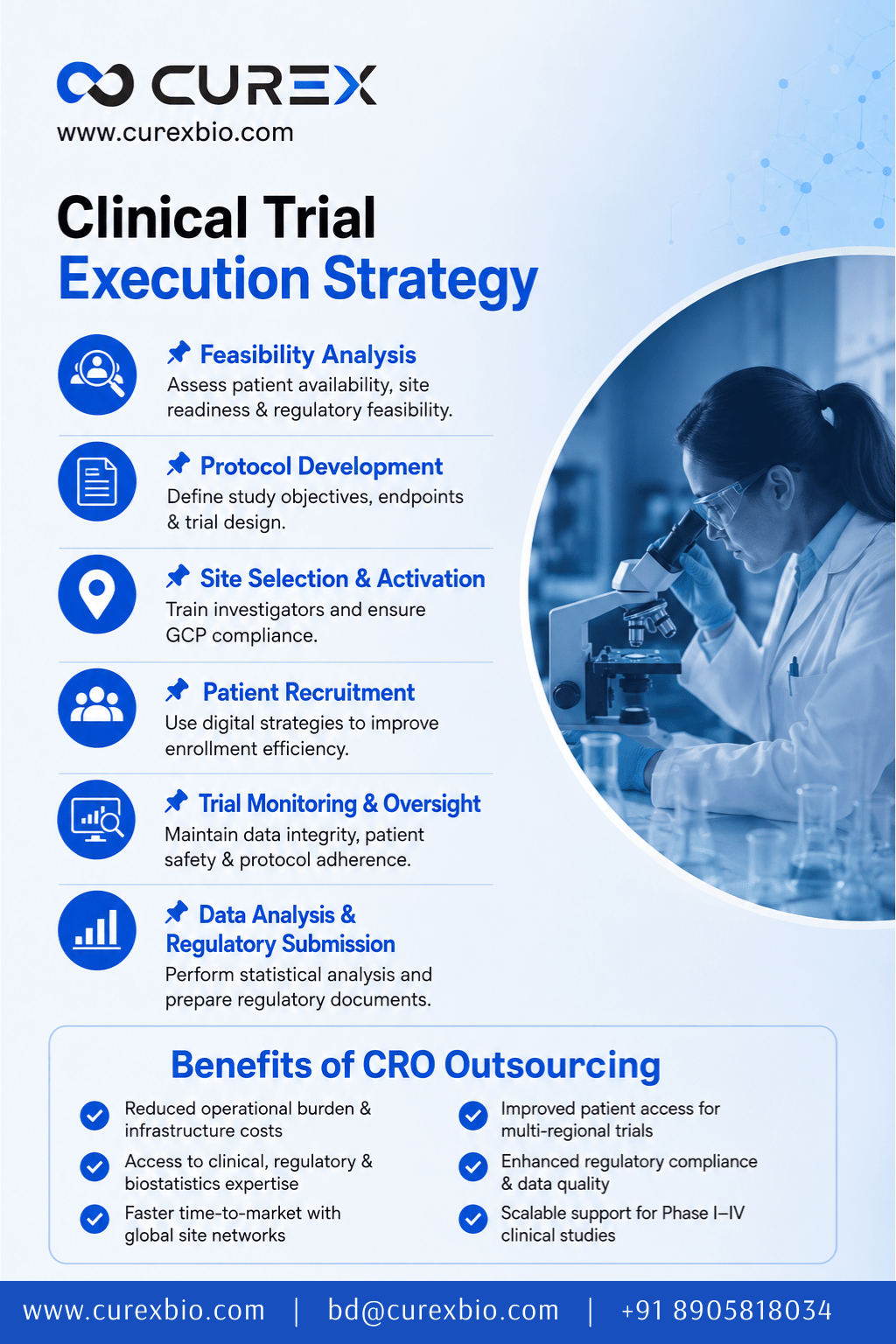
Clinical trial execution is a structured process that requires precision, coordination, and regulatory alignment.
It begins with feasibility analysis, where study viability is assessed based on patient availability, site infrastructure, and regulatory environment. This step is crucial for reducing operational risks later in the trial.
Protocol development follows, defining study objectives, endpoints, and statistical design in collaboration with clinical and regulatory teams.
Site selection and activation ensure that qualified investigators are onboarded and trained to conduct the study according to Good Clinical Practice (GCP) guidelines.
Patient recruitment strategies are then implemented, often supported by digital tools and centralized monitoring systems to improve enrollment efficiency.
During the trial, continuous oversight ensures protocol adherence, data integrity, and patient safety. Many CROs now use risk-based monitoring (RBM) approaches to optimize oversight efficiency.
Once data collection is complete, statistical analysis and interpretation are performed before regulatory submission preparation begins.
Benefits of CRO Outsourcing
Outsourcing clinical development offers multiple strategic advantages for pharmaceutical companies.
It significantly reduces operational burden by eliminating the need for large internal infrastructure while providing access to specialized expertise in clinical trial management, regulatory compliance, and biostatistics services.
CROs also improve time-to-market by leveraging established global site networks and streamlined operational processes.
Another key advantage is access to global patient populations, which is essential for rare disease and multi-regional clinical trials.
Additionally, outsourcing reduces regulatory risk by ensuring compliance with international guidelines and maintaining consistent data quality standards.
Challenges in Clinical Development Outsourcing
Despite its benefits, outsourcing clinical development introduces certain challenges that must be managed effectively.
One major challenge is communication gaps between sponsors and CRO teams, particularly in large-scale global studies.
Data consistency and quality assurance are also critical concerns, especially when multiple sites and systems are involved.
Regulatory complexity across different regions can further increase operational difficulty, requiring strong coordination between regulatory affairs and clinical operations teams.
These challenges highlight the importance of selecting a reliable CRO partner with strong governance and integrated systems.
Emerging Trends in Clinical Development
The clinical research landscape is rapidly evolving due to technological advancements and regulatory modernization.
Artificial intelligence is being used to improve patient recruitment, optimize trial design, and enhance predictive analytics in clinical studies.
Decentralized clinical trials are enabling remote participation through digital platforms, wearable devices, and telemedicine solutions, significantly improving patient accessibility.
Real-world evidence is increasingly being used to support regulatory decision-making by providing insights into how treatments perform in everyday clinical practice.
Risk-based monitoring approaches are replacing traditional site monitoring models, allowing CROs to focus resources on high-risk data points rather than uniform monitoring.
These innovations are reshaping the future of clinical development by making it more efficient, patient-centric, and data-driven.
Looking for a Trusted CRO Partner?
Curexbio provides end-to-end clinical development services including clinical operations, regulatory affairs, pharmacovigilance, biostatistics, and clinical data management for global studies.
How to Choose the Right CRO Partner
Selecting the right CRO partner is one of the most important strategic decisions in clinical development.
Pharmaceutical companies should evaluate CROs based on their expertise in clinical trial execution, regulatory affairs consulting, pharmacovigilance services, and data management capabilities.
Other critical factors include global operational presence, therapeutic experience, technological infrastructure, and proven regulatory success rates.
A strong CRO partner should function as a strategic extension of the sponsor, ensuring alignment across scientific, operational, and regulatory domains.
Curexbio provides integrated clinical development solutions designed to support pharma companies across all phases of drug development.


