
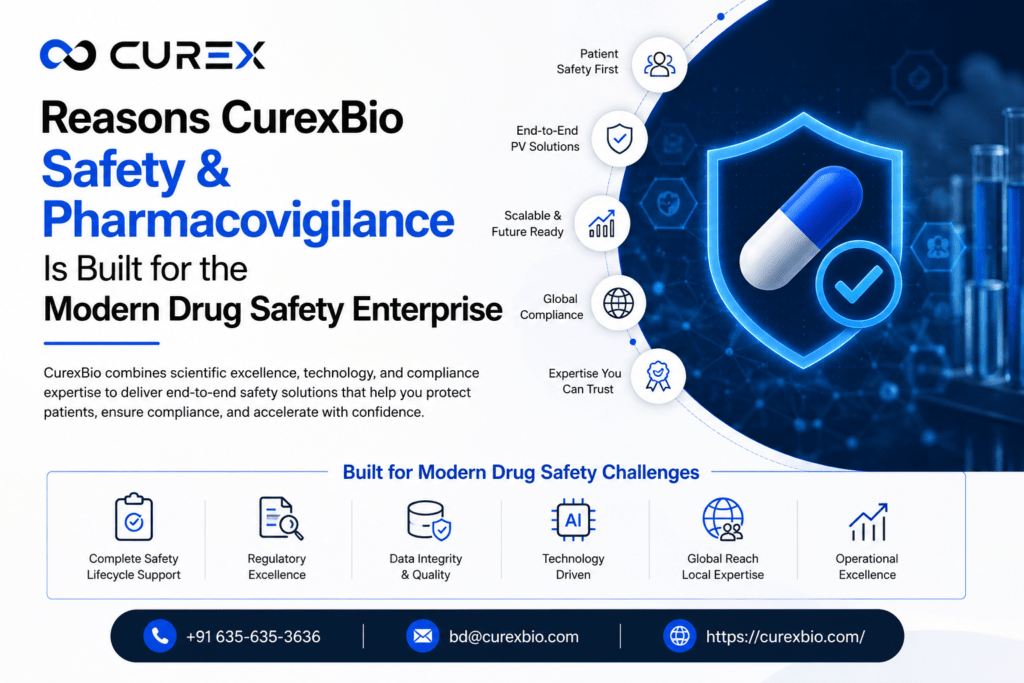
Modern pharmacovigilance services are no longer limited to processing adverse event reports. Today’s pharmaceutical and biotech companies face growing pressure from global regulators, increasing safety data volumes, decentralized clinical trials, AI-driven signal detection requirements, and rising patient safety expectations. The entire drug safety enterprise has evolved rapidly, especially as agencies like the FDA and EMA demand faster reporting timelines, stronger compliance systems, and proactive safety oversight.
That shift is exactly why organizations are moving away from traditional safety vendors and choosing strategic partners with scalable infrastructure, integrated compliance systems, and advanced technology capabilities. CurexBio Safety & Pharmacovigilance has positioned itself as a modern solution for companies seeking reliable, scalable, and globally aligned drug safety operations.
Industry trends show that AI-assisted signal detection, centralized safety operations, and integrated compliance ecosystems are becoming essential for pharmaceutical companies in 2026 and beyond. Organizations now require partners that combine regulatory affairs services, clinical trial support, risk-based monitoring, and quality management systems within one connected operational model.
The Evolution of Pharmacovigilance in the Global Pharma Industry
The pharmaceutical industry has entered an era where drug safety operations are no longer treated as a secondary compliance task. Today, pharmacovigilance services influence every stage of product development, from early clinical trials to post-marketing surveillance and lifecycle management. Regulatory agencies expect continuous safety monitoring, proactive risk mitigation, and transparent communication across global markets. Companies that fail to adapt to these expectations risk delayed approvals, inspection findings, reputational damage, and expensive remediation activities.
Healthcare systems have also become significantly more interconnected. A single pharmaceutical product may launch simultaneously across Europe, the United States, APAC, LATAM, and MENA regions. Every market comes with different reporting timelines, local regulations, language requirements, and safety compliance standards. Managing those complexities manually or through disconnected vendors creates operational inefficiencies that modern pharmaceutical companies can no longer afford.
The growing volume of Individual Case Safety Reports (ICSRs), aggregate reports, literature monitoring requirements, and safety signal detection activities has dramatically changed operational expectations. Safety teams are under constant pressure to improve turnaround times while maintaining strict compliance accuracy. Outdated workflows often create bottlenecks that affect reporting quality and regulatory submissions.
This is where CurexBio Safety & Pharmacovigilance stands apart. Instead of treating safety as an isolated operational function, CurexBio integrates pharmacovigilance, regulatory affairs services, clinical trial monitoring, risk-based monitoring, and quality management systems into a connected compliance ecosystem. This integrated approach helps organizations reduce operational fragmentation while improving inspection readiness and long-term scalability.
Why Traditional Drug Safety Models No Longer Work
Older pharmacovigilance models were designed for slower product launches, smaller safety datasets, and region-specific compliance structures. Those models struggle in today’s environment because pharmaceutical companies now handle massive amounts of structured and unstructured safety data from clinical trials, patient support programs, real-world evidence platforms, and spontaneous reporting systems.
Think of modern pharmacovigilance like air traffic control at a global airport. If communication systems become disconnected or outdated, even small operational issues can quickly escalate into major compliance risks. Drug safety systems work the same way. Delayed reporting, fragmented vendor structures, inconsistent workflows, or disconnected databases can create serious regulatory exposure.
Industry experts increasingly emphasize centralized safety operations supported by advanced analytics and automation. AI-assisted workflows are helping organizations improve real-time safety monitoring, accelerate adverse event identification, and streamline case management activities.
Organizations also require flexibility. Emerging biotech firms may need lean safety infrastructure before commercialization, while global pharmaceutical companies may require scalable multi-region pharmacovigilance outsourcing services. A rigid one-size-fits-all vendor model simply cannot support modern operational requirements.
Strengthen Your Clinical Safety Operations
Need support with clinical monitoring services, medical writing, pharmacovigilance services, clinical data management, or regulatory affairs consulting?
CurexBio’s Global-First Pharmacovigilance Infrastructure
One of the biggest differentiators in modern drug safety operations is the ability to manage both global consistency and local regulatory compliance simultaneously. That balance is difficult because pharmacovigilance requirements differ significantly across regions. Reporting timelines, local language obligations, aggregate reporting standards, and risk management expectations vary widely between the EU, US, LATAM, APAC, and MENA regions.
CurexBio Safety & Pharmacovigilance follows a centralized outsourcing approach supported by localized regulatory expertise. This model helps organizations reduce operational silos while maintaining country-specific compliance standards effectively.
The value of centralized global pharmacovigilance services becomes especially important during rapid expansion phases. Pharmaceutical and biotech companies often launch products across multiple countries within short timeframes. Disconnected local vendors can create inconsistent workflows and reporting standards that increase compliance risk.
Centralized governance improves standardization for:
- Adverse event reporting
- Signal detection workflows
- Literature surveillance
- Risk management plans
- PSUR/PBRER submissions
- Safety database management
- Regulatory communication tracking
At the same time, localized expertise remains critical. Different regions require different regulatory approaches, documentation structures, and submission procedures. Companies that lack regional expertise often struggle during inspections or market expansion activities.
Another important factor is scalability. Safety workloads fluctuate dramatically depending on clinical trial growth, product launches, and post-marketing surveillance demands. Modern pharmacovigilance outsourcing services must scale resources quickly without compromising compliance timelines or reporting accuracy.
Multi-Region Regulatory Support and Local Expertise
Global pharmacovigilance sounds simple in theory, but real-world execution is highly complex. Every regulatory region has unique operational expectations. Europe emphasizes QPPV responsibilities and EudraVigilance compliance. The FDA focuses heavily on timely reporting and inspection readiness. Emerging markets often require country-specific documentation and localized submission pathways.
CurexBio Safety & Pharmacovigilance recognizes that effective safety operations require both centralized coordination and regional specialization. This operational structure allows organizations to maintain global consistency while adapting efficiently to local regulatory expectations.
This model is especially valuable for mid-sized biotech companies entering commercialization. Many smaller organizations lack the internal infrastructure to manage global safety operations independently. Building fully staffed internal drug safety operations teams across multiple regions is expensive and operationally difficult.
By integrating local expertise into centralized governance models, companies can improve compliance consistency, reduce operational risk, and strengthen regulatory responsiveness during inspections and audits.
Looking for a Reliable CRO & Drug Safety Partner?
From clinical trial monitoring and biostatistics services to safety pharmacovigilance, medical writing services, and regulatory affairs support, CurexBio helps sponsors scale confidently.
AI, Automation, and Advanced Signal Detection in Modern PV
Artificial intelligence has become one of the most important innovations in modern pharmacovigilance services. While many organizations still rely heavily on manual review processes, leading pharmaceutical companies are increasingly adopting AI-enabled tools to improve operational efficiency, reporting accuracy, and signal detection performance.
This transformation is not simply about replacing people with automation. Instead, it is about helping safety teams identify meaningful safety trends earlier while reducing operational overload. Current pharmacovigilance systems process enormous amounts of data from spontaneous adverse event reports, literature monitoring platforms, electronic health records, social media channels, and real-world evidence databases.
Human-only review models struggle to scale effectively under that volume. AI-supported technologies help organizations prioritize high-risk cases, automate repetitive workflows, and accelerate signal validation activities.
CurexBio Safety & Pharmacovigilance emphasizes advanced technologies and AI-driven operational strategies to strengthen safety monitoring and modernize compliance workflows.
The pharmaceutical industry is gradually moving toward predictive pharmacovigilance instead of reactive pharmacovigilance. That means organizations are attempting to identify potential safety concerns before they escalate into regulatory findings or public health issues.
Still, technology alone is not enough. One of the biggest misconceptions about AI pharmacovigilance is that automation eliminates the need for experienced safety professionals. In reality, advanced systems still require medical review expertise, regulatory judgment, validated quality controls, and operational oversight.
Organizations increasingly prioritize:
- Automated case intake
- AI-assisted literature screening
- Real-time signal detection
- Workflow standardization
- Cloud-based safety databases
- Regulatory submission automation
- Data integrity monitoring
Companies that delay modernization may struggle to maintain operational efficiency as reporting requirements continue increasing globally.
How Technology Is Reshaping Drug Safety Operations
Technology has fundamentally changed expectations around compliance timelines and operational transparency. Regulators increasingly expect near real-time access to safety data, especially during accelerated approvals or public health emergencies.
Digital transformation also affects inspections. Regulatory agencies now evaluate electronic audit trails, validated systems, cybersecurity practices, and compliance documentation more aggressively than ever before.
This interconnected environment means pharmacovigilance no longer functions independently from the broader quality ecosystem. Modern safety operations now intersect with:
- Regulatory affairs
- Clinical trial management
- Clinical data management systems
- GMP quality systems
- Risk-based monitoring
- Medical writing services
- Inspection readiness
Organizations increasingly prefer integrated partners capable of supporting multiple operational functions under one quality framework.
Risk-Based Quality Systems and Compliance Excellence
Modern pharmacovigilance services require much more than fast case processing. Regulatory agencies expect structured quality systems capable of supporting traceability, inspection readiness, CAPA management, data integrity, and continuous improvement initiatives.
CurexBio positions quality and compliance as foundational elements across its service ecosystem, including GCP compliance, GMP consulting, CSV services, regulatory affairs, and pharmacovigilance support.
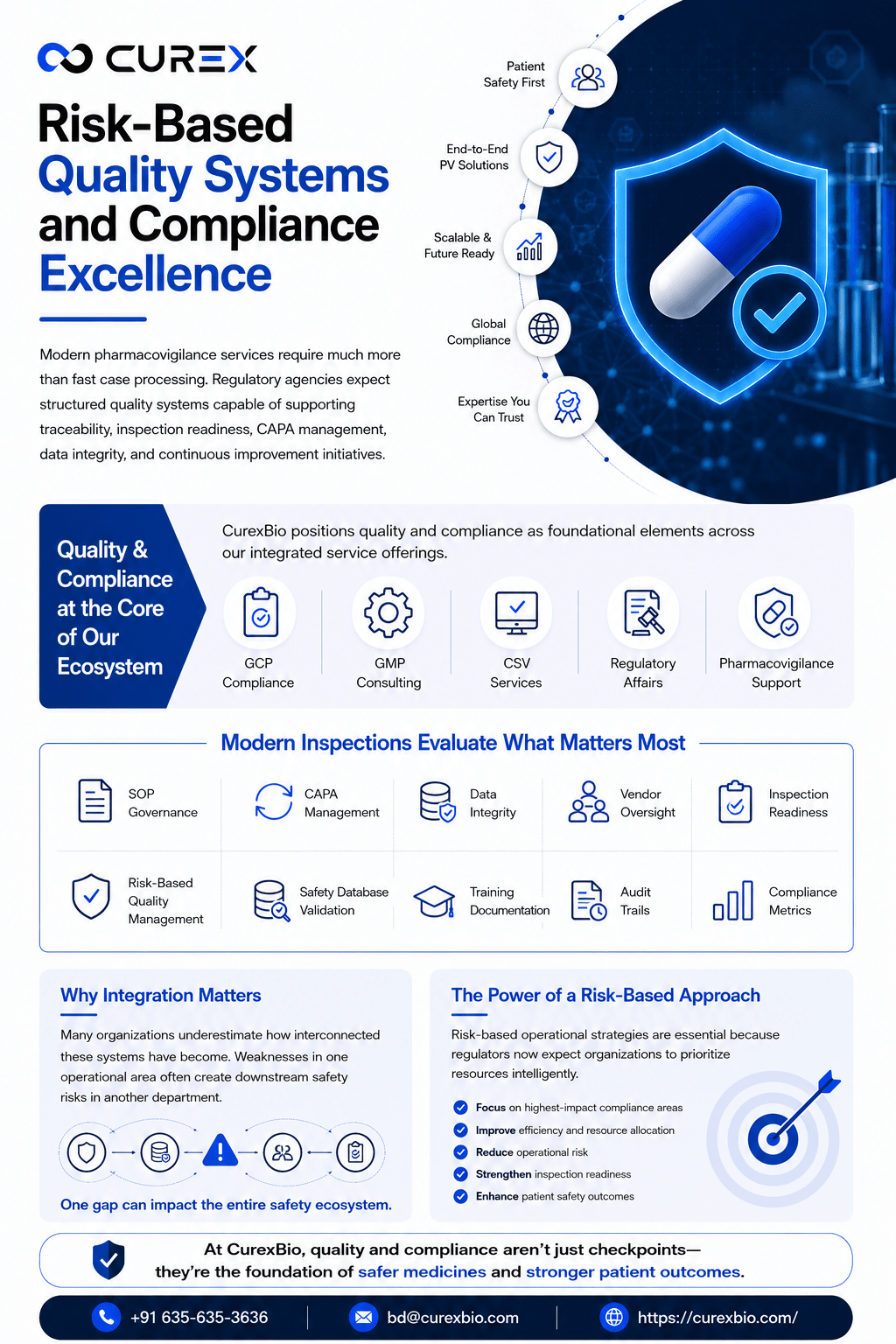
This integrated quality-first approach matters because modern inspections increasingly evaluate:
- SOP governance
- CAPA management
- Data integrity
- Vendor oversight
- Inspection readiness
- Risk-based quality management
- Safety database validation
- Training documentation
- Audit trails
- Compliance metrics
Many organizations underestimate how interconnected these systems have become. Weaknesses in one operational area often create downstream safety risks in another department.
Risk-based operational strategies are especially important because regulators now expect organizations to prioritize resources intelligently instead of applying identical oversight to every workflow. Risk-based methodologies improve efficiency while focusing attention on the highest-impact compliance areas.
Integration with GCP, GMP, and Regulatory Affairs
One of the biggest challenges in life sciences organizations is departmental fragmentation. Clinical operations, regulatory affairs, quality assurance, and pharmacovigilance teams often work independently despite sharing overlapping compliance responsibilities.
CurexBio’s integrated operational model connects:
- GCP compliance
- Regulatory affairs services
- Audit readiness
- GMP consulting
- Risk-based monitoring
- QMS development
- Medical writing support
- CSV services
This interconnected framework improves consistency, strengthens communication, and enhances overall regulatory preparedness.
Why Sponsors and CROs Need Strategic PV Partners in 2026
The pharmaceutical industry in 2026 is moving faster than ever. Accelerated approvals, decentralized trials, biologics expansion, AI-enabled research, and global commercialization strategies are reshaping operational expectations.
Sponsors and CROs now require pharmacovigilance outsourcing services capable of supporting both rapid growth and increasing regulatory complexity. Traditional outsourcing focused primarily on cost reduction. Modern outsourcing decisions prioritize scalability, compliance resilience, technology integration, and strategic flexibility.
Strategic pharmacovigilance partnerships help organizations address:
| Business Challenge | Modern PV Solution |
| Increasing global regulations | Centralized compliance oversight |
| High safety case volumes | AI-enabled workflow optimization |
| Limited internal staffing | Flexible outsourced PV teams |
| Inspection readiness pressure | Integrated quality systems |
| Multi-region product launches | Local regulatory expertise |
| Data integrity requirements | CSV and validated systems support |
The organizations succeeding in today’s environment are those building adaptable, technology-enabled compliance ecosystems rather than reactive operational structures.
Scalability, Cost Efficiency, and Faster Regulatory Readiness
Scalability has become one of the most valuable operational advantages in modern drug safety operations. Safety workloads can change rapidly depending on clinical trial growth, new product approvals, or post-marketing requirements.
Organizations need partners capable of scaling efficiently without compromising compliance standards. Integrated expertise across regulatory affairs, quality management systems, clinical monitoring, and pharmacovigilance services creates operational flexibility for sponsors and CROs.
Cost efficiency also remains important, but organizations increasingly recognize that the cheapest outsourcing model often becomes the most expensive during audits or remediation activities. Strong governance structures reduce long-term compliance risks while improving operational continuity.
Inspection readiness is another growing priority. Regulatory inspections are becoming increasingly data-focused and technology-driven. Companies that maintain validated systems, integrated quality controls, and proactive governance frameworks are far better prepared for agency reviews.
Conclusion
Modern pharmacovigilance services are no longer just regulatory obligations hidden behind paperwork. They have become strategic business functions directly connected to patient safety, regulatory success, operational scalability, and long-term market credibility.
The life sciences industry is rapidly moving toward connected, technology-enabled, globally coordinated safety ecosystems. Pharmaceutical companies now require partners capable of integrating AI-driven pharmacovigilance, centralized operations, local regulatory expertise, quality management systems, risk-based monitoring, and inspection readiness into one cohesive operational framework.
CurexBio Safety & Pharmacovigilance stands out because its approach goes far beyond traditional case processing models. By combining drug safety operations with regulatory affairs, clinical trial support, CSV expertise, audit readiness, and quality governance, the company reflects the future direction of modern pharmacovigilance.
Organizations that invest in scalable, integrated, and future-ready safety infrastructure today will be positioned far more strongly for growth, compliance, and patient trust tomorrow.
Frequently Asked Questions
1. What makes modern pharmacovigilance different from traditional drug safety operations?
Modern pharmacovigilance services focus on centralized global operations, AI-assisted signal detection, proactive risk management, and integrated quality systems instead of only adverse event processing.
2. Why is AI becoming important in pharmacovigilance?
AI pharmacovigilance helps organizations process large safety datasets more efficiently, automate repetitive workflows, improve signal detection accuracy, and accelerate reporting timelines.
3. What are the benefits of outsourcing pharmacovigilance services?
Outsourcing pharmacovigilance services can improve scalability, reduce infrastructure costs, strengthen compliance oversight, and provide access to specialized global expertise.
4. How does CurexBio support global regulatory compliance?
CurexBio supports global compliance through centralized safety operations, local regulatory expertise, quality management systems, audit readiness support, and integrated regulatory affairs services.
5. Why are integrated quality systems important in drug safety?
Integrated quality systems improve operational consistency, strengthen inspection readiness, support data integrity, and enhance governance across pharmacovigilance and broader clinical operations.


