
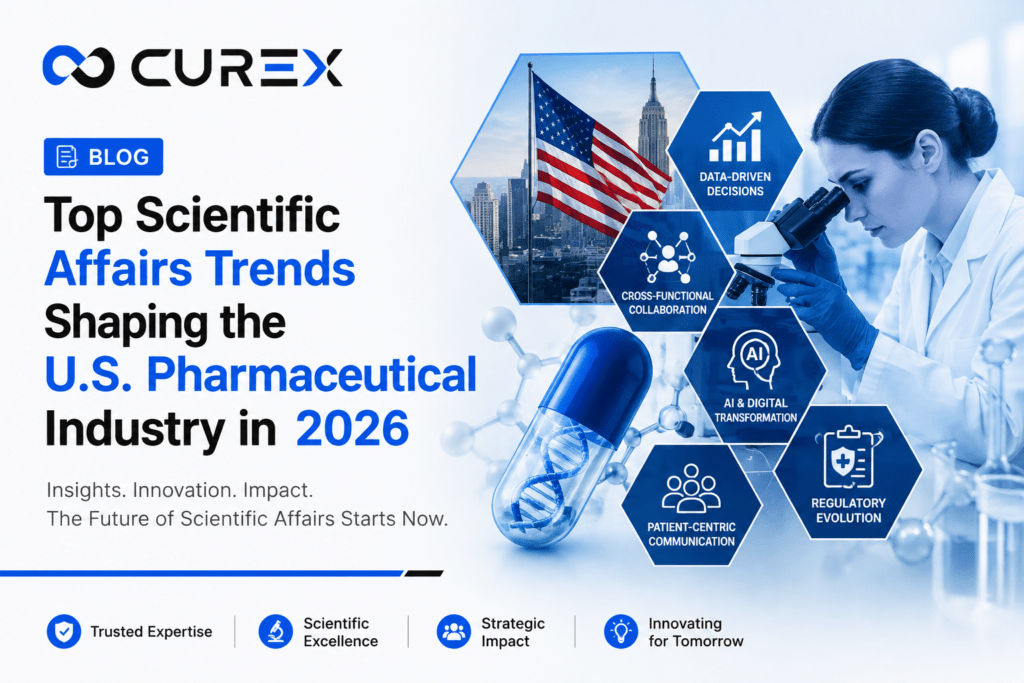
The U.S. pharmaceutical landscape in 2026 is shaped by regulatory changes, technological advancements, cost constraints, and demands for quicker patient access. Scientific Affairs teams play a crucial role in this transformation by connecting clinical data, regulatory strategies, medical communication, and evidence generation, which are essential for supporting clinical trials and development in the industry.
Here are the top scientific affairs trends shaping the industry this year:
Table of Contents
ToggleUse of AI for Protocol Design and Medical Content:
Artificial intelligence is now integral to daily operations, being utilized for protocol optimization, informed consent forms, medical writing support, and real-time risk detection. AI tools enhance scientific and medical writing teams, improving documentation speed and consistency while ensuring human oversight for accuracy and regulatory compliance. This evolution affects Medical Writing for Pharmaceutical Companies, raising the demand for high-quality Pharmaceutical Medical Writing Services that combine AI efficiency with expert judgment.
Innovative and Adaptive Trial Designs
Rising trial costs and complexity are diminishing the viability of traditional fixed designs in favour of adaptive designs, basket trials, Bayesian approaches, and “living protocols.” These methods aim to reduce sample sizes, expedite decision-making, and enhance efficiency. Scientific Affairs teams are essential in justifying these designs, ensuring they align with regulatory expectations, and effectively communicating their rationale in protocols and submissions.
Use of Real world data and secondary data
The industry is enhancing the integration of historical trial data and real-world sources. Scientific Affairs professionals are focused on incorporating secondary data into development strategies supporting external control arms, and creating strong evidence packages to satisfy regulatory and payer requirements. This trend reinforces the scientific narrative across the product lifecycle.
Focus on inspection readiness and quality oversight
As ICH guidelines evolve, including E6(R3), Scientific Affairs must prioritize data integrity, documentation, and quality oversight. Risk-based monitoring and data review are increasingly essential, necessitating enhanced collaboration among medical, clinical, and quality functions.
Healthcare professionals and scientific communications
Healthcare professionals are increasingly utilizing digital and AI-based information. In response, Scientific Affairs teams are enhancing the clarity and accessibility of medical content while upholding scientific standards and supporting compliant, evidence-based omnichannel medical communication strategies.
Cost and complexity management
Clinical Research Trends 2026 indicates that trial timelines are pressured despite increasing complexity. Scientific Affairs enhances this by optimizing early study design, ensuring feasible protocols, and producing high-quality clinical reports and regulatory summaries, thus reducing queries and rework.
CurexBio offers tailored Scientific Affairs, Clinical Development, and Medical Writing services for pharmaceutical and biotech companies focused on 2026 priorities. Our offerings include protocol development, comprehensive medical writing services (such as protocols and clinical study reports), scientific oversight, and regulatory-aligned documentation that conforms to U.S. and global standards.
By integrating scientific knowledge with regulatory insight, CurexBio aids organizations in creating precise and submission-ready scientific documentation while adapting to evolving Pharmaceutical Industry Trends in 2026. It emphasizes that successful companies will view scientific affairs as a crucial strategic function that enhances decision-making and regulatory integrity during times of technological and policy changes. CurexBio is prepared to assist organizations refining clinical development, medical writing, or scientific oversight.
Contact us at bd@curexbio.com to explore how our Scientific Affairs and Medical Writing services can assist pharmaceutical companies in navigating the U.S. pharmaceutical landscape.


