
Bioanalysis is crucial in drug development, providing validated methods to measure drug concentrations and biomarkers before patient administration. This foundational analysis informs dosing, safety, and regulatory decisions. As the field evolves, particularly with the adoption of the ICH M10 framework and upcoming FDA guidance on biomarker validation, the need for specialized bioanalytical services has surged, especially with the rise of complex therapeutics like antibody-drug conjugates and gene therapies.
This blog discusses the essential pillars of bioanalytical method development and validation, current regulatory expectations, and how CurexBio provides the scientific rigor and compliance necessary for regulatory success.
The Foundational Role of Bioanalytical Testing
Bioanalytical testing measures drugs, metabolites, or biomarkers in biological matrices like blood, plasma, and urine, crucial for understanding pharmacokinetics (PK) and toxicokinetics (TK). It informs dosing regimens and safety margins by ensuring drug concentrations are optimal: too low risks ineffectiveness, while too high can lead to toxicity. This testing supports modality-specific quantitation across various therapeutics, facilitating drug disposition monitoring throughout the development process.
Core Bioanalytical Methods: Chromatography and Ligand-Binding Assays
Bioanalytical quantification is categorized into two primary technology platforms, each characterized by unique applications and validation needs
- LC-MS/MS (Liquid Chromatography–Tandem Mass Spectrometry) is the preferred method for quantifying small molecules, metabolites, and specific peptides in complex biological samples due to its exceptional sensitivity, selectivity, and speed. It is particularly effective for detecting analytes at low concentrations in matrices such as plasma and serum. Recent advancements are also enhancing its capability to analyze complex substances like antibody-drug conjugates (ADCs) and oligonucleotides, which are increasingly important in drug development.
- Ligand Binding Assays (LBAs), such as ELISA-based immunoassays, are crucial for quantifying biologics like monoclonal antibodies in complex matrices. They play a significant role in immunogenicity testing, including the screening and characterization of anti-drug antibodies and neutralizing antibody assays, which assess the safety and efficacy of biologic drugs.
- Many complex development programs necessitate a hybrid analytical approach, combining the strengths of LC-MS/MS and LBA technologies to address the specific needs of each therapeutic entity.
The Method Development & Validation Lifecycle
A reliable bioanalytical result relies on a well-engineered method, as per the ICH M10 guideline, which emphasizes that method development is a critical phase requiring an understanding of the analyte’s physicochemical properties and its interactions with biological matrices.
- Method development optimizes parameters based on the molecule type (small, large, or novel therapeutic), the biological matrix (plasma, urine, tissue), and the calibration range to ensure accurate detection limits. This phase is crucial for data quality and assay robustness.
- ·Method validation ensures that analytical methods are accurate, precise, and reproducible, focusing on key parameters like linearity, accuracy, precision, selectivity, recovery, and stability. For chromatographic methods, selectivity requires testing across various biological matrices, including lipemic and hemolyzed samples. Incurred sample reanalysis (ISR) has broadened its scope to include first-in-human trials and special population studies, outlining procedures for when ISR acceptance criteria fail.
- Partial and cross-validation practices are specified in M10. Partial validation is advised for modifications to validated methods, while cross-validation is necessary when integrating data from different laboratories or studies. International best practices are formalizing the transfer of analytical methods between laboratories to maintain method performance across boundaries.
- Biomarker assays have unique regulatory requirements and a distinct pathway for analytical validation, differing from drug concentration assays. Labs need to identify the appropriate regulatory framework for each context.
Regulatory Landscape: ICH M10 and 2026 FDA Guidance
The ICH M10 guideline, adopted in May 2022, is now the international standard for bioanalytical method validation in regulatory submissions, providing harmonization and addressing inconsistencies in regional guidelines across North America, Europe, and Asia.
On April 10, 2026, the FDA released final guidance titled “Bioanalytical Method Validation for Biomarkers.” This guidance assists sponsors in validating methods to assess biomarker concentrations for various submissions such as INDs, NDAs, BLAs, ANDAs, and supplements, and also aids in developing methods for nonclinical study samples. It aligns with the FDA’s current perspectives and complements ICH M10, primarily focused on PK method validation.
A flexible, risk-based approach to validation is central to modern regulatory philosophy, as recommended by industry bodies like the European Bioanalysis Forum. This “context-of-use” (CoU) approach dictates that validation levels correspond to the assay’s intended purpose, with lean validation suitable for early-stage discovery and full validation necessary for pivotal clinical trials. By incorporating these frameworks into validation protocols, modern CROs ensure that bioanalytical data is scientifically sound and ready for regulatory submission.
Common Bioanalytical Challenges and How Expert CROs Overcome Them
Bioanalysis faces significant challenges, notably the matrix effect, where endogenous substances in samples interfere with analyte detection, and isobaric interference, which affects LC-MS/MS specificity due to compounds having identical mass-to-charge ratios.
Soluble target interference can lead to inaccurately low drug concentration measurements for large molecules, while anti-drug antibodies (ADAs) may interfere with analyte measurement. Emerging modalities like ADCs and oligonucleotides face additional challenges due to unstable metabolites and complex binding interactions.
An experienced partner optimizes method development by carefully preparing samples, selecting matrix-matched calibration standards, and conducting rigorous selectivity testing.
CurexBio Delivers End-to-End Bioanalytical Excellence
CurexBio provides comprehensive bioanalytical support services tailored for contemporary drug development, covering pre-clinical, central lab, and extensive GxP-regulated bioanalysis.
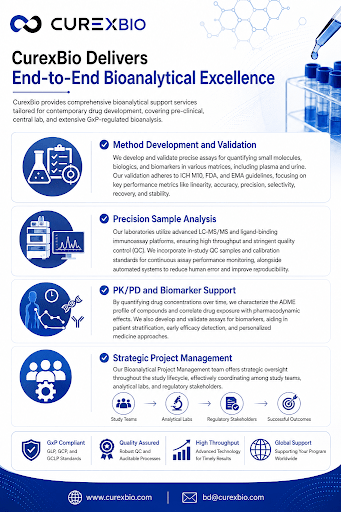
We at CurexBio, in association with the affiliated and recognized vendors, offer this range of services:
- ü Method Development and Validation: We develop and validate precise assays for quantifying small molecules, biologics, and biomarkers in various matrices, including plasma and urine. Our validation adheres to ICH M10, FDA, and EMA guidelines, focusing on key performance metrics like linearity, accuracy, precision, selectivity, recovery, and stability.
- ü Precision Sample Analysis: Our laboratories utilize advanced LC-MS/MS and ligand-binding immunoassay platforms, ensuring high throughput and stringent quality control (QC). We incorporate in-study QC samples and calibration standards for continuous assay performance monitoring, alongside automated systems to reduce human error and improve reproducibility.
- ü PK/PD and Biomarker Support: By quantifying drug concentrations over time, we characterize the ADME profile of compounds and correlate drug exposure with pharmacodynamic effects. We also develop and validate assays for biomarkers, aiding in patient stratification, early efficacy detection, and personalized medicine approaches.
- ü Strategic Project Management: Our Bioanalytical Project Management team offers strategic oversight throughout the study lifecycle, effectively coordinating among study teams, analytical labs, and regulatory stakeholders.
CurexBio offers bioanalytical support across various development stages, from non-GLP analysis for early characterization to GLP-compliant PK/TK studies and rigorous GxP-compliant sample analysis during clinical trials, adapting to specific regulatory and scientific requirements.
We offer precision, compliance, and strategic insight to transform bioanalytical data into regulatory confidence. Ready to Strengthen Your Bioanalytical Foundation? Contact us on bd@curexbio.com, and ensure your regulatory submission is based on precision and data integrity regarding method development and validation.


