
The global generic pharmaceutical industry continues to grow rapidly as healthcare systems seek cost-effective treatment options and governments promote access to affordable medicines. As competition intensifies and regulatory expectations become more demanding, generic drug manufacturers face increasing pressure to accelerate development timelines while maintaining compliance across multiple markets.
Success in generic drug development depends on much more than bioequivalence studies and manufacturing excellence. Regulatory documentation, scientific communication, clinical reports, and submission-ready content play a critical role in securing approvals and achieving successful product launches.
This growing complexity has elevated the importance of medical writing services. Today, leading medical writing companies in India are no longer viewed simply as document providers. They have become strategic partners helping generic pharmaceutical companies navigate regulatory pathways, improve submission quality, and accelerate market entry.
Organizations like CurexBio support sponsors with specialized medical writing expertise, regulatory knowledge, and integrated clinical research services designed to streamline generic drug development from planning through approval.
The Growing Complexity of Generic Drug Development
Many people assume generic drug development is simpler than developing a new molecular entity. While generic programs generally involve lower development risk, they still require extensive documentation and strict regulatory compliance.
Manufacturers must prepare numerous documents throughout the development lifecycle, including:
- Bioequivalence study protocols
- Clinical study reports
- Regulatory submission documents
- Informed consent forms
- Investigator brochures
- Safety narratives
- Product dossiers
- Scientific justifications
Regulatory agencies expect these documents to be scientifically accurate, internally consistent, and fully compliant with submission requirements.
Even minor inconsistencies can create review delays, regulatory questions, or additional information requests. As generic companies expand into global markets, documentation requirements become even more demanding.
This environment explains why many manufacturers increasingly partner with specialized medical writing providers.
Why India Has Become a Global Hub for Medical Writing Services
India has emerged as one of the world’s leading destinations for pharmaceutical and clinical research outsourcing. The country offers a unique combination of scientific expertise, regulatory knowledge, and operational scalability.
Medical writing companies in India support pharmaceutical sponsors across:
- Generic drug development
- Clinical research
- Regulatory affairs
- Pharmacovigilance
- Medical communications
- Publication support
Several factors contribute to India’s growing prominence.
Strong Scientific Talent Pool
India produces a large number of professionals with backgrounds in:
- Pharmacy
- Life sciences
- Biotechnology
- Clinical research
- Medicine
- Regulatory affairs
This multidisciplinary expertise allows medical writers to understand both scientific content and regulatory expectations.
Global Regulatory Experience
Indian medical writing teams frequently support submissions for multiple regulatory authorities, including:
- US FDA
- EMA
- MHRA
- Health Canada
- TGA
- GCC regulatory agencies
This global exposure strengthens document quality and submission readiness.
Scalable Resource Models
Generic pharmaceutical companies often experience fluctuating workloads.
Medical writing partners provide flexible support that allows sponsors to scale resources according to project needs without maintaining large in-house teams.
How Medical Writing Supports Generic Drug Development
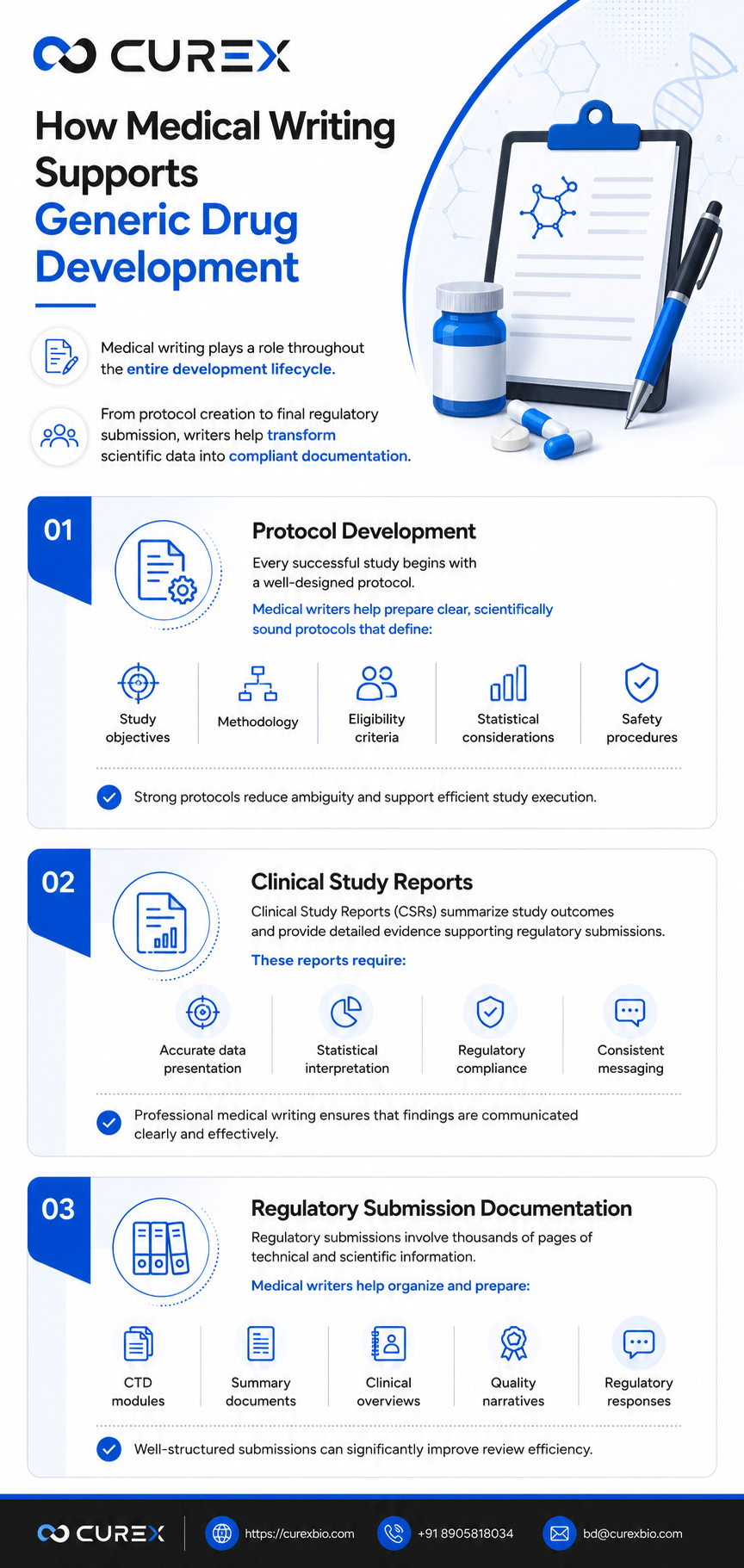
Medical writing plays a role throughout the entire development lifecycle.
From protocol creation to final regulatory submission, writers help transform scientific data into compliant documentation.
Protocol Development
Every successful study begins with a well-designed protocol.
Medical writers help prepare clear, scientifically sound protocols that define:
- Study objectives
- Methodology
- Eligibility criteria
- Statistical considerations
- Safety procedures
Strong protocols reduce ambiguity and support efficient study execution.
Clinical Study Reports
Clinical Study Reports (CSRs) summarize study outcomes and provide detailed evidence supporting regulatory submissions.
These reports require:
- Accurate data presentation
- Statistical interpretation
- Regulatory compliance
- Consistent messaging
Professional medical writing ensures that findings are communicated clearly and effectively.
Regulatory Submission Documentation
Regulatory submissions involve thousands of pages of technical and scientific information.
Medical writers help organize and prepare:
- CTD modules
- Summary documents
- Clinical overviews
- Quality narratives
- Regulatory responses
Well-structured submissions can significantly improve review efficiency.
The Strategic Value of Outsourcing Medical Writing
Outsourcing medical writing offers benefits that extend beyond cost management.
Sponsors gain access to specialized expertise while improving operational flexibility.
| In-House Team | Outsourced Medical Writing Partner |
|---|---|
| Fixed staffing costs | Flexible resource allocation |
| Limited bandwidth | Scalable support |
| Recruitment challenges | Immediate expertise |
| Training requirements | Experienced professionals |
| Narrow therapeutic focus | Broad therapeutic knowledge |
Outsourcing allows generic manufacturers to focus internal resources on core development activities while leveraging external expertise for documentation and regulatory communication.
Integrated Services Deliver Greater Efficiency
Modern drug development requires collaboration across multiple disciplines.
Medical writing works most effectively when integrated with:
- Clinical development
- Regulatory affairs
- Clinical monitoring
- Data management
- Pharmacovigilance
An integrated approach improves consistency across documents and reduces communication gaps between teams.
CTA: Accelerate Your Generic Drug Development Program
Need support with medical writing, regulatory documentation, clinical study reports, or submission-ready scientific content?
Button Text: Connect With CurexBio Medical Writing Experts
Key Challenges Generic Drug Companies Face
Despite advances in technology and regulatory harmonization, generic drug manufacturers continue facing several documentation-related challenges.
Tight Development Timelines
Competition in the generic market is intense. Delays in documentation can affect launch schedules and commercial opportunities.
Evolving Regulatory Requirements
Submission requirements continue evolving across regions, creating additional complexity for sponsors pursuing global approvals.
Resource Constraints
Many companies lack sufficient internal writing resources to manage multiple development programs simultaneously.
Maintaining Consistency
Large submission packages often involve contributions from multiple departments.
Medical writers help ensure consistency across all documents.
Why CurexBio Is a Strategic Partner for Generic Drug Development
CurexBio combines scientific expertise, regulatory knowledge, and clinical research capabilities to support generic pharmaceutical companies throughout the development lifecycle.
Our team provides support for:
- Protocol writing
- Clinical study reports
- Regulatory documentation
- Medical review
- Scientific communication
- Submission support
By integrating medical writing with regulatory affairs, clinical monitoring, pharmacovigilance, and clinical development services, CurexBio helps sponsors streamline operations and improve development efficiency.
The Future of Medical Writing in Generic Pharmaceuticals
Medical writing continues evolving as regulatory expectations, digital technologies, and global submission requirements become more sophisticated.
Artificial intelligence may support workflow automation and document drafting, but scientific interpretation, regulatory strategy, and quality review will continue requiring experienced human expertise.
Medical writing is increasingly becoming a strategic function rather than a documentation task.
Generic pharmaceutical companies that leverage experienced medical writing partners can strengthen submission quality, improve operational efficiency, and accelerate market access.
Conclusion
Medical writing companies in India have become essential partners for generic pharmaceutical manufacturers navigating complex regulatory environments and competitive development timelines.
From protocol development and clinical study reports to regulatory submissions and scientific communication, professional medical writing supports every stage of generic drug development.
As global regulatory expectations continue evolving, strategic partnerships with experienced organizations like CurexBio can help sponsors improve compliance, accelerate approvals, and achieve development goals with greater confidence.
Frequently Asked Questions
1. Why do generic pharmaceutical companies outsource medical writing services?
Outsourcing provides access to specialized expertise, scalable resources, regulatory knowledge, and improved operational efficiency.
2. What documents are commonly prepared by medical writing companies?
Common deliverables include protocols, clinical study reports, informed consent forms, regulatory submissions, safety narratives, and scientific publications.
3. How does medical writing support regulatory approvals?
Medical writing ensures scientific accuracy, document consistency, regulatory compliance, and clear communication of clinical evidence.
4. Why is India a preferred destination for medical writing services?
India offers a strong scientific workforce, global regulatory experience, cost efficiency, and scalable service models.
5. How can CurexBio support generic drug manufacturers?
CurexBio provides medical writing, regulatory affairs, clinical monitoring, clinical data management, and pharmacovigilance services to support efficient and compliant drug development.


