
The global pharmacovigilance landscape in 2026 is rapidly evolving due to stricter regulations, increased data from complex therapies, and the adoption of AI for proactive risk detection. Pharmacovigilance now emphasizes predictive, real-time safety intelligence over reactive case processing, encompassing adverse event reporting, signal detection, risk management, and regulatory compliance.
Market Momentum in 2026
The pharmacovigilance market is experiencing significant growth due to increasing Adverse Drug Reactions (ADRs), enhanced post-marketing responsibilities, and trends towards outsourcing.
Recent estimates vary by source, but consensus points to robust expansion:
- Valued at around USD 9–10.5 billion in 2025–2026, the market is expected to grow to USD 18–31 billion by 2030–2034, with compound annual growth rates (CAGRs) between 6.5% and 14.7%. Estimates include Fortune Business Insights predicting USD 10.5 billion in 2026 growing to USD 31.6 billion by 2034 at 14.7%, Mordor Intelligence forecasting USD 10.45 billion in 2026 to USD 18.26 billion by 2031 at 11.8%, and Grand View Research estimating approximately USD 8.6 billion in 2025 reaching USD 11.8 billion by 2030 at 6.5%.
- Outsourcing, particularly to Contract Research Organizations (CROs) and specialized providers, is rapidly increasing, typically growing at over 10% CAGR, as sponsors pursue scalable, technology-driven solutions.
- North America is at the forefront due to established frameworks like the FDA, whereas the Asia-Pacific region is advancing rapidly aided by harmonization and cost benefits.
Key Trends Shaping 2026
- AI Revolution
AI has advanced to Agentic AI, which automates processes like case intake and signal prioritization, reclaiming up to 40% of PV capacity and facilitating predictive analytics for emerging risks.
- Regulatory Alignment & Guidance
Landmark FDA-EMA joint principles (January 2026) provide 10 guidelines for responsible AI in drug development, focusing on human oversight, transparency, risk-based validation, and lifecycle monitoring.
CIOMS WG XIV report (2025) outlines global best practices for artificial intelligence in pharmacovigilance, emphasizing the importance of ICH E2B(R3) and harmonized standards to minimize fragmentation. It also highlights regulatory expectations for explainable AI and the necessity for strong governance structures.
- Proactive & Predictive Shift
Transitioning from manual or reactive methods to automated, real-time monitoring is facilitated by the use of electronic health record (EHR) mining, social media signals, and multimodal data, with cloud platforms supporting global collaboration and scalability.
- Challenges Persist
Strong change management is required to address data silos, mitigate bias, fulfill validation needs, and manage talent shifts due to automation changing roles.
Why Partner with a CurexBio?
Organizations require comprehensive solutions that integrate regulatory knowledge, cutting-edge technology, and operational efficiency to maintain compliance, expedite insights, and safeguard patients.
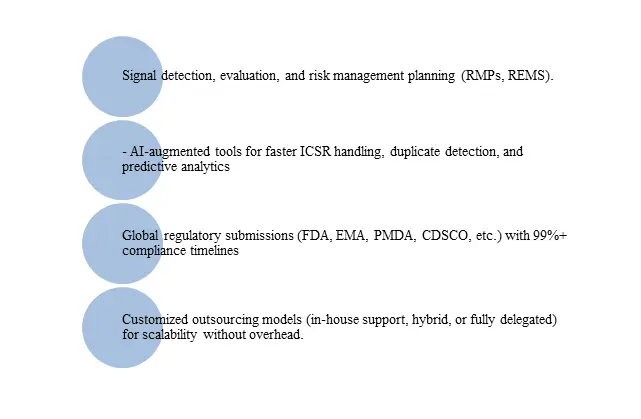
CurexBio provides comprehensive Global Pharmacovigilance and Drug Safety Monitoring Services, assisting biotech, pharmaceutical, and medical device companies with confidence in post-marketing surveillance.
Full-case processing involves several stages: intake, triage, data entry, medical review, and expedited or periodic reporting.
CurexBio transforms drug safety from a compliance burden into a strategic advantage, emphasizing quality, transparency, and innovation to facilitate faster launches, improve risk mitigation, and boost patient trust.
Ready to enhance your pharmacovigilance strategy in 2026? Reach out to CurexBio’s drug safety specialists for a customized consultation on how our solutions can effectively support your pipeline.


