
The clinical research industry is evolving rapidly. Clinical trials are becoming more complex, regulatory expectations continue to increase, and sponsors face growing pressure to accelerate development timelines while maintaining patient safety and data integrity. In this environment, clinical quality compliance services have become a critical component of successful drug, biologic, and medical device development programs.
Organizations operating in pharmaceutical, biotechnology, medical device, and contract research sectors must demonstrate adherence to Good Clinical Practice (GCP), regulatory guidelines, quality management principles, and inspection readiness standards. A single compliance gap can result in regulatory observations, study delays, increased costs, and reputational damage.
As global clinical research expands, India has emerged as a leading destination for clinical quality compliance services. With strong scientific expertise, regulatory knowledge, and growing clinical research capabilities, India offers organizations access to specialized quality professionals who help maintain compliance throughout the clinical development lifecycle.
Companies like CurexBio support sponsors, CROs, and healthcare organizations through comprehensive quality compliance solutions designed to strengthen oversight, improve operational performance, and reduce regulatory risk.
Why Clinical Quality Compliance Matters More Than Ever
Clinical research is built on trust. Patients trust investigators to protect their safety. Sponsors trust research sites to follow protocols. Regulatory agencies trust organizations to generate reliable and accurate data.
Quality compliance acts as the foundation supporting this trust.
Think of clinical quality compliance as the structural framework of a building. While the framework may not always be visible, it supports everything above it. Without strong quality systems, even the most promising development program can encounter significant challenges.
Modern clinical studies involve multiple stakeholders, global sites, electronic systems, third-party vendors, decentralized trial components, and increasingly complex regulatory requirements. Managing quality across these moving parts requires structured processes and continuous oversight.
Clinical quality compliance services help organizations:
- Maintain regulatory compliance
- Protect patient safety
- Improve data integrity
- Strengthen operational consistency
- Prepare for inspections
- Reduce quality-related risks
Organizations that prioritize quality early in development often avoid costly corrective actions later.
Clinical Quality Compliance Services for Pharmaceutical Companies
Pharmaceutical companies operate within one of the most heavily regulated industries in the world. Regulatory agencies expect sponsors to maintain robust quality systems throughout product development.
Clinical quality compliance services support pharmaceutical companies by ensuring that clinical trial activities align with regulatory requirements and industry best practices.
Areas of support often include:
Clinical Trial Audits
Quality audits help identify potential compliance gaps before they become regulatory findings.
Audit programs may cover:
- Investigator sites
- Clinical vendors
- CRO partners
- Internal processes
- Trial master files
SOP Development and Review
Standard Operating Procedures provide the framework for consistent operations.
Well-designed SOPs help organizations:
- Standardize processes
- Reduce variability
- Support training
- Maintain compliance
Inspection Readiness
Regulatory inspections can occur at any stage of development.
Quality compliance teams help sponsors prepare by reviewing documentation, conducting mock inspections, and addressing potential deficiencies before regulatory visits.
Supporting Biotechnology Companies Through Growth and Innovation
Biotechnology companies often operate in fast-moving and highly innovative environments. Many biotech organizations focus on advanced therapies, precision medicine programs, gene therapies, and biologics.
These programs present unique quality challenges.
Biotech companies frequently experience:
- Rapid organizational growth
- Limited internal quality resources
- Complex regulatory pathways
- Evolving operational processes
Clinical quality compliance services provide the structure needed to support sustainable growth.
Quality experts assist biotech organizations with:
| Quality Need | Compliance Support |
|---|---|
| Early-stage development | Quality framework establishment |
| Growing pipelines | Process standardization |
| Regulatory interactions | Inspection readiness |
| Vendor oversight | Audit programs |
| Quality events | CAPA management |
Strong quality systems help biotech companies maintain agility while meeting regulatory expectations.
Clinical Quality Compliance for Medical Device Companies
Medical device clinical investigations differ from pharmaceutical studies in several important ways.
Device studies may involve:
- User interaction assessments
- Human factors evaluations
- Device performance endpoints
- Software validation
- Usability considerations
Medical device manufacturers must comply with regulations such as ISO 14155 and applicable regional requirements.
Clinical quality compliance services help organizations manage these complexities through:
Device-Specific Audit Programs
Quality professionals evaluate compliance across device development and clinical investigation processes.
Documentation Reviews
Critical documentation may include:
- Clinical investigation plans
- Risk management files
- Device accountability records
- Monitoring reports
Quality System Assessments
Medical device companies often benefit from independent reviews of quality management systems to ensure regulatory alignment.
As device technologies become increasingly sophisticated, maintaining strong quality oversight becomes even more important.
Why CROs Depend on Strong Quality Compliance Programs
Contract Research Organizations play a central role in modern clinical research.
Sponsors rely on CROs to manage clinical operations, monitoring activities, data management, and project oversight. Because CROs act on behalf of sponsors, maintaining quality compliance becomes a business-critical requirement.
A strong quality framework helps CROs:
- Demonstrate sponsor confidence
- Improve operational performance
- Reduce inspection findings
- Maintain regulatory credibility
Clinical quality compliance services support CROs through:
Internal Quality Audits
Regular assessments help identify process gaps and opportunities for improvement.
Vendor Qualification Programs
Third-party vendors influence trial quality.
Vendor qualification processes help ensure suppliers meet established quality standards.
CAPA Management
Corrective and Preventive Actions (CAPA) help organizations address quality issues systematically while reducing the likelihood of recurrence.
Key Components of Effective Clinical Quality Compliance Services
High-performing quality programs share several common characteristics.
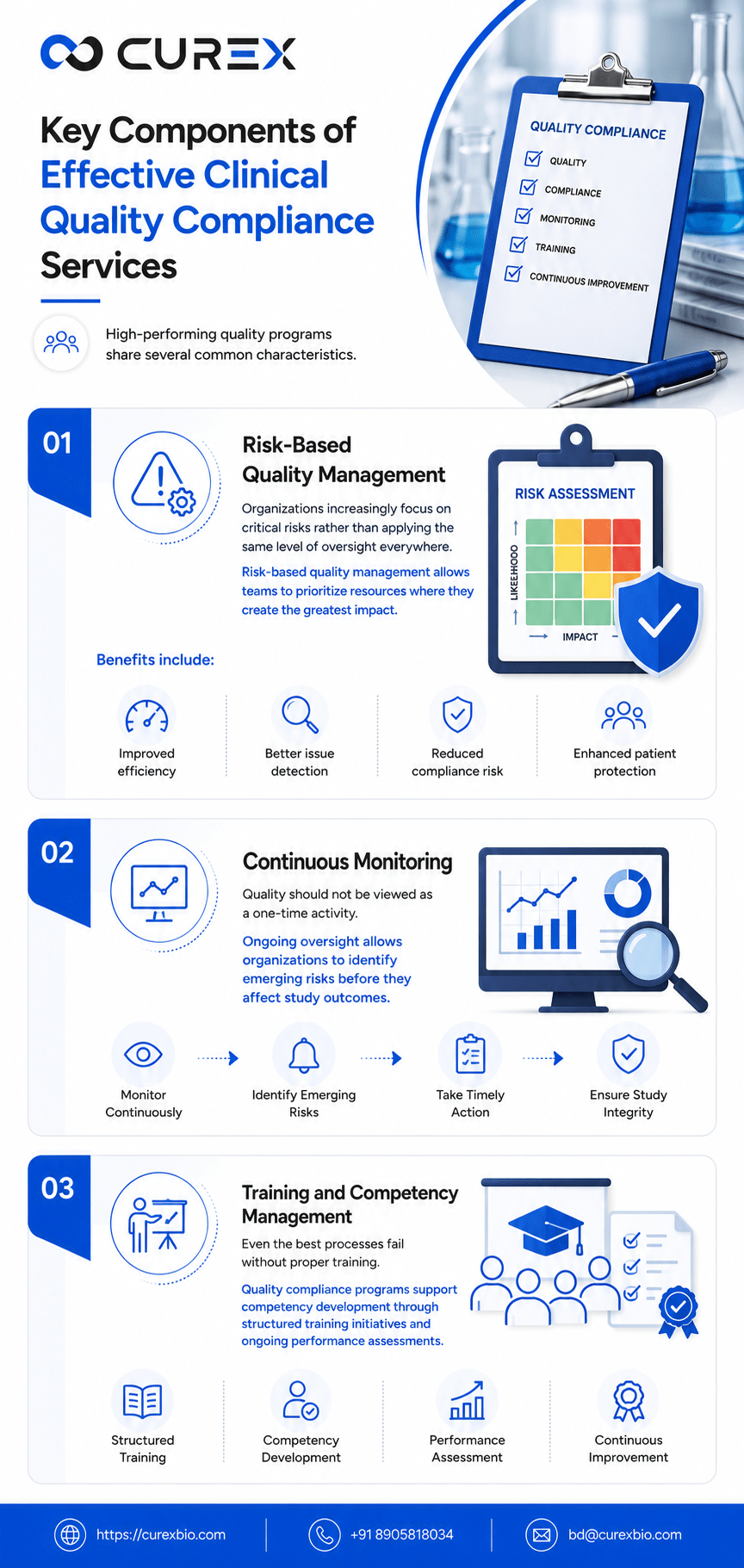
Risk-Based Quality Management
Organizations increasingly focus on critical risks rather than applying the same level of oversight everywhere.
Risk-based quality management allows teams to prioritize resources where they create the greatest impact.
Benefits include:
- Improved efficiency
- Better issue detection
- Reduced compliance risk
- Enhanced patient protection
Continuous Monitoring
Quality should not be viewed as a one-time activity.
Ongoing oversight allows organizations to identify emerging risks before they affect study outcomes.
Training and Competency Management
Even the best processes fail without proper training.
Quality compliance programs support competency development through structured training initiatives and ongoing performance assessments.
How Clinical Quality Compliance Improves Regulatory Readiness
Regulatory inspections remain a significant concern for sponsors and CROs.
Inspections evaluate whether organizations:
- Follow approved procedures
- Maintain adequate documentation
- Protect study participants
- Ensure data reliability
Organizations with mature quality systems typically experience greater confidence during inspections.
Inspection Readiness Activities
Common readiness activities include:
| Activity | Purpose |
|---|---|
| Mock inspections | Identify gaps |
| Documentation reviews | Verify completeness |
| Process assessments | Evaluate compliance |
| Staff preparation | Improve interview readiness |
| CAPA reviews | Confirm effectiveness |
Preparation helps reduce surprises and improve regulatory outcomes.
Strengthen Your Clinical Quality Framework
Need support with clinical quality compliance, GCP audits, inspection readiness, or quality management systems?
Why Organizations Choose India for Clinical Quality Compliance Services
India has become a preferred destination for clinical quality compliance support due to several advantages.
Access to Experienced Professionals
India offers a large pool of professionals with expertise in:
- Clinical research
- Regulatory affairs
- Quality assurance
- Pharmacovigilance
- Medical writing
Cost-Effective Support Models
Organizations gain access to high-quality expertise while optimizing operational costs.
Global Regulatory Knowledge
Quality professionals in India frequently support studies conducted across multiple regions and regulatory environments.
This experience strengthens compliance programs and supports global development strategies.
Why CurexBio Is a Trusted Clinical Quality Compliance Partner
CurexBio provides comprehensive quality and compliance support tailored to the needs of pharmaceutical, biotechnology, medical device, and CRO organizations.
Our expertise extends across:
- Clinical Quality Compliance Services
- Clinical Monitoring Services
- Regulatory Affairs Services
- Pharmacovigilance Services
- Medical Writing Services
- Clinical Data Management
- Clinical Development Services
Integrated Quality Oversight
Quality compliance does not operate in isolation.
CurexBio integrates quality activities with clinical operations, regulatory strategy, safety oversight, and data management to provide a holistic approach to compliance.
Risk-Based Approach
Our team focuses on identifying critical risks early and implementing practical solutions that strengthen operational performance.
Flexible Engagement Models
Whether supporting a single audit, preparing for an inspection, or developing a comprehensive quality management system, CurexBio offers scalable solutions aligned with sponsor objectives.
Build a Stronger Compliance Program
CurexBio helps sponsors, CROs, biotech companies, and medical device organizations improve quality oversight and regulatory readiness.


