
Adaptive clinical trials are changing how therapies move from research to patients. Traditional clinical trials often follow a rigid path: researchers define the protocol, recruit patients, collect data, and analyze results at the end of the study. While this approach has supported drug development for decades, it can sometimes resemble steering a ship without adjusting course despite changing weather conditions.
Modern drug development does not work comfortably within rigid frameworks anymore. Sponsors are managing increasingly complex therapies, precision medicine programs, biomarker-driven studies, and global regulatory expectations. This growing complexity has accelerated interest in adaptive clinical trials, where pre-planned modifications allow studies to evolve based on interim evidence.
Behind these adaptive decisions sits a critical scientific discipline — biostatistics services.
Biostatistics does far more than calculate p-values or prepare statistical reports. In adaptive trials, statistical planning becomes the architectural blueprint guiding decision-making, risk control, and regulatory confidence. Without robust statistical design, adaptive studies can quickly become vulnerable to bias, operational errors, or regulatory challenges.
This shift has created growing demand for specialized biostatistics services, advanced statistical programming, and CRO-based analytical support.
Sponsors increasingly seek experienced partners capable of integrating adaptive statistical methodologies with clinical development services, clinical monitoring services, clinical data management, and regulatory planning.
This article explores the growing role of biostatistics in adaptive clinical trials, the challenges sponsors face, and the opportunities modern statistical approaches create in 2026 and beyond.
Adaptive Clinical Trials Are Reshaping Drug Development
Clinical research has entered an era where flexibility matters more than ever.
Traditional clinical trials usually follow fixed protocols that remain unchanged throughout study conduct. Adaptive clinical trials, however, allow pre-planned modifications based on interim analyses without compromising scientific validity.
Think of traditional trials like a train locked onto fixed tracks. Adaptive trials function more like GPS-guided navigation. The destination remains the same, but the route can adjust intelligently when new information emerges.
Adaptive trials may allow:
- Sample size modification
- Dose adjustment
- Treatment arm selection
- Early stopping for efficacy
- Futility assessment
- Patient enrichment strategies
These modifications occur according to predefined statistical rules.
Adaptive approaches matter because modern therapies often involve uncertainty. Oncology studies, rare disease programs, and precision medicine trials frequently require more agile development models.
Adaptive designs help sponsors:
| Traditional Trials | Adaptive Trials |
| Fixed study path | Flexible decision framework |
| Late-stage adjustments | Interim evidence-driven decisions |
| Higher failure risk | Improved efficiency |
| Longer timelines | Potential acceleration |
| Limited learning during study | Continuous learning |
This efficiency has positioned adaptive designs as a growing trend across pharmaceutical and biotech development programs.
Why Adaptive Designs Are Gaining Momentum in 2026
The growing popularity of adaptive trials reflects changing industry priorities.
Drug development costs remain high. Recruitment challenges continue affecting timelines. Precision therapies create smaller patient populations. Sponsors face intense pressure to accelerate approvals while maintaining regulatory confidence.
Adaptive trials address these realities.
Instead of waiting years for final outcomes, sponsors can analyze emerging data and make informed decisions earlier.
This capability supports:
- Faster go/no-go decisions
- Reduced resource waste
- Improved trial efficiency
- Better patient allocation
- More strategic development planning
Regulatory agencies have also become increasingly receptive to adaptive methodologies when supported by robust statistical justification.
Bayesian approaches, master protocols, and platform trials now receive growing attention because they align with real-world development needs.
This momentum explains why adaptive clinical research increasingly depends on sophisticated biostatistics services capable of managing evolving study designs and statistical complexity.
Understanding Biostatistics Services in Adaptive Trials
Many people still associate biostatistics with final data analysis.
That view misses the bigger picture.
In adaptive trials, biostatistics becomes central to study planning, conduct, monitoring, and interpretation.
Biostatistical teams support:
- Study design
- Endpoint selection
- Randomization planning
- Interim analysis
- Statistical analysis plans (SAP)
- Data interpretation
- Regulatory submissions
The role extends far beyond mathematics.
Biostatisticians function as scientific strategists helping sponsors balance innovation with statistical rigor.
A poorly designed adaptive study may create:
- Type I error inflation
- Bias risk
- Inconsistent interpretation
- Regulatory concerns
- Operational inefficiencies
Strong statistical planning prevents these issues.
Sponsors often combine Biostatistics Services with Clinical Development Services and Clinical Data Management to maintain integrated trial oversight.
Core Statistical Responsibilities Across the Trial Lifecycle
Biostatistics influences nearly every stage of adaptive trials.
Responsibilities begin before patient enrollment and continue through submission.
| Trial Phase | Biostatistics Contribution |
| Protocol Design | Statistical framework |
| Randomization | Allocation strategy |
| Interim Analysis | Adaptation decisions |
| Monitoring | Data trend evaluation |
| Final Analysis | Endpoint interpretation |
| Submission | Statistical reporting |
The Statistical Analysis Plan (SAP) becomes particularly important.
The SAP defines:
- Interim timing
- Adaptation rules
- Analysis methods
- Multiplicity control
- Decision boundaries
Without a clear SAP, adaptive flexibility may create confusion rather than efficiency.
Strengthen Adaptive Trial Decision-Making
Need support with biostatistics services, adaptive trial design, or statistical programming for complex studies?
Types of Adaptive Clinical Trial Designs
Adaptive design is not a single methodology.
It represents several statistical frameworks.
Bayesian Adaptive Designs
Bayesian models use accumulating evidence to update probability estimates throughout a study.
These approaches support:
- Dose finding
- Predictive modeling
- Flexible decision-making
Bayesian methods work particularly well in precision medicine and rare disease research.
Group Sequential Designs
These designs include planned interim analyses.
Trials may stop early if:
- Efficacy becomes clear
- Safety concerns emerge
- Futility thresholds appear
This approach protects resources and patients.
Platform Trials
Platform trials evaluate multiple therapies under a shared infrastructure.
Advantages include:
- Shared control arms
- Efficient recruitment
- Continuous learning
- Lower operational duplication
Platform studies have become increasingly relevant in oncology and infectious disease programs.
Key Challenges in Adaptive Trial Biostatistics
Adaptive flexibility creates opportunity — but also complexity.
Statistical challenges remain substantial.
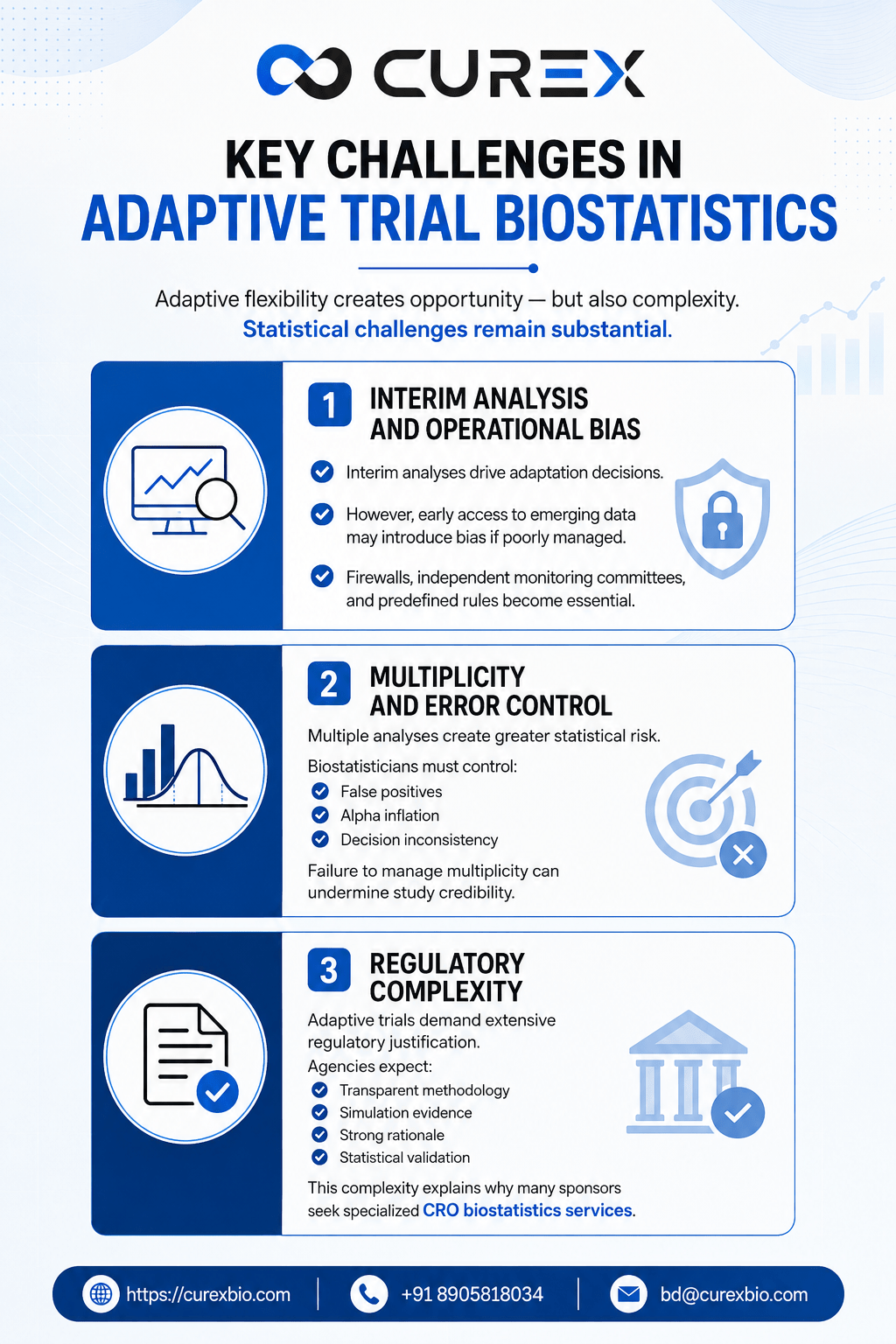
Interim Analysis and Operational Bias
Interim analyses drive adaptation decisions.
However, early access to emerging data may introduce bias if poorly managed.
Firewalls, independent monitoring committees, and predefined rules become essential.
Multiplicity and Error Control
Multiple analyses create greater statistical risk.
Biostatisticians must control:
- False positives
- Alpha inflation
- Decision inconsistency
Failure to manage multiplicity can undermine study credibility.
Regulatory Complexity
Adaptive trials demand extensive regulatory justification.
Agencies expect:
- Transparent methodology
- Simulation evidence
- Strong rationale
- Statistical validation
This complexity explains why many sponsors seek specialized CRO biostatistics services.
Opportunities Created by Advanced Biostatistical Approaches
Despite these challenges, adaptive trials create remarkable opportunities.
Biostatistical innovation supports:
- Faster development
- Better resource allocation
- Improved patient protection
- Stronger decision-making
Adaptive methods reduce uncertainty.
Rather than waiting until the study ends, sponsors learn continuously.
This capability matters in:
- Oncology
- Rare disease trials
- Biomarker studies
- Cell and gene therapy
Biostatistics helps convert uncertainty into informed action.
Role of CRO-Based Biostatistics Services
Outsourcing biostatistics has become increasingly common.
Sponsors often face:
- Internal bandwidth limits
- Specialized expertise gaps
- Timeline pressure
- Statistical programming needs
CRO-based biostatistics teams provide:
- Therapeutic expertise
- SAS programming
- Adaptive design support
- Regulatory statistics
- Submission-ready analysis
Integrated models create additional value.
Optimize Complex Trial Analytics
CurexBio supports sponsors with biostatistics, clinical data management, and regulatory-focused analytical expertise for adaptive clinical trials.
Future of Adaptive Trial Statistics and AI-Enabled Decision Making
The future of adaptive trials increasingly intersects with AI.
Machine learning and real-time analytics may support:
- Recruitment forecasting
- Risk detection
- Predictive modeling
- Dynamic monitoring
Yet AI does not replace biostatistics.
Human interpretation remains essential.
Biostatistics will likely evolve into an even more strategic discipline combining:
- Statistical rigor
- Computational tools
- Regulatory science
- Clinical insight
Sponsors that embrace these integrated approaches may gain meaningful development advantages.
Conclusion
Adaptive clinical trials represent one of the most significant evolutions in modern drug development.
Their flexibility creates opportunities to improve efficiency, reduce waste, and accelerate decision-making. But adaptive designs depend heavily on robust statistical foundations.
Biostatistics services provide those foundations.
From study design and interim analysis to regulatory strategy and submission readiness, biostatistics guides adaptive trials through scientific and operational complexity.
As adaptive methodologies continue expanding across precision medicine and global research programs, experienced CRO-based statistical support will remain increasingly valuable.
Organizations like CurexBio help sponsors combine biostatistics, clinical development, monitoring, and regulatory expertise to navigate this evolving landscape with greater confidence.
FAQs
1. What are adaptive clinical trials?
Adaptive clinical trials allow predefined study modifications based on interim data while maintaining scientific integrity.
2. Why are biostatistics services important in adaptive trials?
Biostatistics supports study design, interim analysis, error control, and regulatory compliance.
3. What is interim analysis?
Interim analysis evaluates accumulating trial data to support planned adaptations or decision-making.
4. Are adaptive trials accepted by regulators?
Yes. Regulatory agencies increasingly support adaptive methodologies when statistically justified.
5. Why do sponsors outsource biostatistics services?
Sponsors outsource for expertise, scalability, regulatory support, and faster analytical execution.


