
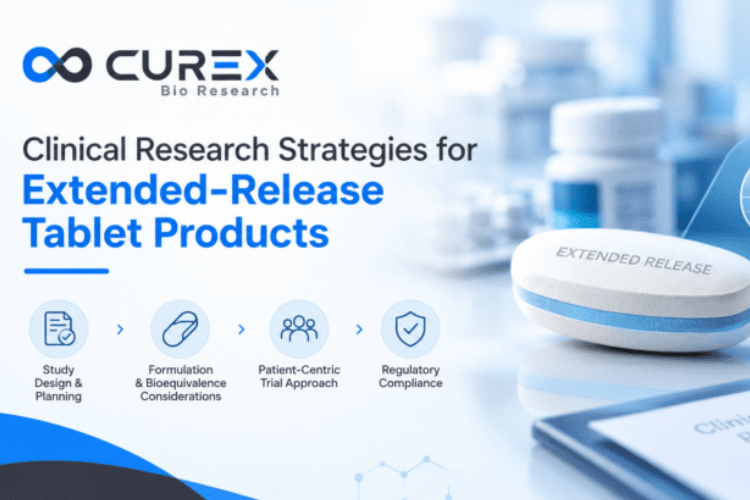
Extended-release (ER) tablet formulations are essential in pharemaceutical development, as they enhance patient adherence and tolerability by controlling drug release rates. Their clinical development, however, faces scientific and regulatory challenges, necessitating well-designed studies to characterize release profiles and ensure bioequivalence while addressing risks like dose dumping.
Here are key clinical research strategies that support robust development of extended-release tablet products.
- Comprehensive Pharmacokinetic Characterization
ER formulations necessitate comprehensive pharmacokinetic evaluations for both single and multiple doses, focusing on parameters such as Cmax, AUC0-t, AUC0-∞, Tmax, half-life, and fluctuation indices, with multiple sampling time points being crucial for accurately depicting absorption and release profiles.
- Bioequivalence Studies Tailored for Modified-Release Products
Bioequivalence studies for generic or hybrid applications must show equivalence in absorption rate and extent. Regulatory agencies require fasting and fed studies, multipoint sampling, assessment of partial AUCs, and steady-state studies when applicable. These requirements exceed standard immediate-release protocols, necessitating careful protocol design and bioanalytical sensitivity.
- Food-Effect and Dose-Dumping Assessments
Food impacts the release characteristics of ER tablets, necessitating dedicated food-effect studies. Additionally, evaluations for alcohol-induced dose dumping and other release failures are crucial for safety and regulatory compliance.
- Steady-State and Multiple-Dose Evaluation
Multiple-dose studies at steady state are essential for understanding the accumulation, fluctuation, and consistency of exposure to ER products intended for chronic use. They also play a vital role in assessing safety and tolerability under real-world dosing conditions.
- Safety Monitoring and Risk Management
ER formulations require careful safety assessments due to the potential for rapid dose release. Clinical protocols should include adverse event monitoring and established stopping rules. Pharmacovigilance planning should start early and persist through post-marketing.
Table of Contents
ToggleRegulatory Alignment and Adaptive Design
Guidance from regulatory agencies such as the FDA and EMA highlights the importance of early engagement regarding expectations for modified-release products. This includes exploring biowaiver options, developing IVIVC, and determining suitable study endpoints to minimize delays. Incorporating adaptive elements in study design can enhance efficiency, particularly when formulation changes are expected.
Integration of Bioanalytical and Statistical Rigor
High-quality bioanalytical methods with sufficient sensitivity and specificity are crucial for accurately characterizing prolonged release profiles. Robust statistical analysis plans, which address outliers and assess partial AUCs, enhance the credibility of study outcomes.
Here, CurexBio Supports These Strategies
CurexBio offers comprehensive clinical research support specifically for the development of extended-release tablets. Our team assists sponsors in navigating the associated complexities.
- Protocol design for single-dose, multiple-dose, fed/fasting, and steady-state studies
- Bioequivalence and pharmacokinetic study execution
- Bioanalytical support and data management
- Medical writing, biostatistics, and regulatory documentation; clinical monitoring, quality oversight, and pharmacovigilance
Our teams leverage scientific expertise and operational discipline to assist pharmaceutical and biotech firms in generating high-quality, regulatory-ready data for modified-release products. A well-structured clinical strategy is crucial for success, whether developing a new extended-release formulation or seeking approval for a generic equivalent.
Partner with CurexBio to develop clinical research programs that fulfill scientific and regulatory standards for extended-release tablet products.
Contact us to discuss how we can support your next ER development program.


