
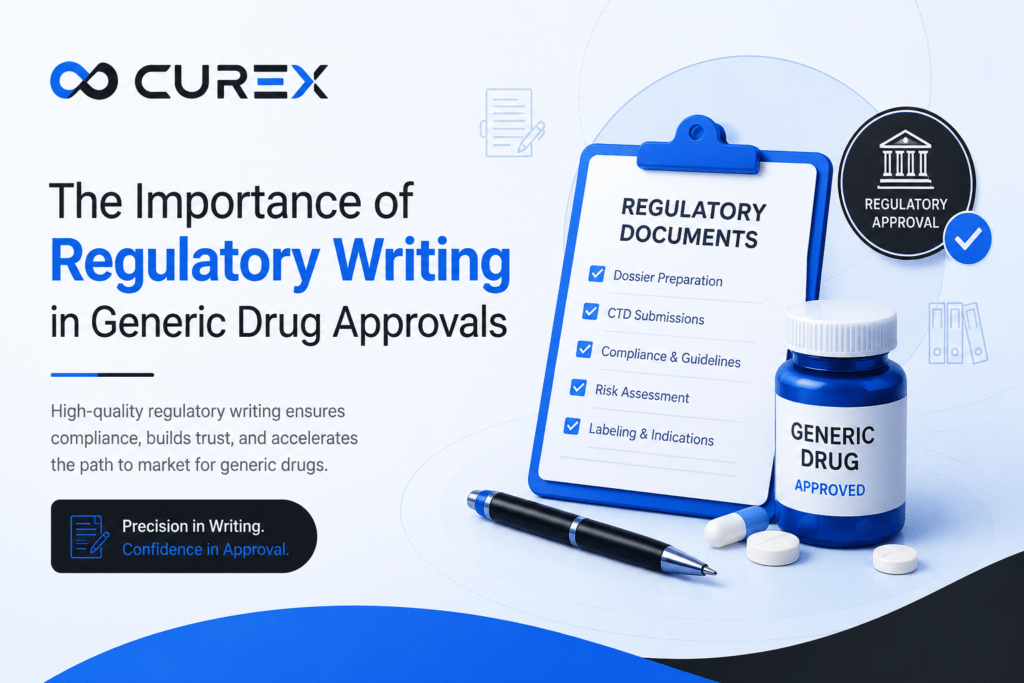
Bringing a generic drug to market requires more than demonstrating it contains the same active ingredient as the reference product. A successful application hinges on a comprehensive collection of scientific, clinical, pharmaceutical, and regulatory evidence and the effective documentation and communication of this information. Regulatory writing is essential for pharmaceutical companies, as it ensures that complex scientific information is presented accurately and in compliance with regulatory standards.
Regulatory writing is essential for creating scientific and technical documents necessary for drug development and approval. It simplifies complex pharmaceutical, clinical, nonclinical, and quality data into clear, structured information for regulatory authorities. In the context of generic drug development, it supports various related activities.
- Preparation of regulatory submission documents
- Clinical and bioequivalence documentation
- Summaries of pharmaceutical and quality information
- Scientific and medical documentation
- Responses to regulatory authority queries
- Submission-related correspondence
- Labeling and product information
- Risk management documentation, where applicable
The documentation needed varies based on the product, development process, target market, and regulatory requirements.
- Converts Complex Data into Regulatory-Ready Documents
Generic drug development involves extensive scientific and technical data, which regulatory writers organize into a logical structure for efficient review and answer three fundamental questions.
Good regulatory writing should address three key questions: what was done, why it was done, and what the results demonstrate. Clear documentation enhances the evaluation of the scientific rationale and supporting evidence.
- Supports Regulatory Compliance
Regulatory submissions require adherence to specific guidelines concerning content, structure, terminology, and presentation. A regulatory writing team must be well-versed in the relevant guidelines and submission expectations to prepare documents correctly. This is particularly crucial for companies seeking approval in various markets, as regulatory requirements vary by jurisdiction. Effective regulatory writing promotes consistency between the development program and the documentation submitted.
- Improves Consistency Across the Submission
A generic drug submission involves input from various departments such as clinical research, bioanalytical teams, biostatistics, pharmacology, pharmaceutical development, quality assurance, regulatory affairs, and manufacturing. Discrepancies in terminology, numerical data, and scientific interpretation may arise due to contributions from multiple teams. Regulatory writers play a crucial role in harmonizing this information, ensuring consistency in key data and conclusions throughout the submission package.
- Facilitates Efficient Regulatory Review
Regulatory reviewers face the challenge of evaluating large volumes of information quickly. Well-structured documents facilitate the identification of relevant information and the assessment of scientific rationale, enhancing the efficiency of the review process. In contrast, poorly organized documents with unclear explanations and inconsistent terminology may complicate the review and necessitate further clarification requests. Clear writing is thus essential for a streamlined review process.
- Helps Address Regulatory Queries
Regulatory reviews can lead to inquiries for further information. Crafting responses involves more than just supplying data; it is essential to clearly specify the question, present relevant evidence, explain the scientific rationale, and directly respond to the regulator’s concerns. Effective regulatory writers are crucial in translating complex technical details into concise, evidence-based communications.
- Regulatory Writing in the Generic Drug Development Lifecycle
Regulatory writing plays a vital role at various stages of the generic drug development lifecycle. Accurate documentation at each stage ensures a clear connection between development strategy, generated evidence, and regulatory requirements, especially when dealing with multiple products, development programs, or regulatory markets.
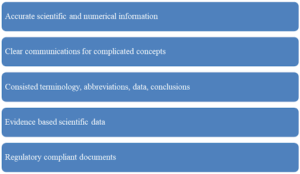
Key requirements for good regulatory writing:
Pharmaceutical companies face various challenges in preparing submissions for generic drugs.
- Large volumes of technical information
- Data received from multiple teams or vendors
- Tight regulatory submission timelines
- Differences between regional regulatory requirements
- Maintaining consistency across multiple documents
- Responding to complex regulatory questions
- Translating highly technical information into reviewer-friendly language
At CurexBio, we provide regulatory writing services to assist pharmaceutical and biotechnology companies in creating clear and scientifically sound regulatory documents essential for drug development. Our support includes regulatory submission documentation, clinical writing, bioequivalence documentation, regulatory responses, scientific summaries, and development documentation, particularly for generic drug programs. We leverage scientific expertise and regulatory knowledge to transform complex data into coherent regulatory documentation.
Looking for Regulatory Writing Support?
CurexBio is ready to support your generic drug development and regulatory documentation needs. Connect with CurexBio to discuss your regulatory writing requirements.


