
In drug development, generating reliable data is essential, with bioanalytical method validation (BMV) being crucial for ensuring that methods for measuring drugs and biomarkers in biological samples are accurate and reproducible. Inadequate validation can lead to rejected regulatory submissions, unreliable clinical trial data, and compromised patient safety.
Over the past decade, the regulatory landscape for bioanalytical method validation has evolved significantly, marked by the FDA’s 2018 BMV guidance, the ICH M10 standard, and the 2025 BMVB guidance for biomarkers. Understanding these requirements is crucial for pharmaceutical and biotech companies. This blog outlines key FDA guidelines on bioanalytical method validation and highlights how partnering with a specialized CRO like CurexBio can facilitate the transition from method development to regulatory success.
The 2018 FDA BMV Guidance
In May 2018, the FDA released the final version of its updated *Bioanalytical Method Validation Guidance for Industry, enhancing readability from the 2013 draft and ensuring a clearer structure covering method development, validation, sample analysis, and documentation. A key innovation was the unification of recommendations for chromatographic assays and ligand binding assays, addressing the rise of hybrid immunoaffinity/LC-MS techniques. Additionally, the revised appendices provided clearer acceptance criteria and reporting requirements, facilitating compliance for industry practitioners. The 2018 guidance identified seven essential parameters for bioanalytical method validation: selectivity, sensitivity, accuracy, precision, reproducibility, limit of quantitation, and stability.
ICH M10: Global Harmonization
In May 2022, the International Council for Harmonization (ICH) adopted Guideline M10, Bioanalytical Method Validation and Study Sample Analysis, which the FDA adopted in November 2022. This guideline replaces previous FDA-specific guidance and offers a unified framework accepted by major regulatory bodies, including the FDA and EMA.
ICH M10 brings several important enhancements:
Notably, ICH M10 explicitly excludes biomarkers and immunogenicity assays from its scope, meaning prior country-specific guidances remain in effect for those applications.
The 2025 FDA BMVB Guidance
In January 2025, the FDA issued new guidance on Bioanalytical Method Validation for Biomarkers (BMVB), replacing the 2018 BMV guidance. This document highlights the fundamental differences between validating biomarker assays and pharmacokinetic (PK) assays. The 2025 BMVB guidance adopts a “fit-for-purpose” approach, where validation requirements depend on the biomarker’s intended use, while also referencing ICH M10 as a starting point, despite its limitations for various biomarker platforms.
Key Validation Parameters Explained
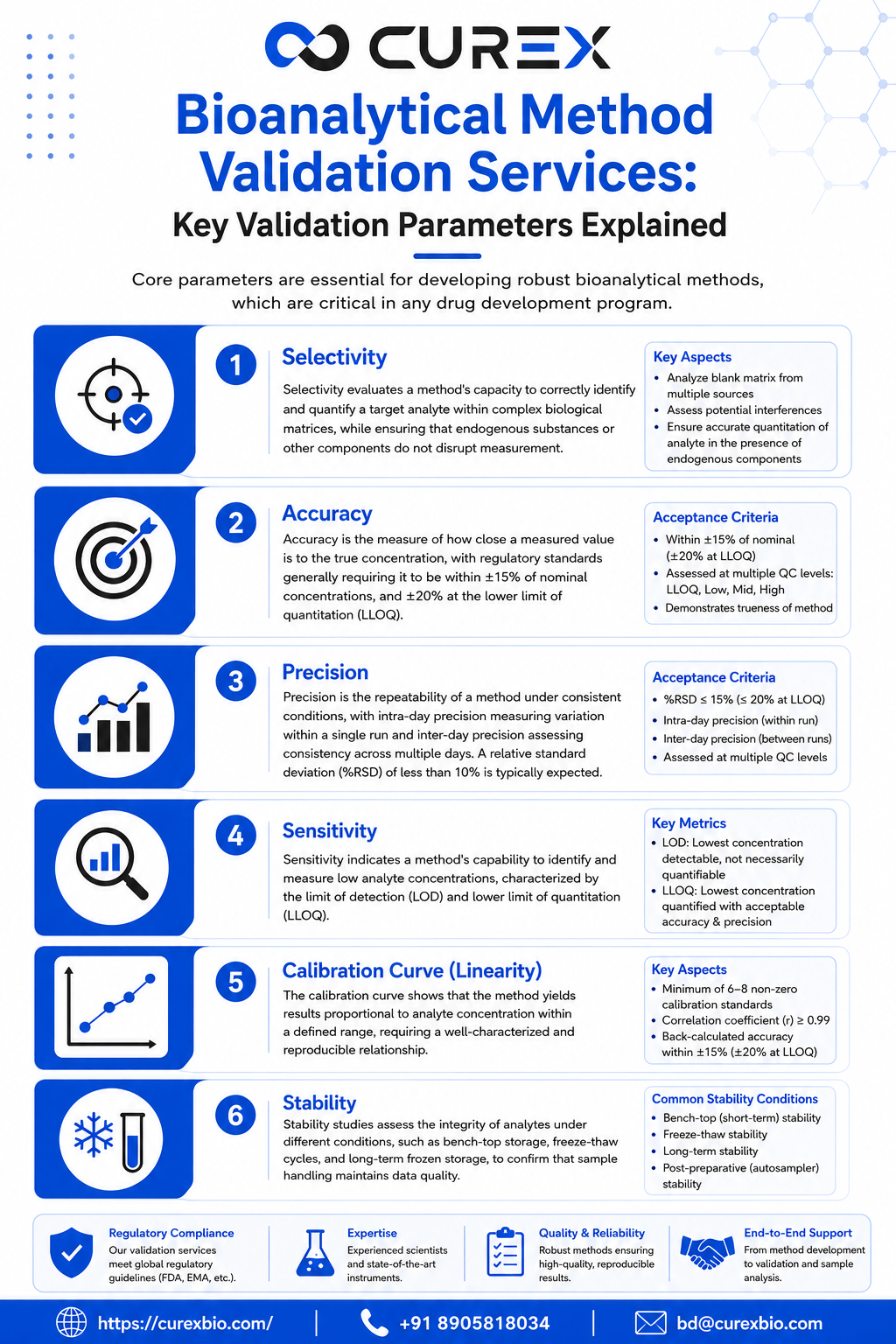
Core parameters are essential for developing robust bioanalytical methods, which are critical in any drug development program.
Selectivity
Selectivity evaluates a method’s capacity to correctly identify and quantify a target analyte within complex biological matrices, while ensuring that endogenous substances or other components do not disrupt measurement.
Accuracy
Accuracy is the measure of how close a measured value is to the true concentration, with regulatory standards generally requiring it to be within ±15% of nominal concentrations, and ±20% at the lower limit of quantitation (LLOQ).
Precision
Precision is the repeatability of a method under consistent conditions, with intra-day precision measuring variation within a single run and inter-day precision assessing consistency across multiple days. A relative standard deviation (%RSD) of less than 10% is typically expected.
Sensitivity
Sensitivity indicates a method’s capability to identify and measure low analyte concentrations, characterized by the limit of detection (LOD) and lower limit of quantitation (LLOQ).
Calibration Curve (Linearity)
The calibration curve shows that the method yields results proportional to analyte concentration within a defined range, requiring a well-characterized and reproducible relationship.
Stability
Stability studies assess the integrity of analytes under different conditions, such as bench-top storage, freeze-thaw cycles, and long-term frozen storage, to confirm that sample handling maintains data quality.
Why Bioanalytical Method Validation Matters
The consequences of inadequate method validation can be severe. Data that fails to meet regulatory standards may lead to:
Properly validated methods yield credible data that underpins regulatory decisions and speeds up drug development.
Navigating FDA guidelines, ICH M10 requirements, and biomarker validation standards demands specialized expertise. CurexBio provides bioanalytical testing and method validation services to meet high regulatory standards.
CurexBio provides full-spectrum support for both small and large molecules, including: –Deep Regulatory Expertise
CurexBio adheres to global standards like GLP and FDA regulations, ensuring high-quality, compliant data for regulatory approvals and clinical trials. We keep updated with guidelines such as the 2025 BMVB guidance and ICH M10 requirements, instilling confidence in regulatory submissions.
– Strategic Global Presence
With operations in India, the USA, and Canada, CurexBio integrates a global outlook with local execution, offering support for various study designs, including First-in-Human (FIH), pharmacokinetic (PK), Proof-of-Concept, and dose-escalation studies.
Choosing CurexBio as a specialized bioanalytical CRO provides significant advantages for companies dealing with tight timelines or complex molecules, as our experienced team can develop and validate both established methods and novel custom approaches efficiently.
Ready to accelerate your drug development program with confidence? Contact CurexBio to discuss how their bioanalytical validation expertise can support your next regulatory submission.
References:
- FDA Bioanalytical Method Validation Guidance for Industry (2018)
- ICH M10 Bioanalytical Method Validation and Study Sample Analysis (2022)
- FDA M10 Bioanalytical Method Validation and Study Sample Analysis (November 2022)
- FDA Bioanalytical Method Validation for Biomarkers (BMVB) Guidance (January 2025)


