

The pharmaceutical and clinical research landscape has changed dramatically over the past few years. Sponsors are developing increasingly complex therapies, managing multinational trials, and navigating evolving regulatory expectations across global markets. At the same time, submission timelines continue shrinking while documentation requirements grow larger and more sophisticated.
This combination of speed, complexity, and compliance pressure has transformed how sponsors approach medical writing services.
In 2026, medical writing is no longer viewed as a back-office administrative activity. It has become a strategic function directly influencing regulatory success, clinical timelines, and market access. Sponsors now recognize that high-quality medical and regulatory documentation can accelerate approvals, reduce compliance risk, and improve communication across development teams.
As a result, more pharmaceutical, biotech, and medical device companies are choosing to outsource medical writing rather than relying exclusively on internal teams.
This shift is not simply about reducing operational costs. Sponsors increasingly outsource because they need specialized expertise, scalable resources, therapeutic knowledge, and regulatory-focused writing capabilities that can adapt quickly to modern clinical development demands.
Organizations offering integrated medical writing services, regulatory affairs services, clinical monitoring services, and pharmacovigilance support have become strategic partners rather than transactional vendors.
This article explores why outsourcing continues growing in 2026, the business and regulatory factors driving this trend, and how CRO partnerships help sponsors manage documentation efficiently and confidently.
Understanding Medical Writing Services in Modern Drug Development
Medical writing covers far more than preparing scientific documents. It supports communication across the entire product lifecycle, from early clinical development through regulatory approval and post-marketing safety reporting.
Medical writers translate complex scientific and clinical information into structured, compliant, and regulator-ready documentation.
Typical medical writing deliverables include:
| Medical Writing Document | Purpose |
| Clinical Study Protocols | Guide study conduct |
| Investigator Brochures | Support investigator understanding |
| Clinical Study Reports (CSR) | Summarize trial outcomes |
| Informed Consent Forms | Protect patient rights |
| Regulatory Submission Documents | Support approval pathways |
| Safety Narratives | Document adverse events |
| Manuscripts and Publications | Communicate research findings |
| Risk Management Documentation | Support pharmacovigilance |
The role of medical writers has expanded significantly in recent years.
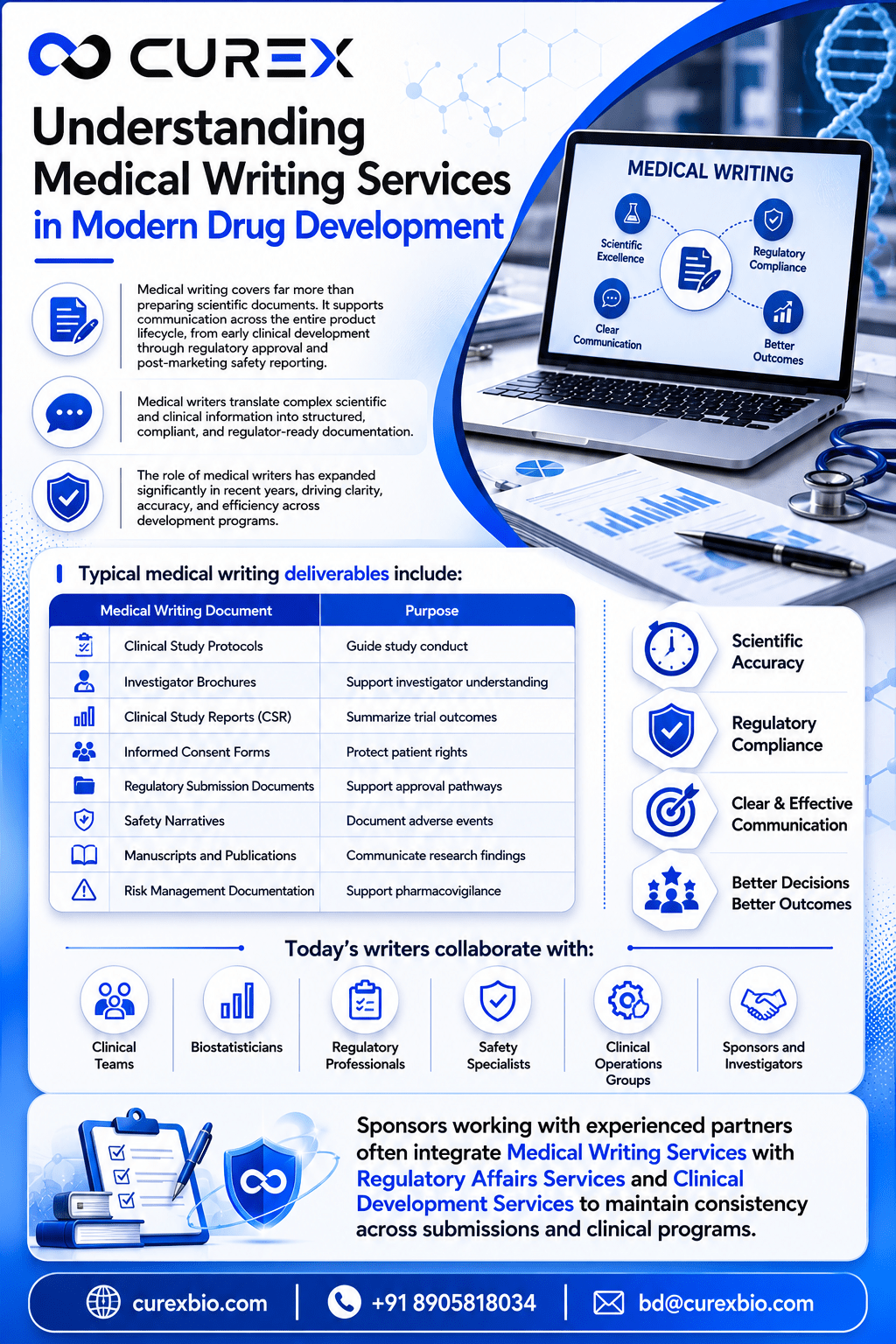
Today’s writers collaborate with:
- Clinical teams
- Biostatisticians
- Regulatory professionals
- Safety specialists
- Clinical operations groups
- Sponsors and investigators
This cross-functional involvement means medical writing now sits at the intersection of science, regulation, and strategic communication.
Sponsors working with experienced partners often integrate Medical Writing Services with Regulatory Affairs Services and Clinical Development Services to maintain consistency across submissions and clinical programs.
Why Outsourcing Medical Writing Is Growing in 2026
The outsourcing trend did not emerge overnight. It developed gradually as sponsors encountered increasing pressure to deliver faster while maintaining regulatory quality.
Think about modern clinical development like building a skyscraper.
Years ago, a smaller internal construction team could manage most activities. Today, projects involve specialized engineers, global contractors, advanced technologies, and highly coordinated operations. Drug development works similarly.
Sponsors increasingly face:
- Global trial complexity
- Higher documentation volumes
- Accelerated timelines
- Multi-region submissions
- Advanced therapy requirements
- Resource limitations
- Competitive market pressure
Medical writing workloads now fluctuate dramatically during development.
One month may require protocol drafting, while another demands multiple CSRs and submission modules simultaneously. Maintaining large permanent internal writing teams often becomes inefficient.
Outsourcing provides flexibility.
Sponsors gain access to experienced professionals exactly when needed without carrying long-term staffing burdens.
This flexibility explains why outsourcing continues accelerating across pharma and biotech sectors.
Cost Efficiency and Operational Scalability
Cost remains a major outsourcing driver, but not always for the reasons people assume.
Outsourcing is rarely about finding the cheapest writer.
Sponsors prioritize value, efficiency, and risk reduction.
Internal medical writing teams create several operational expenses:
- Recruitment
- Training
- Retention
- Software systems
- Therapeutic specialization gaps
- Workload imbalance
These costs become especially challenging for mid-size biotech companies or rapidly growing development programs.
Outsourced medical writing models help sponsors scale resources according to project needs.
| Internal Team | Outsourced Model |
| Fixed staffing cost | Flexible project cost |
| Limited bandwidth | Scalable resources |
| Training burden | Ready expertise |
| Hiring delays | Immediate support |
| Narrow specialization | Broad therapeutic access |
Scalability matters because regulatory workloads rarely remain predictable.
A sponsor preparing multiple submissions across regions may suddenly require additional writers with oncology, biologics, or pharmacovigilance expertise.
Outsourcing allows rapid expansion without disrupting internal operations.
Need Expert Medical Writing Support?
From regulatory documentation and clinical study reports to submission-ready scientific content, CurexBio supports sponsors with scalable medical writing and regulatory expertise.
Access to Specialized Scientific and Regulatory Expertise
One of the strongest reasons sponsors outsource in 2026 involves expertise.
Modern medical writing demands more than language skills.
Writers must understand:
- Therapeutic science
- Clinical development
- Regulatory guidance
- Statistical interpretation
- Safety reporting
- Submission strategy
This specialization becomes particularly important in:
- Oncology
- Rare diseases
- Cell and gene therapy
- Biologics
- Precision medicine
These programs involve highly technical documentation and evolving regulatory expectations.
Sponsors often outsource because specialized expertise may not exist internally.
Integrated service models help bridge these gaps.
Medical writers working alongside Clinical Monitoring Services and Clinical Data Management teams produce stronger, more consistent documents because they understand operational and statistical context.
Faster Regulatory Timelines and Submission Readiness
Time-to-market remains one of the biggest commercial pressures facing sponsors.
Delays in documentation can delay:
- Study initiation
- Regulatory submissions
- Market approval
- Revenue generation
Medical writing often becomes a critical path activity.
A delayed CSR or incomplete protocol may affect downstream milestones.
Outsourcing helps reduce these bottlenecks.
Experienced medical writing partners maintain:
- Established workflows
- Document templates
- Review systems
- Regulatory formatting expertise
- Cross-functional coordination
This infrastructure supports faster turnaround and improved submission readiness.
Sponsors preparing IND, NDA, or global submissions increasingly rely on outsourced writers to keep timelines moving efficiently.
Writers familiar with Regulatory Affairs Services contribute additional value by aligning documentation with authority expectations from the beginning.
Quality and Compliance Remain Non-Negotiable
Speed matters, but quality matters more.
Regulators evaluate documentation carefully.
Poor medical writing creates significant risks:
- Inconsistent messaging
- Missing data
- Ambiguous interpretation
- Formatting issues
- Inspection findings
- Review delays
Outsourced medical writing teams typically operate under validated quality systems and structured review processes.
These controls include:
- SOP-driven workflows
- Peer review
- Editorial review
- Scientific review
- Regulatory QC
- Version control
Quality assurance reduces submission risk.
This becomes especially important when writing intersects with Pharmacovigilance Services and safety reporting.
Safety narratives, aggregate reports, and benefit-risk documentation require precise, compliant language.
AI Is Changing Medical Writing — But Human Expertise Still Leads
Artificial intelligence has become one of the most discussed developments in medical writing.
Many sponsors now use AI-assisted drafting tools.
AI supports:
- Literature screening
- Draft generation
- Formatting
- Language refinement
- Workflow automation
But AI has not replaced medical writers.
Instead, it has changed how they work.
Human oversight remains essential because medical writing involves:
- Scientific judgment
- Context interpretation
- Regulatory strategy
- Critical review
- Ethical responsibility
Think of AI as a navigation system.
It helps guide the journey but cannot replace the experienced driver.
The strongest 2026 model combines AI efficiency with expert human review.
Sponsors increasingly outsource to partners capable of balancing both.
Choosing the Right Medical Writing Partner
Not all outsourcing models provide equal value.
Sponsors should evaluate partners carefully.
Important criteria include:
| Evaluation Factor | Why It Matters |
| Therapeutic expertise | Supports scientific accuracy |
| Regulatory experience | Improves submission quality |
| Quality systems | Reduces compliance risk |
| Scalability | Supports changing workloads |
| Communication | Improves collaboration |
| Integrated services | Enhances consistency |
Strong partnerships extend beyond document delivery.
They support strategic development goals.
Future of Outsourced Medical Writing Services
The outsourcing trend will likely continue growing.
Medical writing is evolving into a strategic capability supporting:
- AI-enabled workflows
- Global submissions
- Personalized medicine
- Advanced therapies
- Integrated development programs
Sponsors increasingly seek partners rather than vendors.
The future belongs to collaborative models combining scientific expertise, technology, and regulatory strategy.
Conclusion
Medical writing outsourcing in 2026 reflects far more than cost reduction.
Sponsors outsource because modern development requires scalable expertise, regulatory insight, operational flexibility, and submission-ready quality.
As trials become more complex and timelines more demanding, experienced medical writing partners help sponsors manage risk and maintain momentum.
Integrated CRO support combining medical writing, regulatory affairs, clinical monitoring, and pharmacovigilance offers a stronger, more efficient development framework.
Organizations like CurexBio help sponsors transform documentation from a bottleneck into a strategic advantage.
FAQs
1. Why do sponsors outsource medical writing services?
Sponsors outsource to access expertise, improve scalability, accelerate timelines, and maintain regulatory-quality documentation.
2. What documents are included in medical writing services?
Common deliverables include protocols, CSRs, investigator brochures, consent forms, safety narratives, and submission documents.
3. Is AI replacing medical writers in 2026?
No. AI assists drafting and workflow efficiency, but human writers remain essential for scientific judgment and regulatory interpretation.
4. How does outsourced medical writing improve compliance?
Experienced partners use SOPs, review systems, and regulatory expertise to maintain documentation quality and submission readiness.
5. How do sponsors choose the right medical writing CRO?
Sponsors evaluate therapeutic expertise, regulatory knowledge, quality systems, scalability, and communication capabilities.


